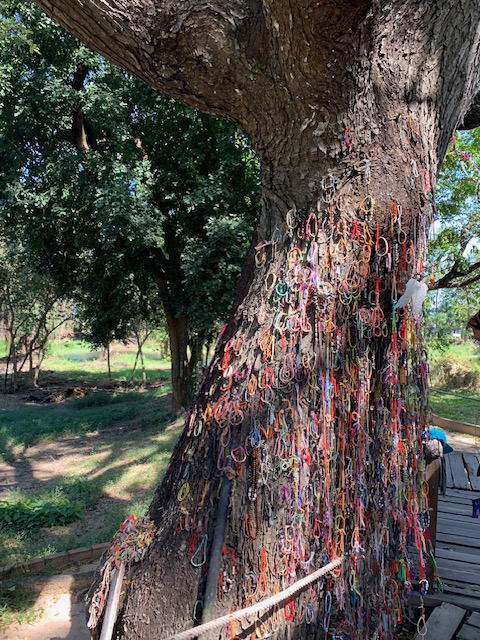
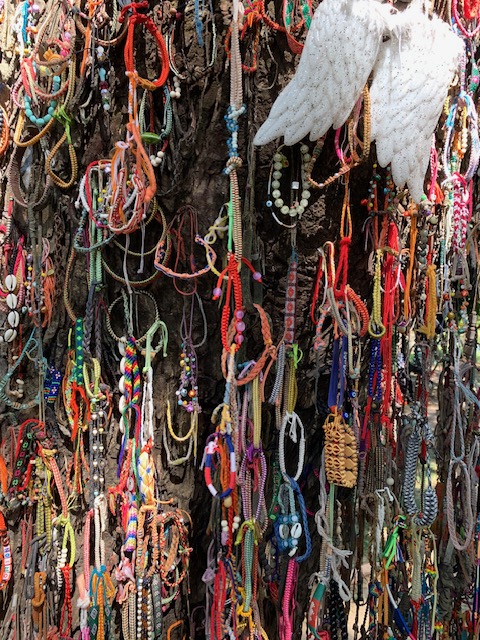
There’s one tree, of an impressive girth, that stands out from all the others at the Choeung Killing Field Memorial just outside Phnom Penh. Its trunk is festooned with brightly-coloured necklaces, angel wings, bangles, and ribbons. Although the place has the appearance of well-kept gardens, the atmosphere is sombre and you can get an audio guide that tells the story, with testimonies from some who were there. The tree is known as the Killing Tree and is a garish splash of colour in the green surroundings. It is called the Killing Tree because it was the chosen instrument of execution used in the brutal murder of young children and babies who were picked up by the feet and dashed against the trunk. They know this because of witness statements and the bits of skull and brain matter found embedded in the bark. The regime did not want to run the risk of the children of adult victims growing up with revenge issues so it decided to nip it in the bud in this indescribably cruel way. And bullets were too expensive to waste on slaughtering infants.
The Khmer Rouge under Pol Pot took power in Cambodia (which they renamed Kampuchea) in 1975 after a five-year civil war: about the time I was going through the final years of secondary school. By the time they were thrown out by the invading Vietnamese in 1979, somewhere between 1.7 and 2.5 million people had lost their lives through murder, starvation or disease directly attributable to the dictatorship. This was out of a population of about 8 million. It is the Vietnamese who were responsible for the plethora of people with missing limbs, victims of the landmines they left behind and are still a problem today. The Killing Field Memorial is just one of some 300 Killing Fields throughout Cambodia. Many of these are inaccessible nowadays due to jungle encroachment or dangers from the surrounding minefields.
So what brought about this genocide? Why would anyone do it? The truth is that you can uncover the facts, but understanding the mindset of such dictators as Pol Pot is probably beyond most of us. Pol Pot became a communist as a young man when he was living in America. He greatly admired Chairman Mao and had a vision of an agrarian socialist republic for his country. As soon as he seized power, all the schools and government offices were closed. The cities were emptied and the inhabitants marched out to labour camps in the countryside to work the land. Many died from malnutrition or disease. Many had not the faintest idea of how to work the land.
Everything from the West was banned, including medicines. Doctors were outlawed too and had been sent to the countryside along with any other intellectuals anyway. Child/teenage medics took their place and had little or no training. They performed medical experiments on enemies of the state, without anaesthetics. One horrific witness report tells of one victim who was cut open and had his intestines severed then crudely rejoined so that they could learn about the healing process.
When the Vietnamese invaded, Pol Pot fled to the jungles across the border into Thailand where he hid out and from where he still led the Khmer Rouge. The party was still recognized by the international community as the legitimate state rulers of Cambodia and conducted guerilla warfare from their base, hidden in the dense forest, right into the early 1990s. The party eventually fell into decline; Pol Pot was put under house arrest and died in 1998, almost 25 years after had begun his four-year reign of terror. Some say it was from heart failure, some say suicide. He lived to the age of 73: long enough for him to enjoy his grandchildren.
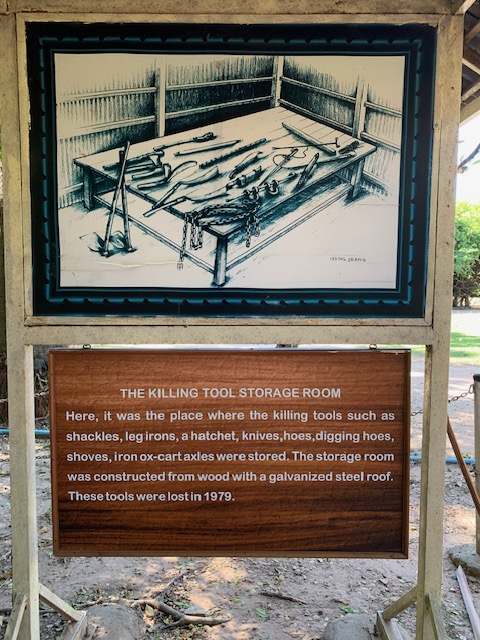
During those four terrible years, those sent to grow rice saw their crops sent away to China to earn money for bullets and arms, while they were left on the brink of starvation. And they faced the constant danger of arrest. You would be given a warning if you had transgressed. A third warning meant that you would be taken away to a ‘Re-education Camp’ (along with your family), which we today know as the Killing Fields. Any instrument of destruction was used: iron bars, hoes, machetes… The screams of the victims were drowned out by blaring communist propaganda music. Bodies were thrown into mass graves and doused with DDT to keep the smell down and finish off any who had survived the butchering.
Some of the guards who committed these atrocities were also victims of the regime. Not following orders could see you decapitated. The headless bodies of soldiers found at the Killing Field tell the story. A few Australians and other foreign nationals, were amongst the dead. And it didn’t take much to get you into trouble. Crimes against the Khmer Rouge included:
wearing glasses;
having soft hands;
speaking a foreign language;
having any connection to the former regime;
having any links with a foreign government;
being suspected of being a professional or intellectual;
being Vietnamese, Thai, Christian or Buddhist.
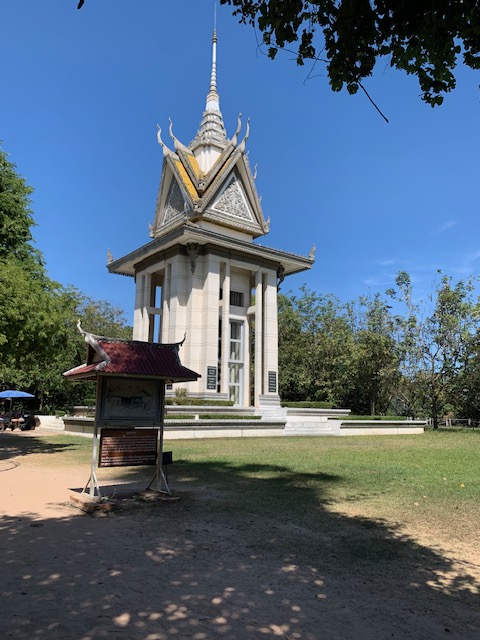
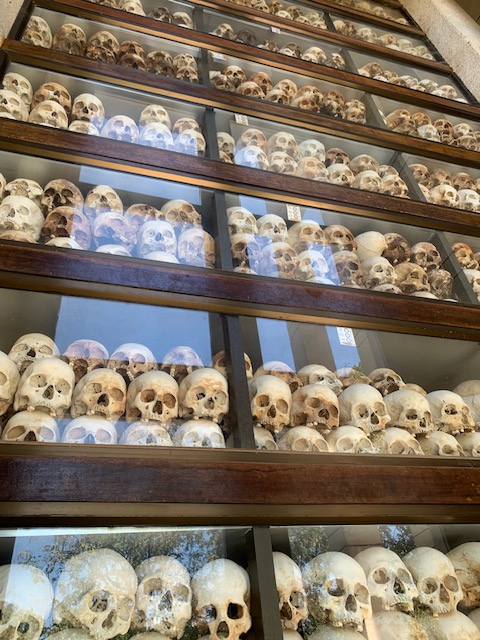
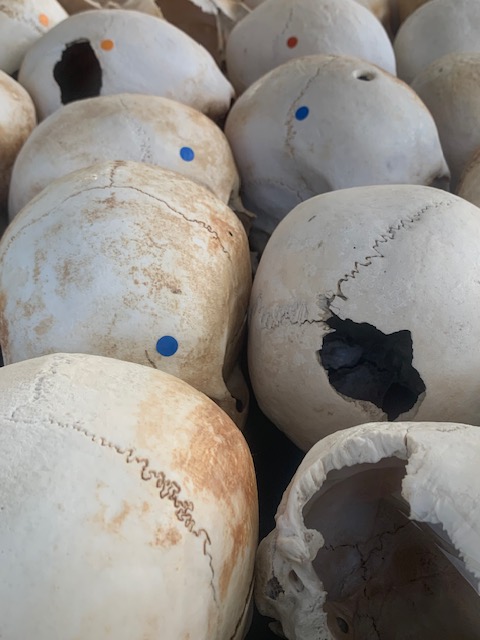
At the Killing Field, there is a mausoleum, where the skulls of 8995 victims are displayed in glass cabinets on all four sides and reaching from floor to high ceiling, arranged by age and instrument used in the execution.
Even today, the bones of victims or pieces of their clothing are regularly coming to the surface through weathering processes or maintenance work. They are all reverently collected and are treated with great respect.
It is incomprehensible to reconcile this violent past with the beaming, gentle, polite people of Cambodia we met on our trip: the way they smile, put their hands together in a prayer position, and bow as they welcome or greet you. It is quite remarkable. But, as they themselves are all too aware, this was Cambodian people killing Cambodian people. It just doesn’t match up.
A visit to the Killing Field Memorial sends you away in a contemplative mood. You step away with an unnerving feeling of having had a snapshot glimpse into the outermost reaches of the human psyche and of finding there a dark corner of pure, unmitigated evil.
Traveling long haul can be an exhausting process. So recently, I’ve been planning stopovers en route. It was worth trying out. Just to see a bit of a country you may never have been to before. That’s what I did on the way to Cambodia and spent a night in Amsterdam, a night in Hong Kong and 6 or so hours in Singapore.
…something beginning with ‘P/P’
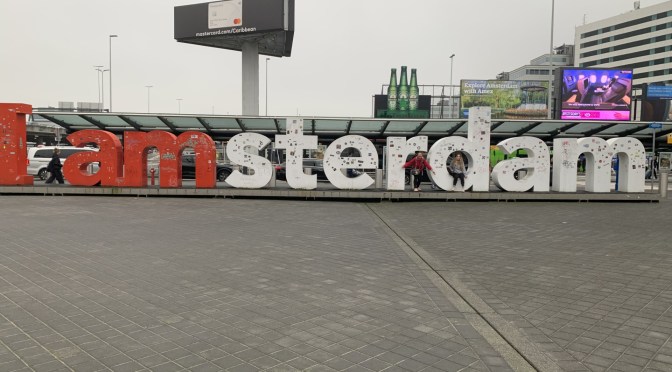
Flying first to Amsterdam meant that we could leave and come back to a local airport. As the stopovers were only for one night, I’d searched out and booked hotels near the airports in advance. It didn’t seem worth spending time looking once there if time is short. The transfer to the hotel in Amsterdam was easy – they ran a free taxi service. I didn’t even bother trying to speak more Dutch than ‘Dank u wel’ and ‘Goedemiddag’ afterlast time’s debacle with trying to apply my keen would-be polyglottony to Dutch. But I had much greater success this time. When we were on the return leg and I ‘Dank u wel’-ed the man who had just frisked me, his colleague came up and asked me if I was South African, as she had heard me SPEAKING DUTCH! I think that counts as fluency, doesn’t it?
By getting the taxi back to the airport, we could easily get a train into town, so that’s what we did. This is where the letters PP started to haunt me. At Grand Central Station, there were Palestinian Protesters out, waving flags, chanting and singing. A small police presence were keeping a discreet distance and ignoring the fact that some were smoking long joints (which is forbidden in public now in Amsterdam, largely due to the poor behaviour of British tourists).
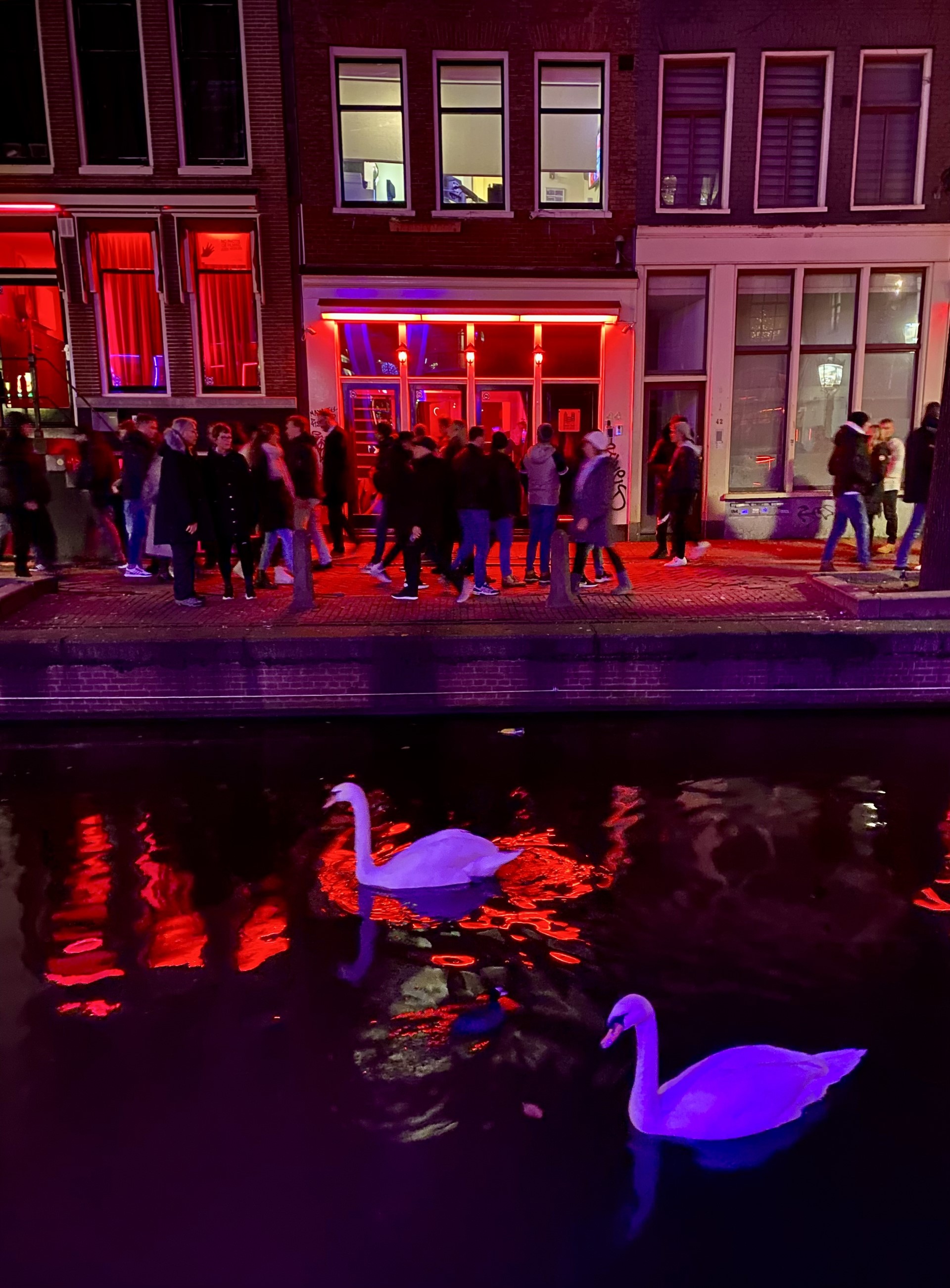
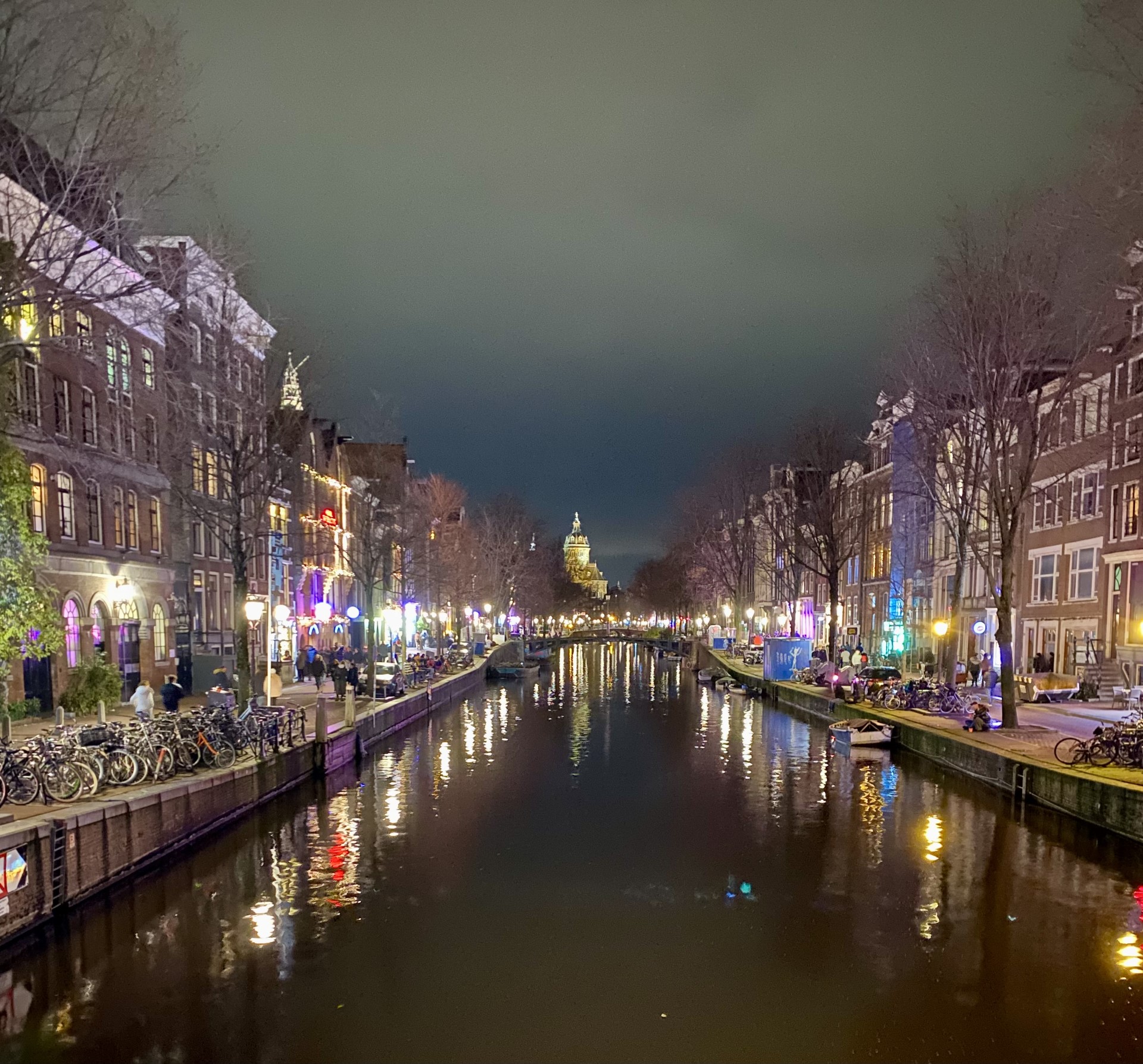
We wandered around, taking photos and soaking up the Friday night atmosphere. “Let’s go back that way,” She said, “and go down that canal back there,” She said, “that looks buzzy,” She said. The canal soon became flecked with striking glowing red splashes as it reflected the street lights in quite an impressive way. Do you see where this is going? Suddenly, there were all these women in shop windows in only their lacy underwear, pouting, winking provocatively and beckoning people in. Including me. “Are we in the Red Light district?” Iona asked. “Ask your mother,” I tell her, “It was Her idea to come down here. She thought it looked buzzy.” So Iona got a lovely tour of the canals, backstreets and pouting prostitutes of Amsterdam.
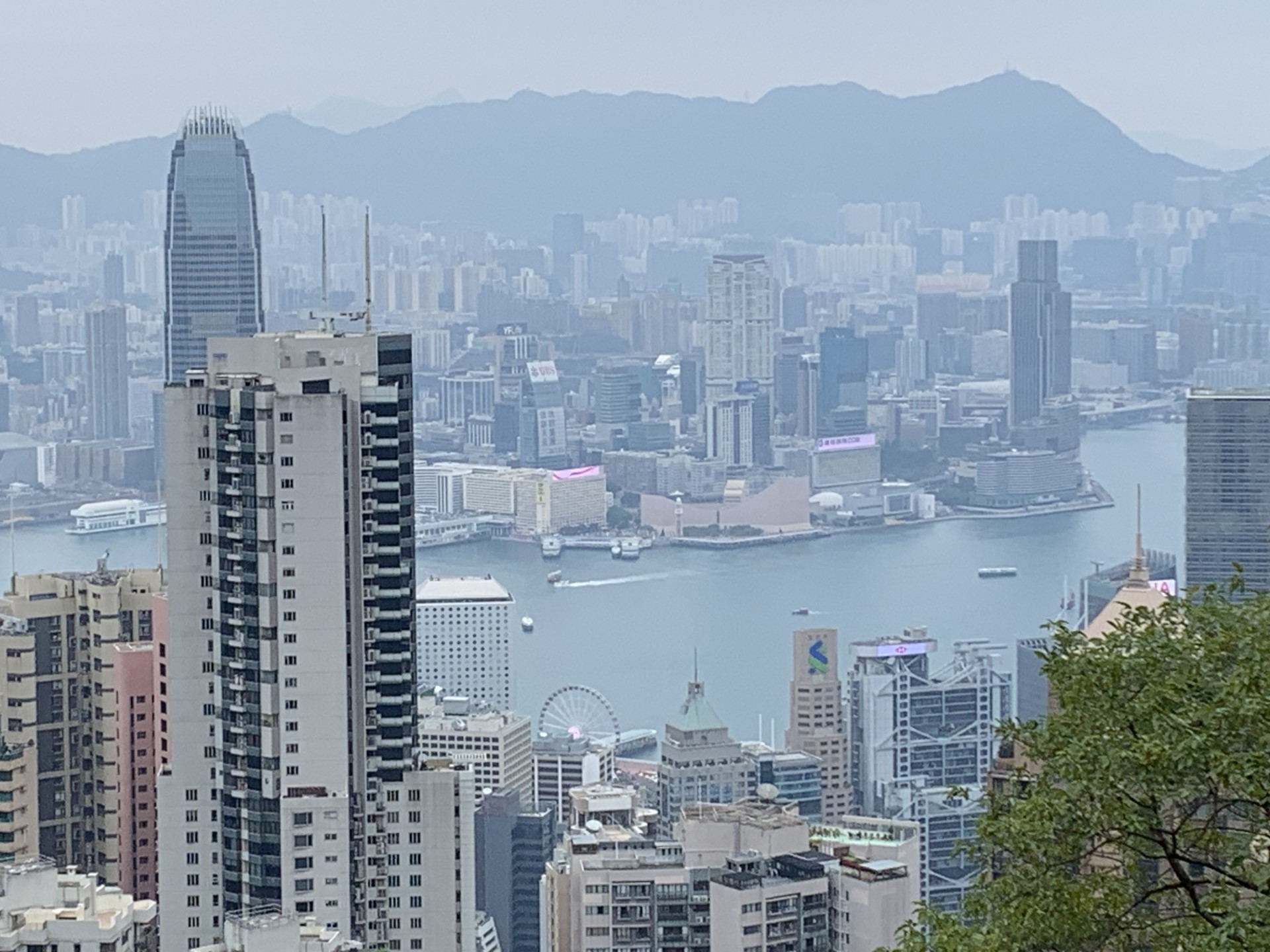
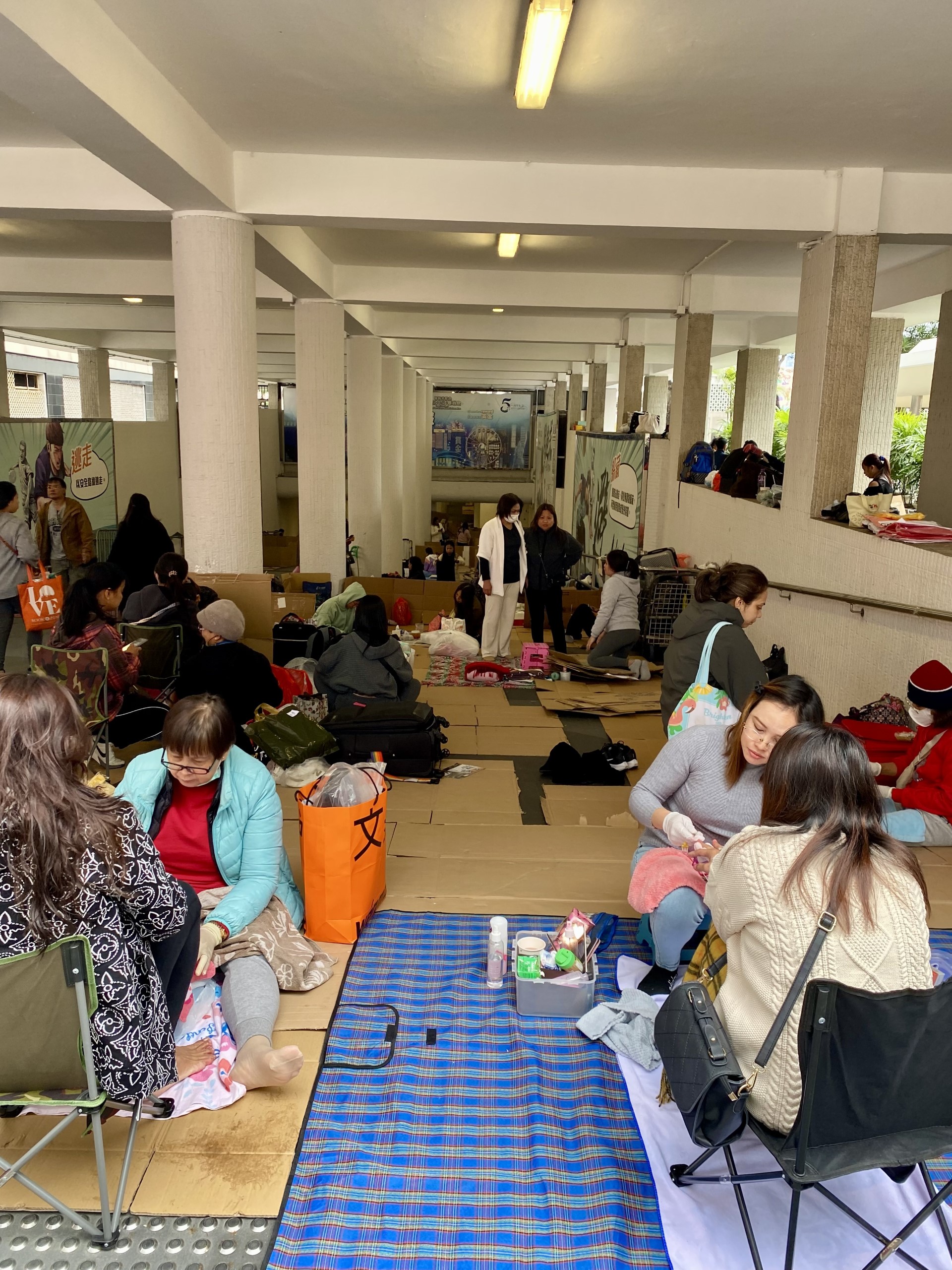
We arrived in Hong Kong in the very early morning. A lady at the information counter told us that to reach our hotel, we must take a bus, the only bus today, right now, for a journey that would take an hour and a half. Well, this posed a problem. We needed to sit and deplane, have a coffee and a vape or cigarette and to think about this. Our flight was early next morning and we’d have to be up and out by three or four o’clock to get back to the airport in time for the flight. I never thought of that when booking. It was just an ‘airport hotel’. We decided to take the hit on the hotel, which was unrefundable by now, and looked for somewhere much closer to the airport. In the city, there are the famous double-decker trams and the streets have been taken over by women, sleeping in small tents and cardboard shelters on the pavements and in subways. It is a large protest of Filipino women demanding integration – presumably mostly domestic workers who wanted to be treated a bit better, even equally. They are cheerful and well-dressed and sit around singing, chatting or playing cards. There’s even a Filipino Pride Protest group supporting their compatriots and out with placards. We had a good look around the city and went on the tramway to the top of the mountain to look down at the skyscrapers.
In all, I’d count that as a couple of nice experiences before we even got to Phnom Penh, in the land of Pol Pot… something beginning with P/P…
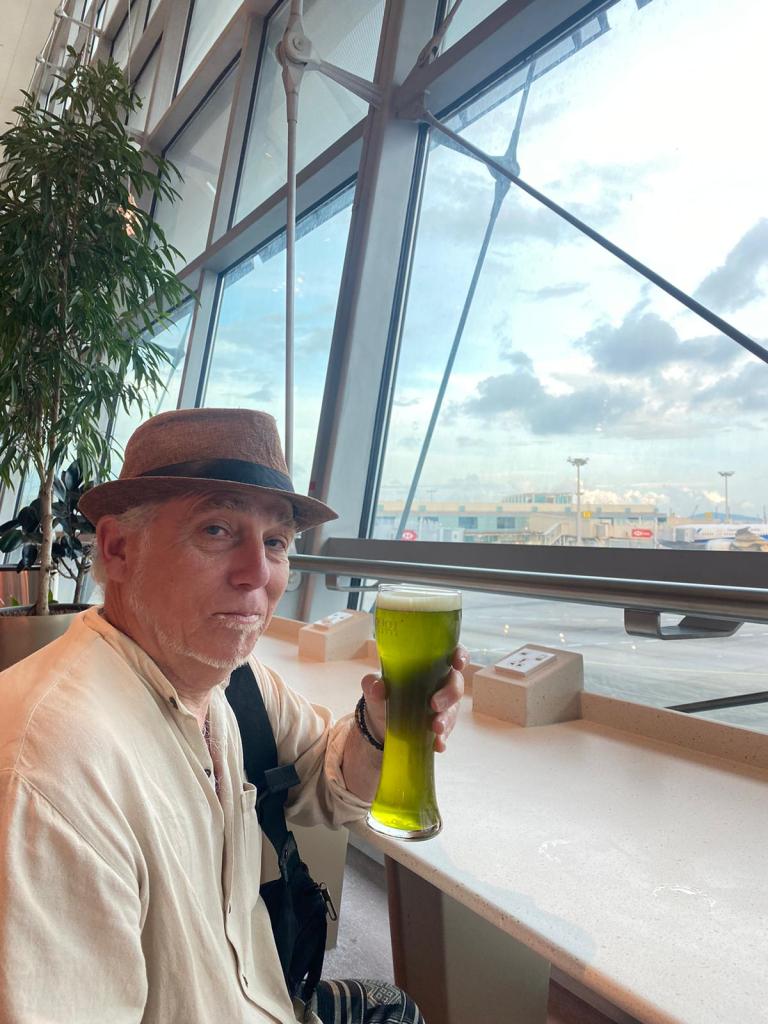
Singapore Airport is consistently winning awards for being the best airport in the world. It’s more like a swanky shopping mall with a butterfly garden and indoor waterfalls and tropical gardens/forests. They have automated systems that send you through in seconds, rather than having to queue for an uncomfortably long time. Even the help desks are touch screens that connect you to a real person in an office somewhere. OK, the lager was green and overpriced, but Changi Airport is a whole holiday all by itself. Had I researched it more, then we could have booked on to the open-topped bus city tour, which they run for free if you have a long stopover. In the event we just had to sit around for five hours, marveling at the lime-green lager and flies embossed into the urinals which encourage users to try and pee it off, thus ensuring that they hit the sweet spot on the porcelain and avoid embarrassing splashback. Now that’s attention to detail! It’s a man thing, as instinctive as socially responsible non-invasive graffiti relief (writing your name in the snow): if there’s an insect in the pan, it just has to be dealt with. You can’t help yourself.
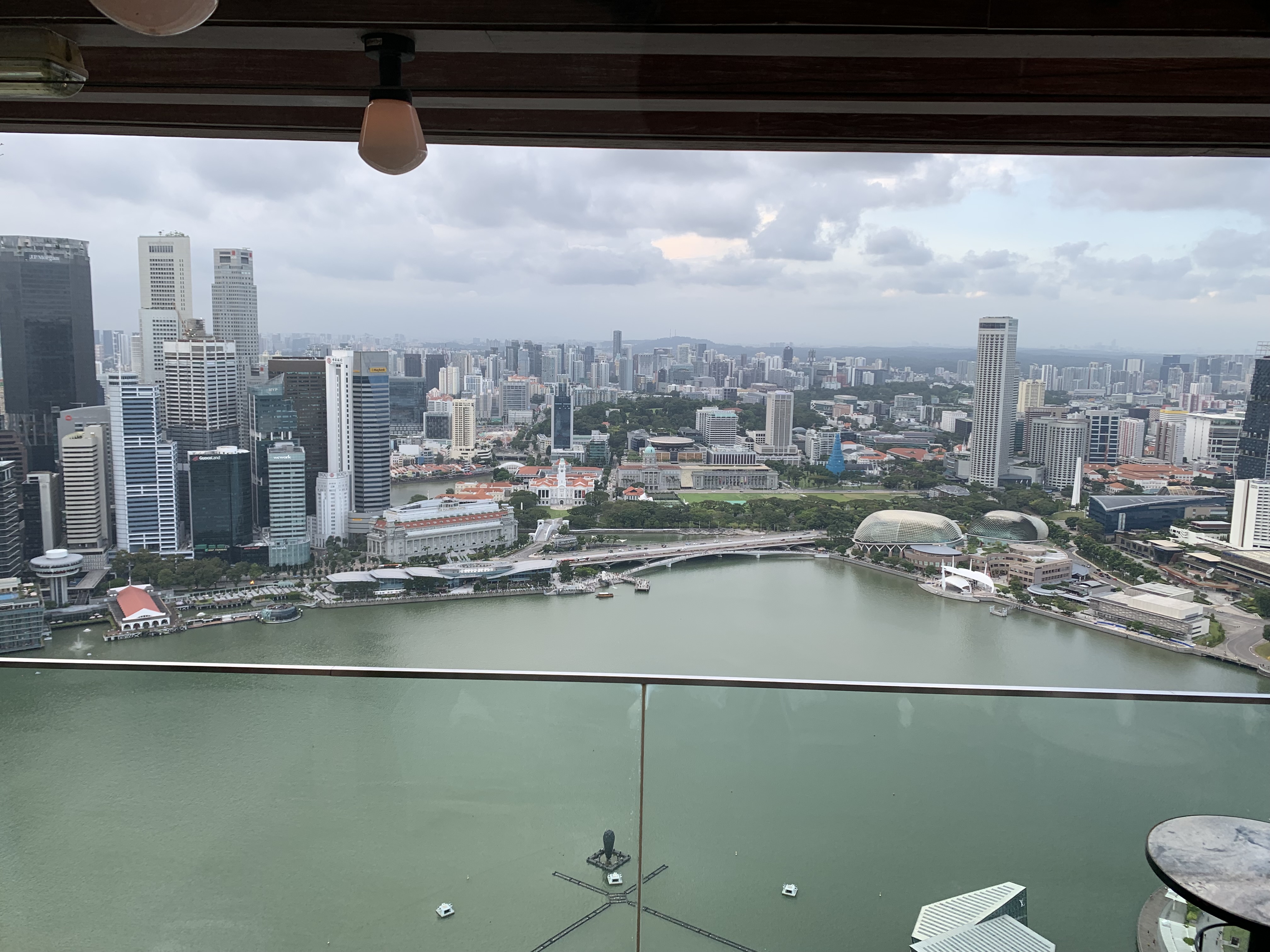
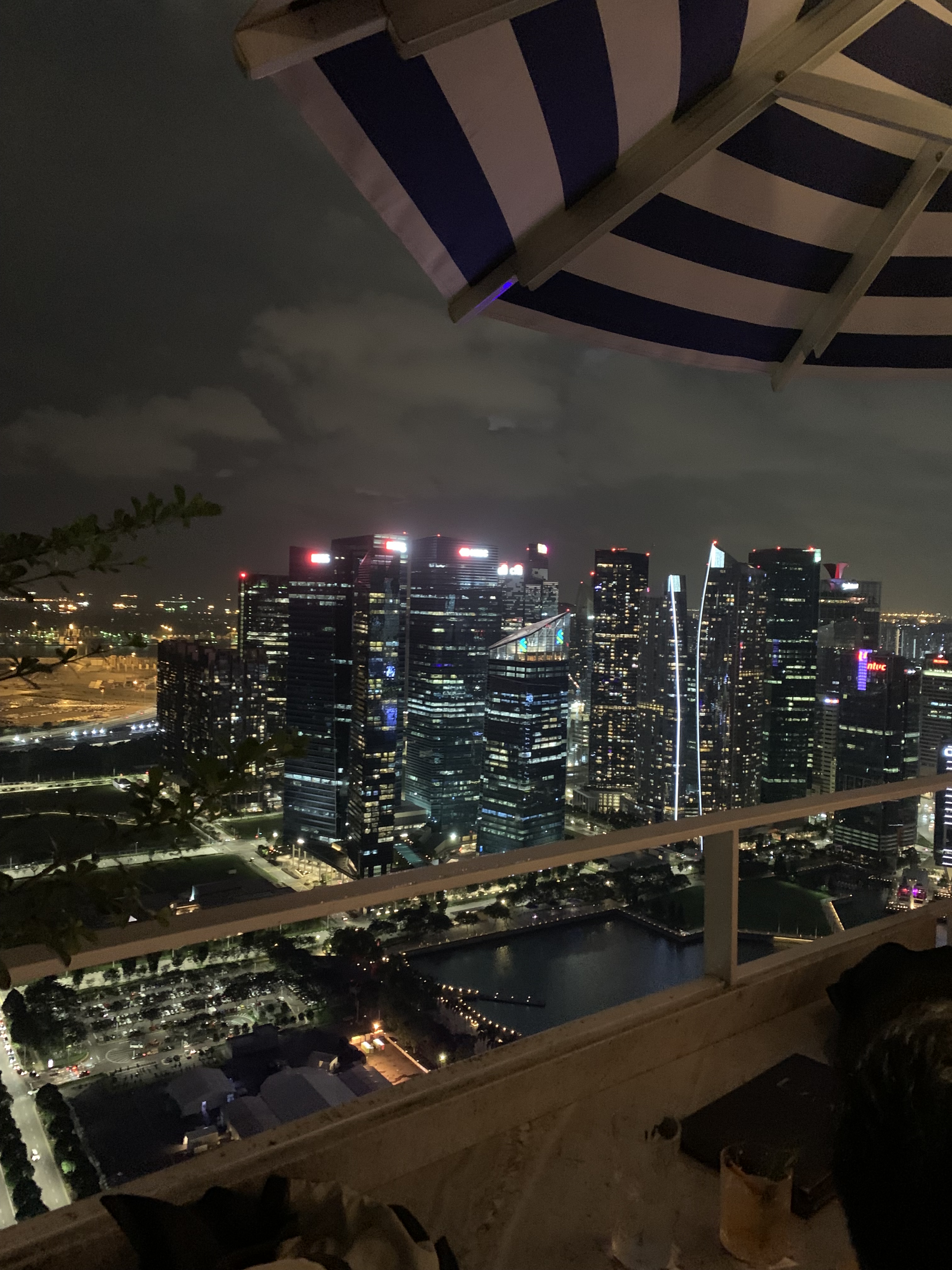
Last time we were here we did spend a night on the island and went to the famous tree sculpture park where outsize trees with live plants growing out of their trunks light up the night sky in a wonderful display and had a great meal up the top of the impressive twin towers of the Marina Bay Sands complex.
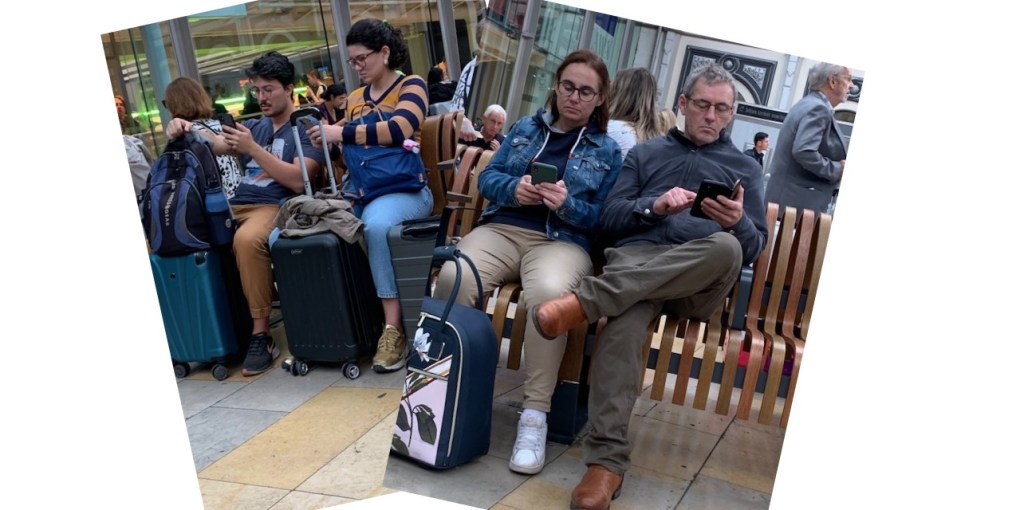
In Hong Kong Airport, I spotted a gem of a sign on the escalators. Think about it:
If you read this, then presumably you were not looking only down at your mobile phone and so don’t need to read it. And if you were only looking at your device… well then you wouldn’t see it, would you? Lovely!
All in all, I think stopovers are a great idea. Here are five things I’ve learnt about stopovers:
Do your research, find out what is available in the airport and how far your ‘airport hotel’ is from the runways.
Go with the flow and explore on public transport.
If you get the chance to choose a place to stop, Singapore is great.
Lager can sometimes be lime green.
I know where to aim for the perfect and successful urinal experience.
Photo and video credits to Tash and Iona. There are a few (very short – one minute or less) video links you can click on here to help get more of the feeling of the country. The tale of stopovers on this trip can be found in a separate blog.
Phnom Penh
On the highway into town from the airport, the taxi driver points out two swanky new highrise blocks facing each other off across the road.
“This one China, this one Korea,” he tells us. There’s a great deal of investment pouring into this country, mostly from China. They can never own the land, by law, but can take a lease for long enough to turn a profit. Although the dollar is the preferred currency (as long as the notes are pristine – any small tears will see them rejected by shops and businesses), it seems that the yuan is driving the economy here. One dollar buys 4125 Cambodian riels, which are handy for rickshaw rides, but not much else. The amount of conversion you have to do in your head gets fuzzy with very large amounts (e.g. if you were to spend $25 and pay local it would be 102,178 riels) and people prefer to be paid in dollars anyway.
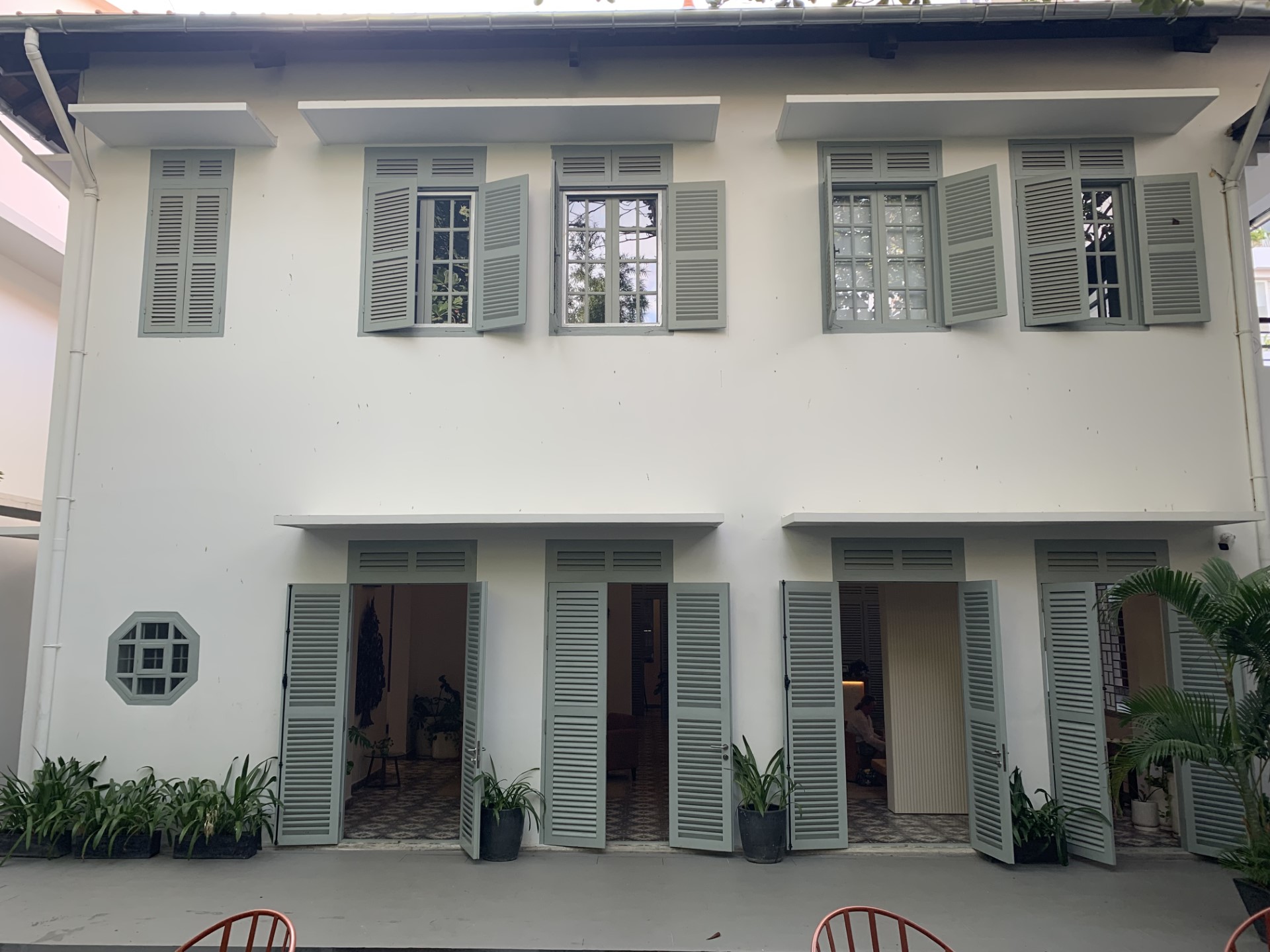
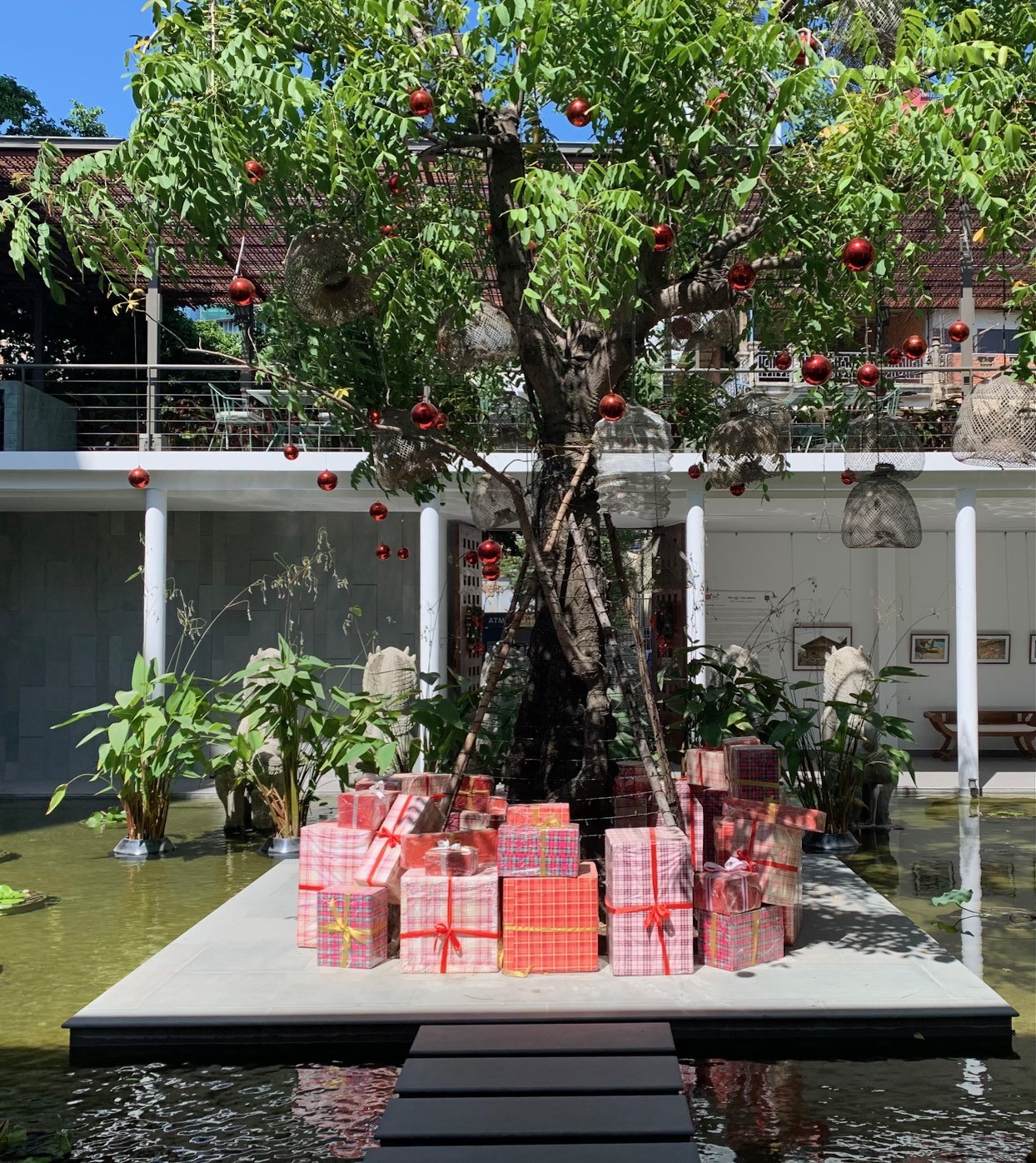
The Plantation Urban Resort is a former French colonial administrative office that has been extended behind the original building. The room looks out to the treetops in the lush garden around the pool. Rather surprisingly to me, the carp pond in the entrance has its central tree decked out in Christmas decorations. There is a whiff of tropical paradise about the place. And just opposite, is a fabulous, very local, vegetarian/vegan restaurant, which set the tone for the fabulous local food we ate on this trip. At breakfast in the hotel, a rather tough-looking, heavily-tattooed Chinese man is talking intently on his phone while his partner, who is looking rather bored, picks away at her breakfast. A few tables away sits their very large, even tougher-looking minder, who could be Indian or Arabic. He looks fierce and does not crack a smile. In fact, he is even too tough to talk to the waitress who is hovering around with a pot of fresh coffee. He sort of nods at her and she scuttles over and makes to pour him his coffee. He scowls and nods towards the boss. It’s him who needs the coffee. She sorts the boss out, who immediately gets up and strides away from the tables with his partner trotting after, followed by the minder, who picks up the electric fan she has left on the table. He may only scowl and head gesture to waiting staff, but he sure does a good job of picking up things that the boss’s partner has dropped or forgotten.
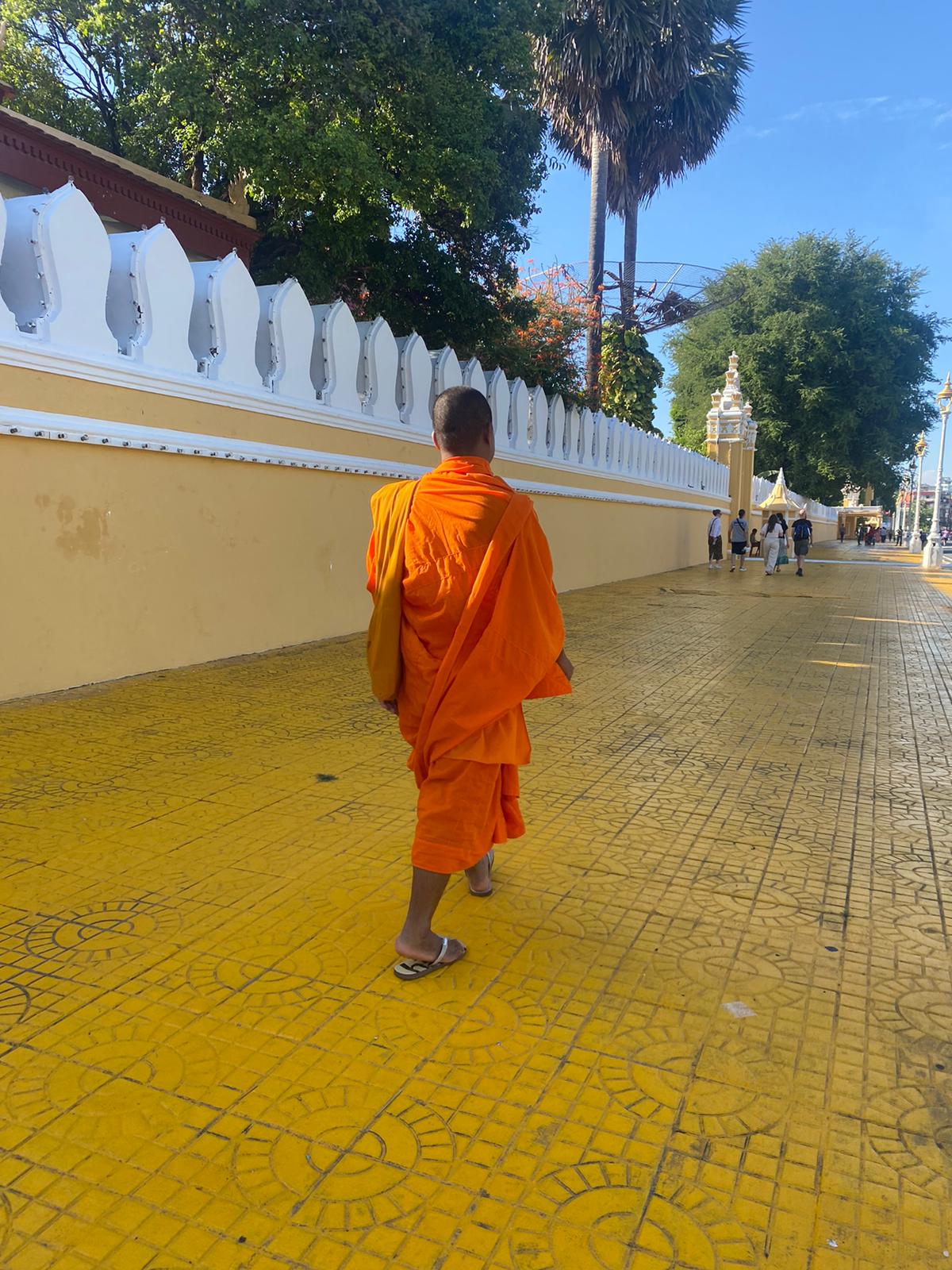
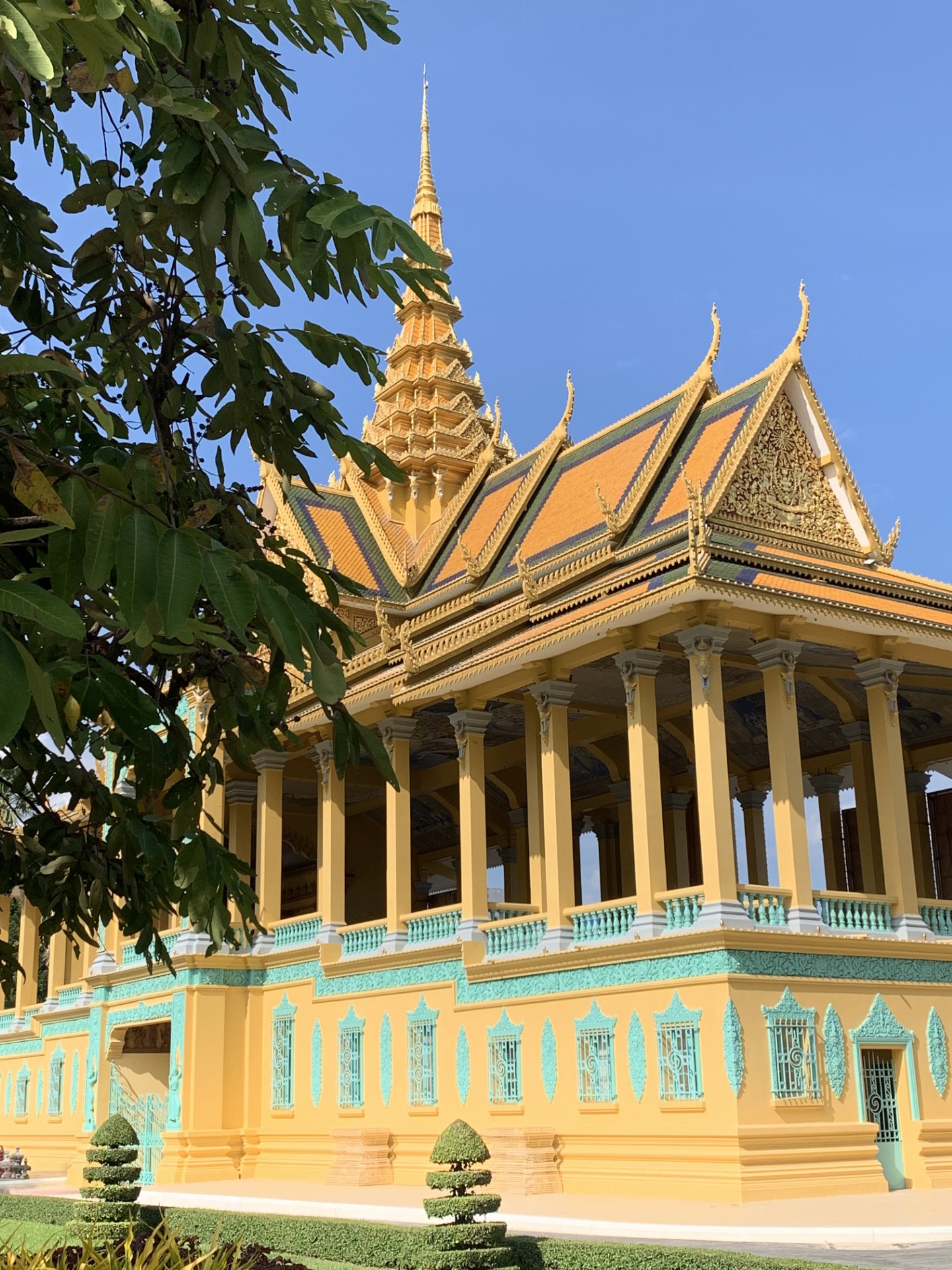
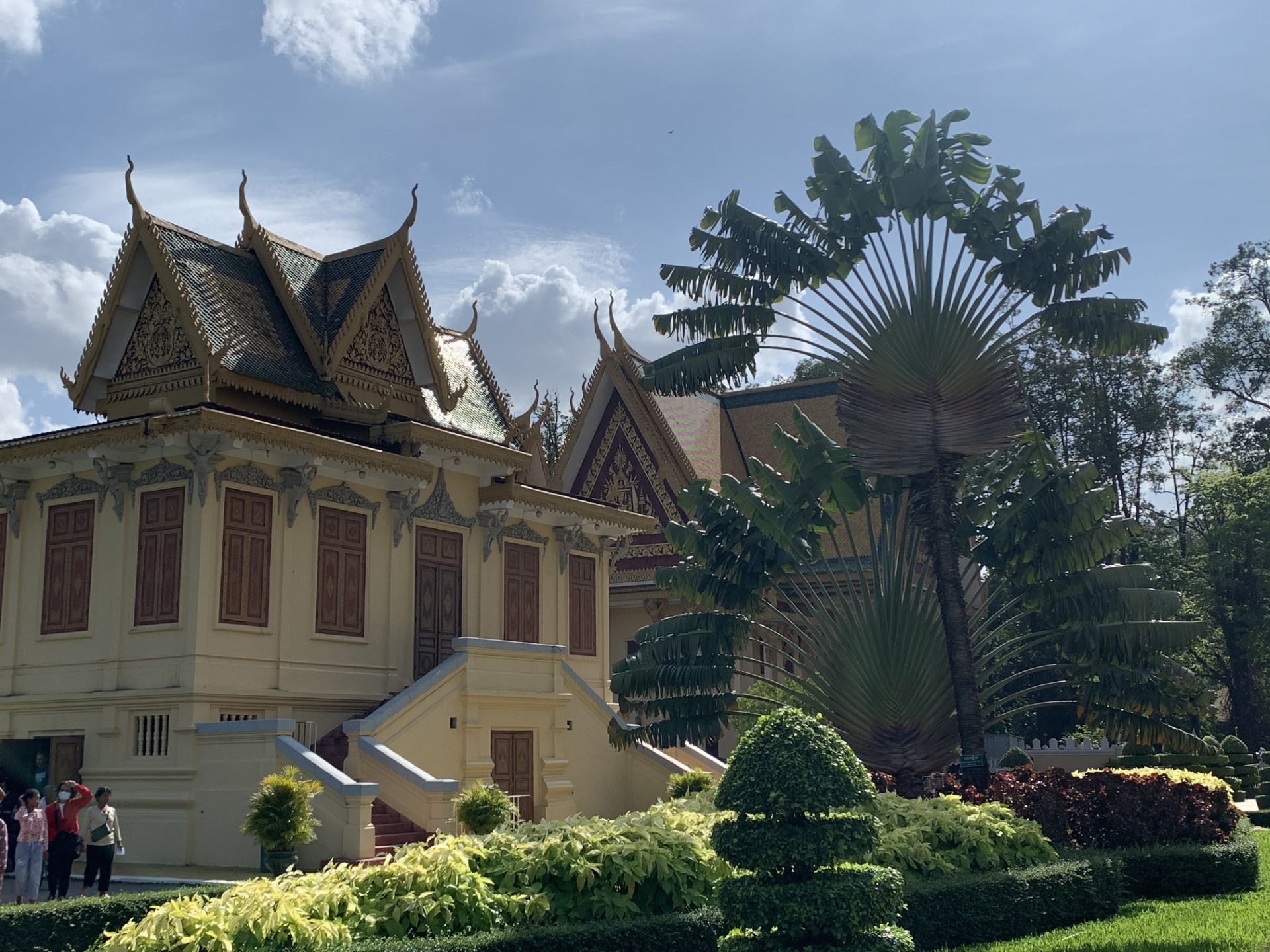
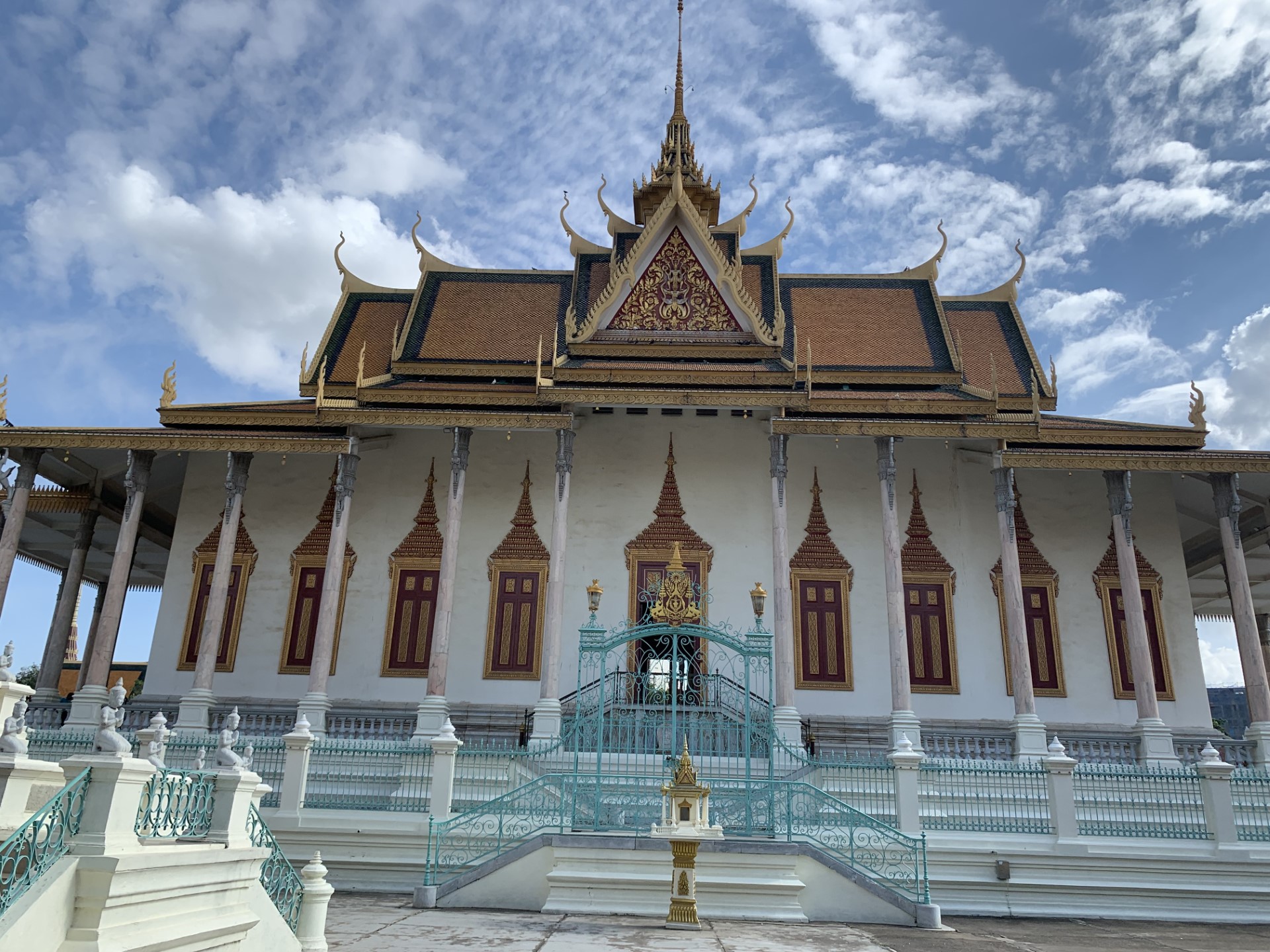
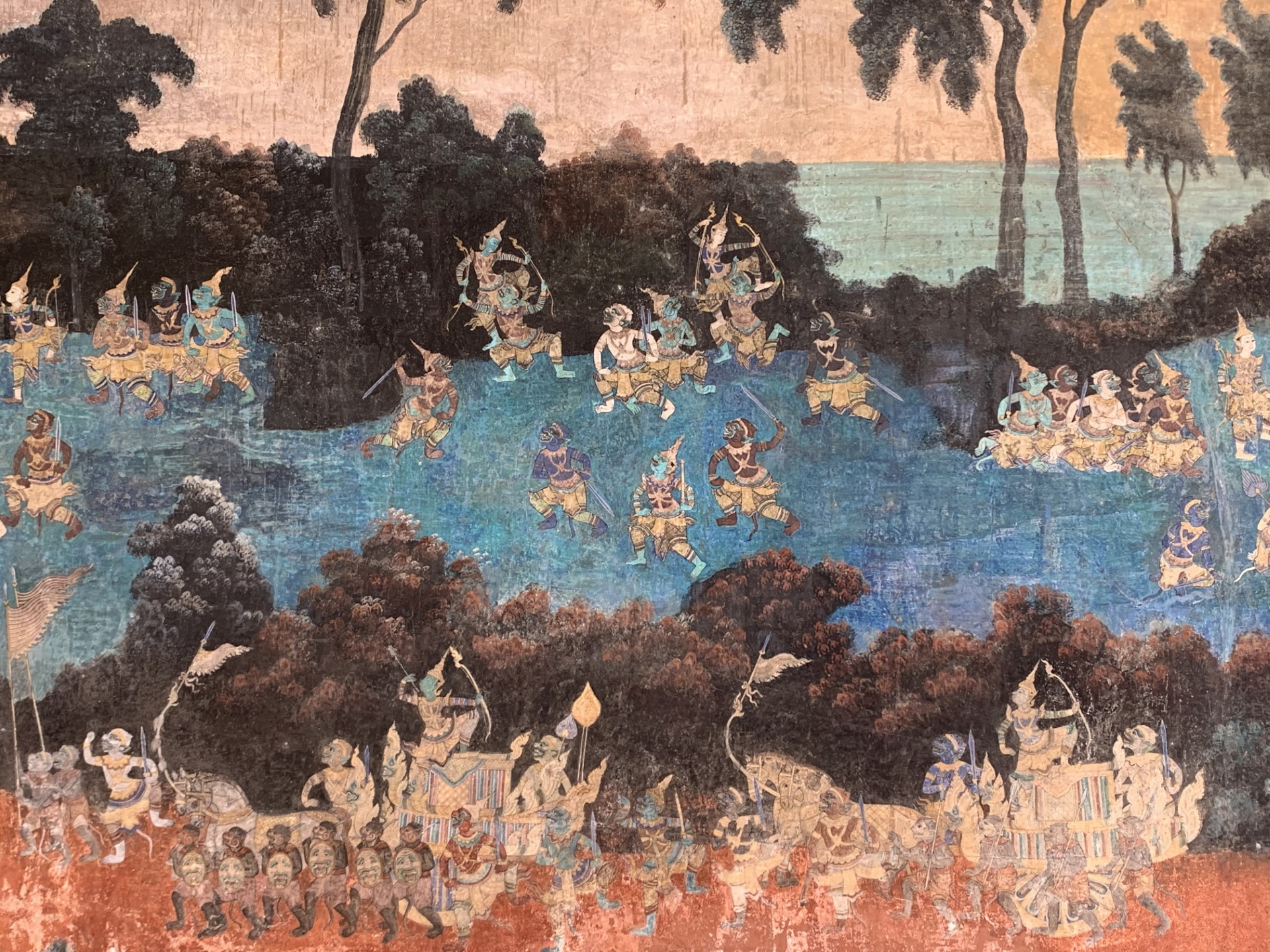
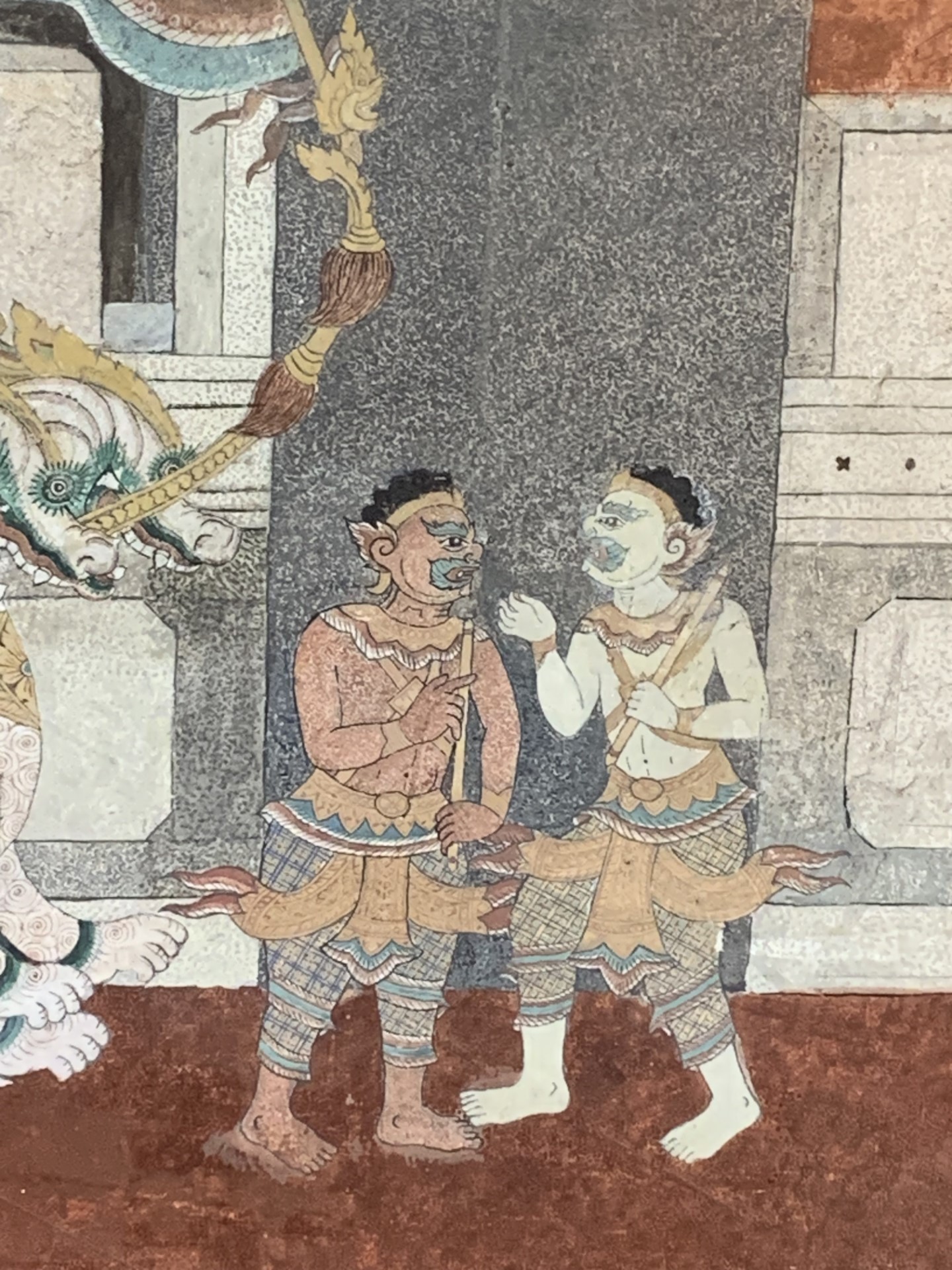
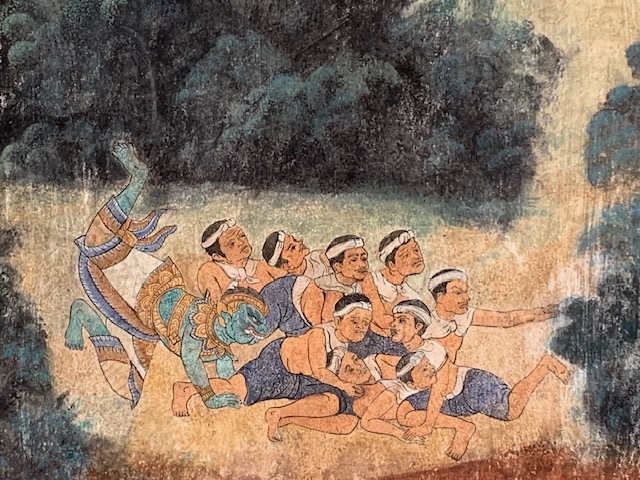
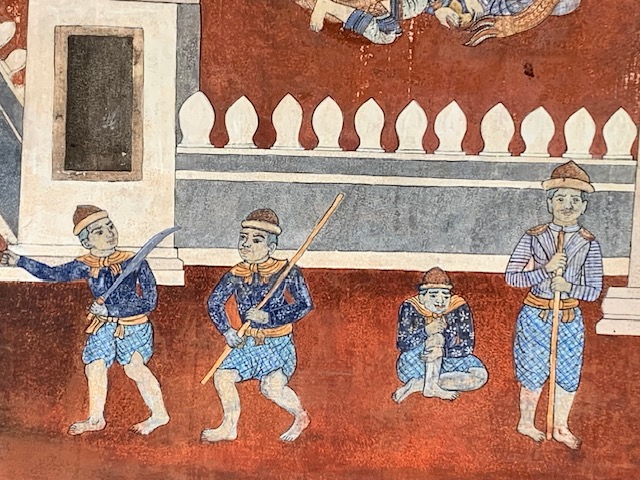
Phnom Penh is an interesting, sprawling city that we only had a couple of days to explore. Colonial architecture, wide, elegant boulevards and modern buildings merge with the typical traffic chaos of South East Asian cities. There is the Russian market and near the hotel, by the Mekong River, is the Royal Palace. You can only visit a small part of it (it’s still an official residence) but the pagodas, pavilions and temples are impressively beautiful and there is a striking mural telling the whole story of the Ramayana. Over 90% of the population are Buddhist. But Hindu Dharma is important in Cambodia and even though fewer than 15,000 people follow it, the religion punches well above its weight in terms of historical and cultural significance, the Ramayana mural in the Royal Palace being a case in point.
Genocide memorials, like the Killing Field at Choeung, near Phnom Penh, serve to remind us never again to go to such dark places. And it really was a dark, sinister, shadowy place, looming somewhere in Cambodia’s relatively recent history. I can’t write about it in this blog out of respect towards anyone sensitive to such details, because they are just too horrific. So take this as a disclaimer: if you want to know what happened during this terrible episode in Cambodia’s past, then by all means click here. But you have been warned.
Phnom Penh to Siem Reap
You can actually feel what the five-and-a-half-hour journey from Phnom Penh to Siem Reap is like by watching this short video. It’s only about a minute long, but all you need to do is put it on repeat and watch it 330 times. And voila. That was what it was like. You’ll feel it.
The buildings on stilts were interesting… to start with. And then those billboards advertising beer, the rival brands touting their respective virtues, one next to another. The only other signs were for the Cambodian People’s Party. But there were no rival brands next to them. The opposition doesn’t advertise. The fact that they’ve been banned by the government may have something to do with this.
It’s quite an event to hit a village where workshops and specialist retailers line the road. The diversity of these outlets is quite amazing: whether you’re looking for a Buddhist shrine for the home, or home appliances for Buddhists, you’re bound to find a shop selling exactly what you need and nothing else. No village post office, grocery store or corner shop here: I didn’t see any general retailers of any nature.
“I won’t be long, I’m just popping down to the watertank store…”
“OK, you couldn’t stop by the wheelbarrow shop on your way for me could you?”
“Yeh, sure. What do you need?”
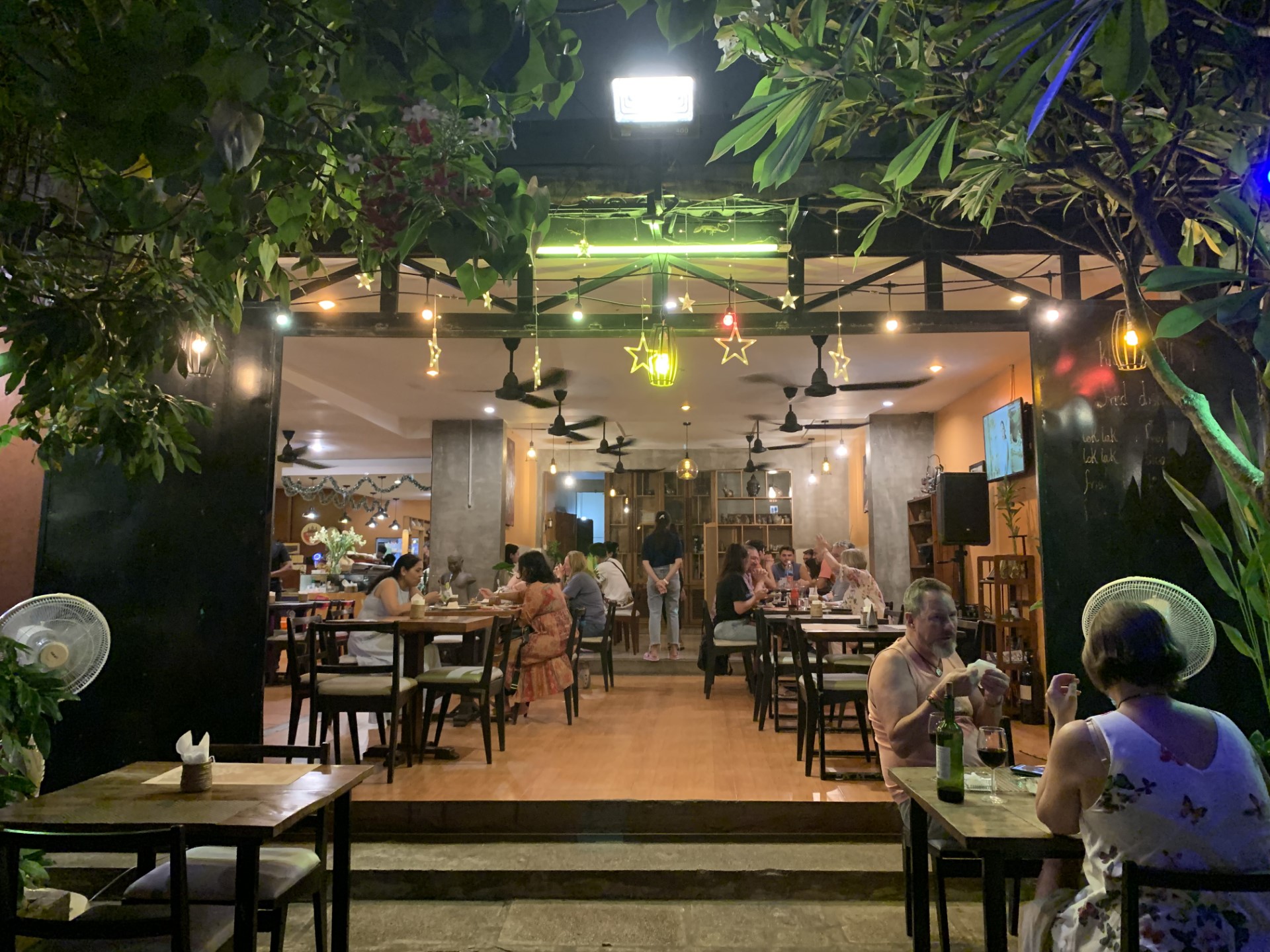
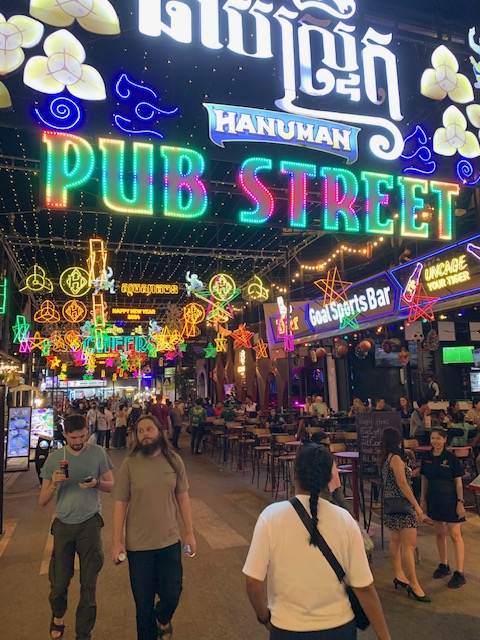
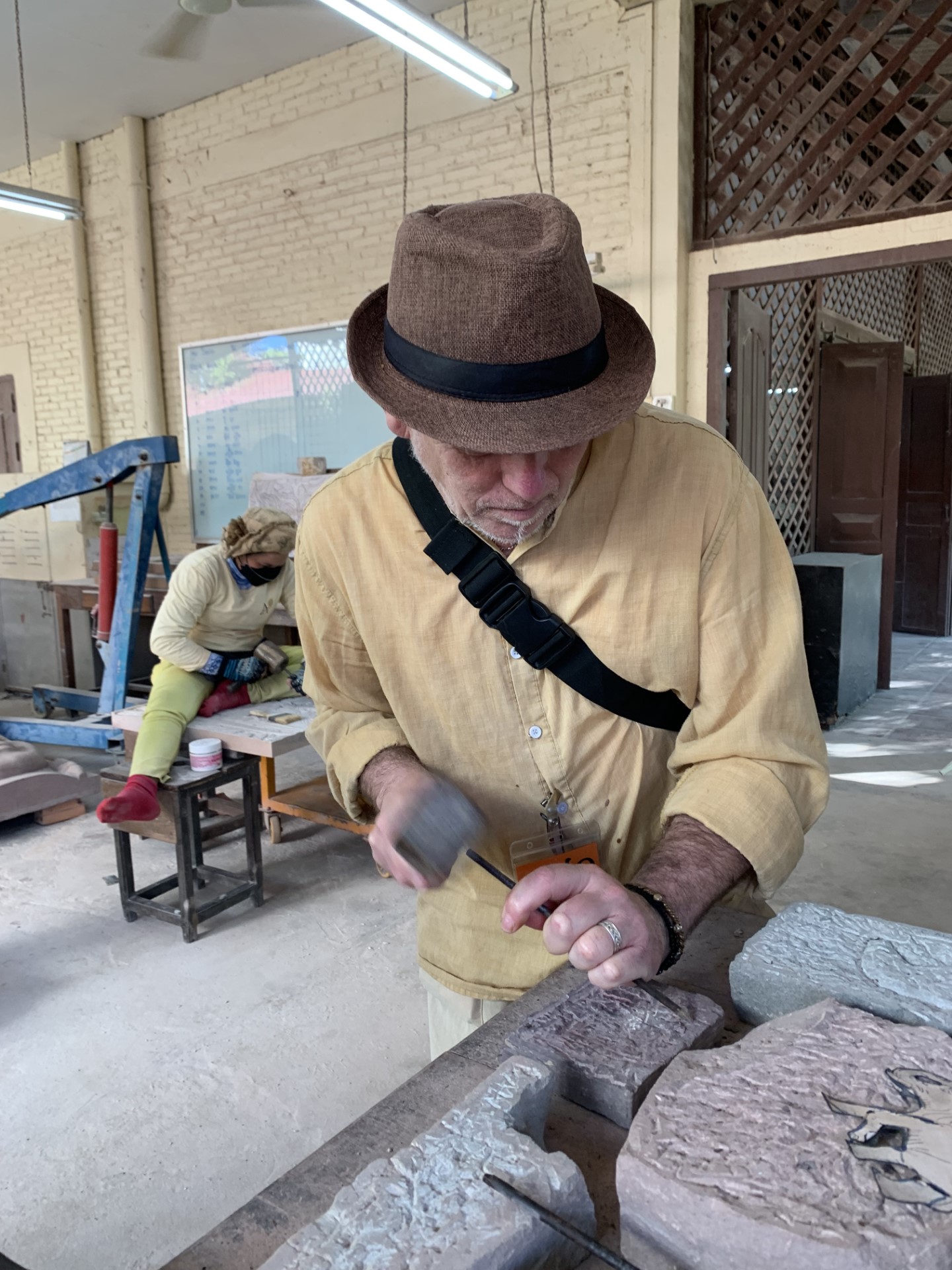
Siem Reap is a pleasant, laid-back town, apart from ‘Pub Street’ where over-priced food is to be had, you can have your feet nibbled by fish and a garish, tasteless array of neon signs make you think: “You have no right to be in a place like this.” At least it’s confined to one street. The adequate, friendly hotel we stayed at over the river was right amongst a taste-treat of local restaurants and there’s a night market on the waterfront. We visited a craft workshop, which supports the disabled and disenfranchised and saw at firsthand the considerable skills required to produce the lacquer-work and the wooden or stone carvings sold around here.
Angkor Wat
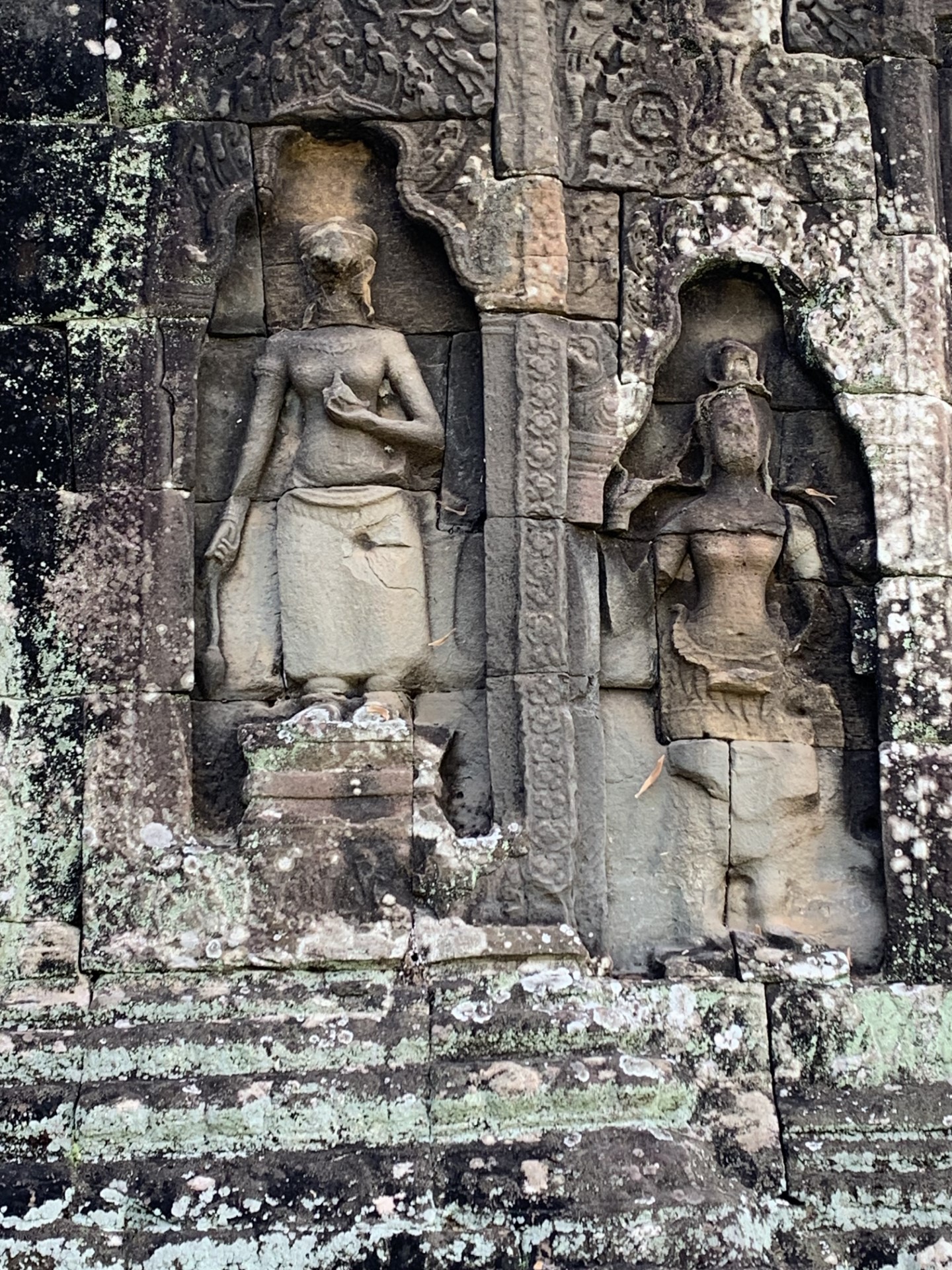
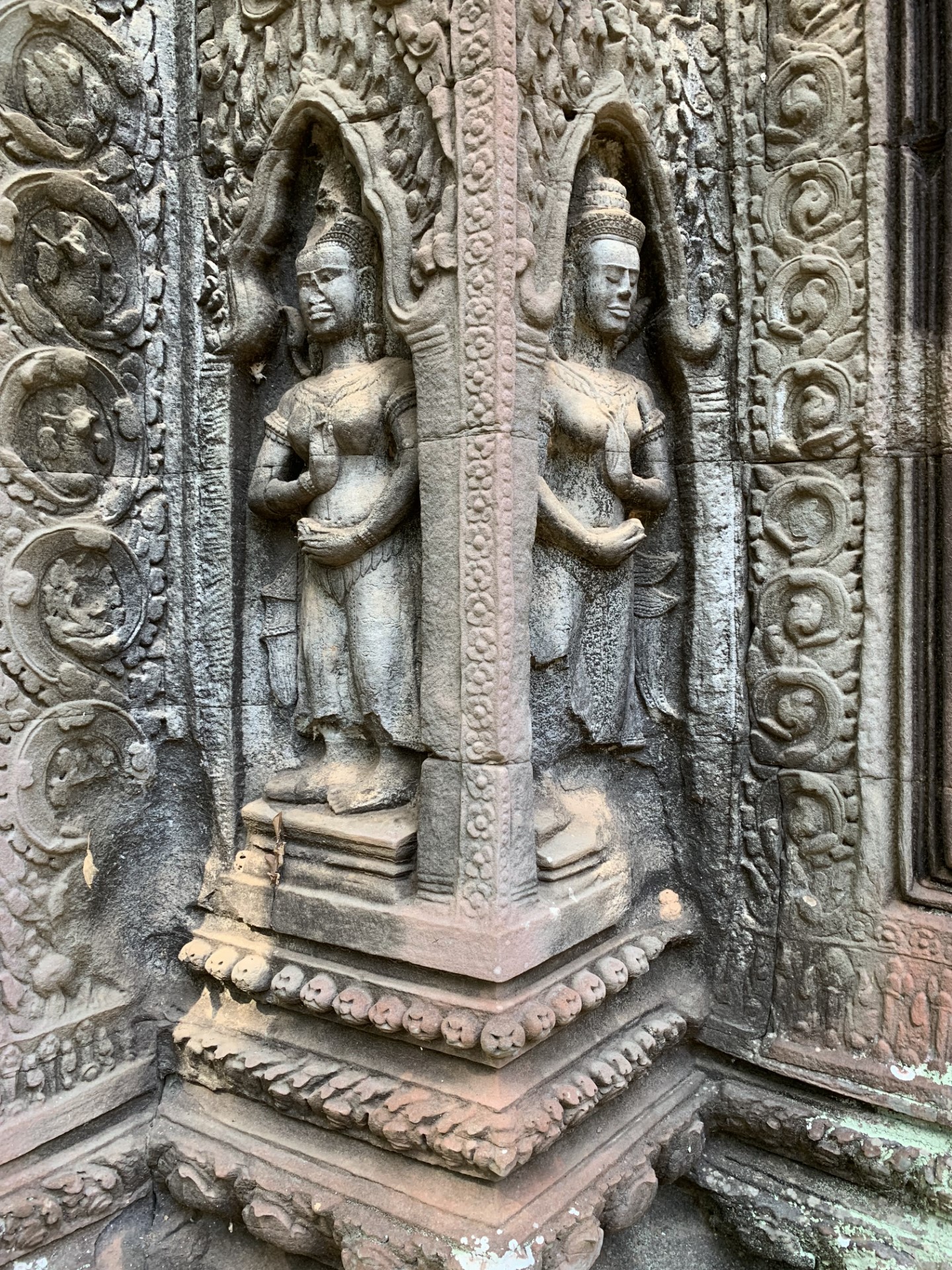
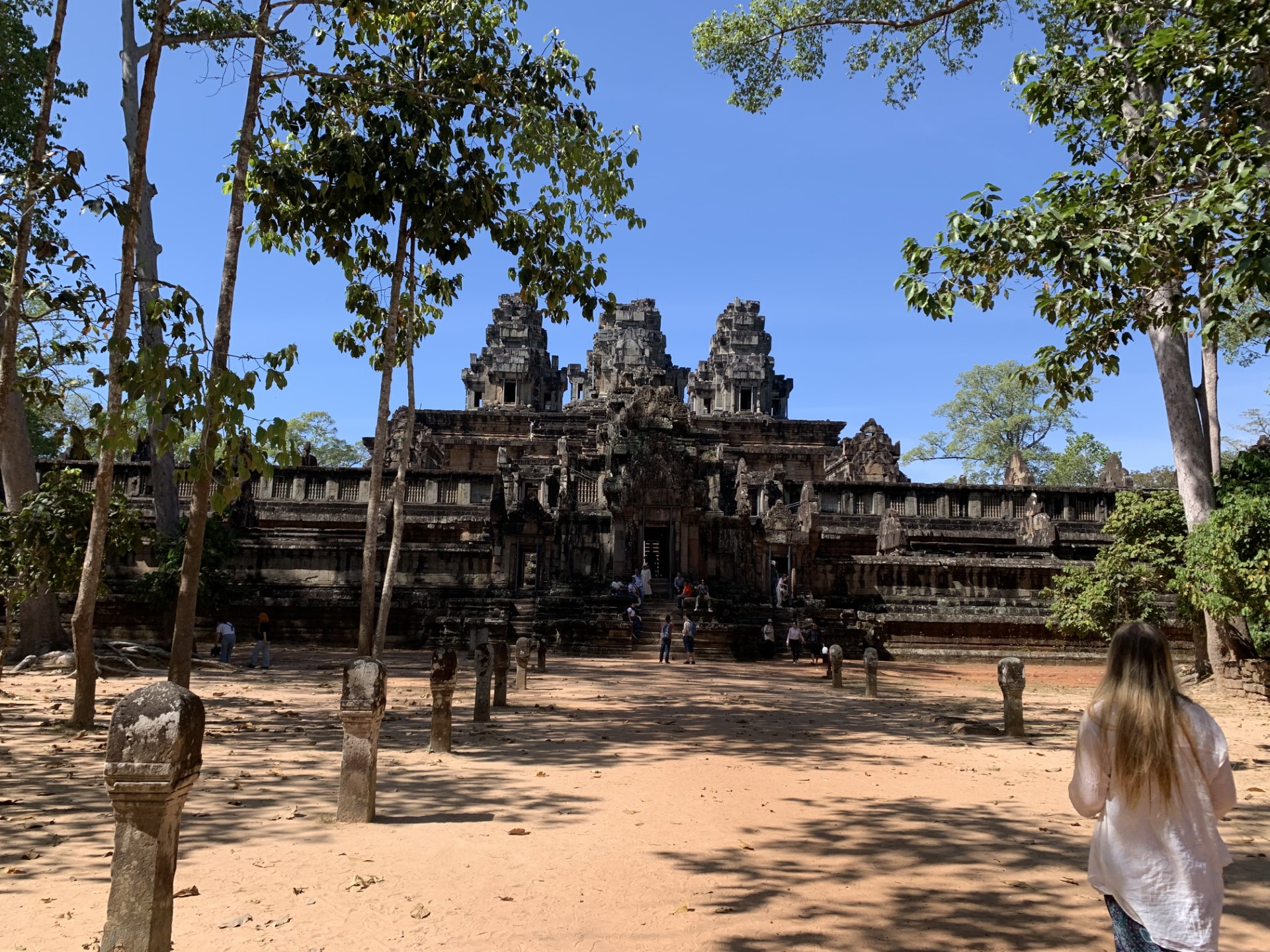
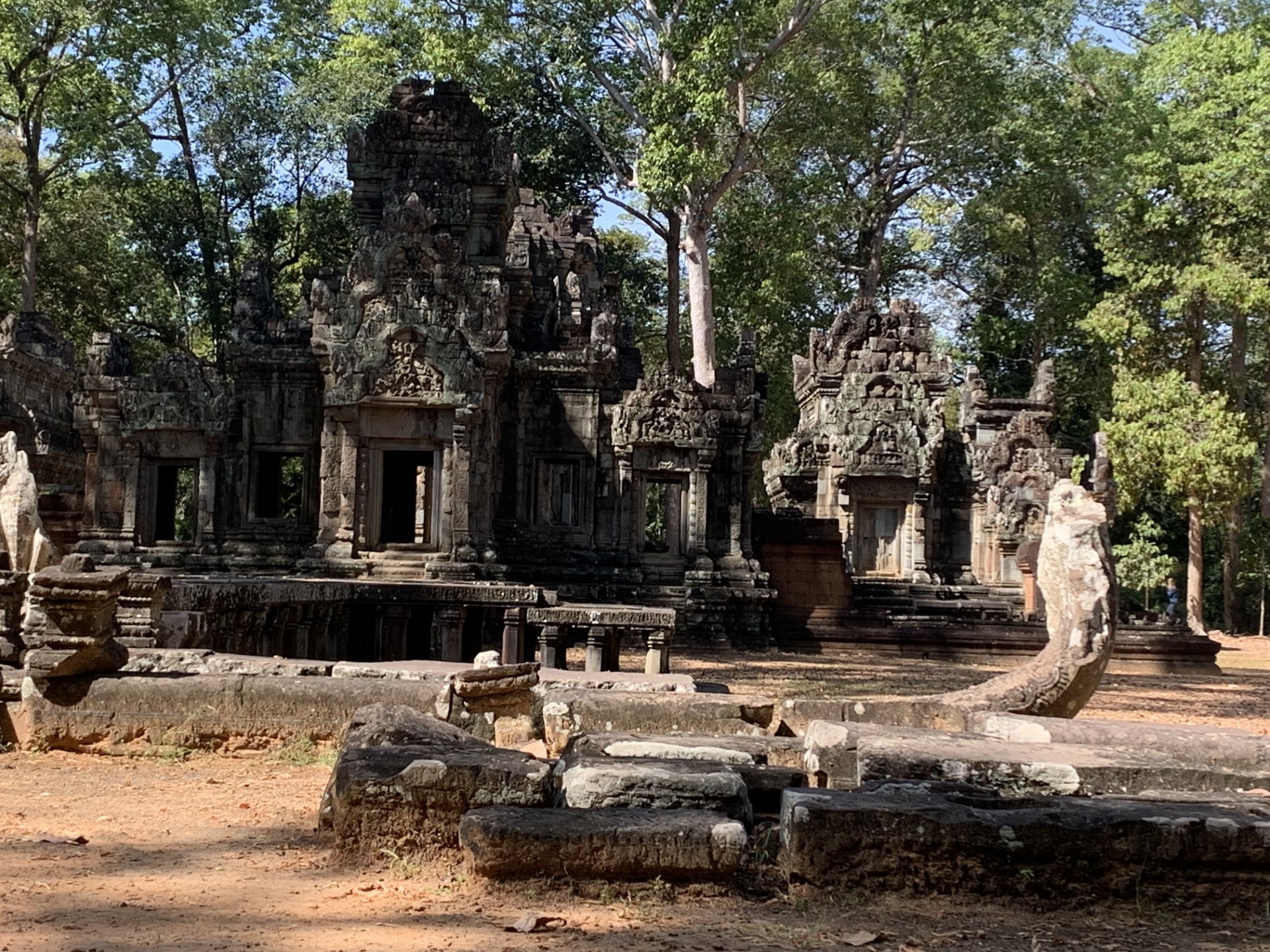
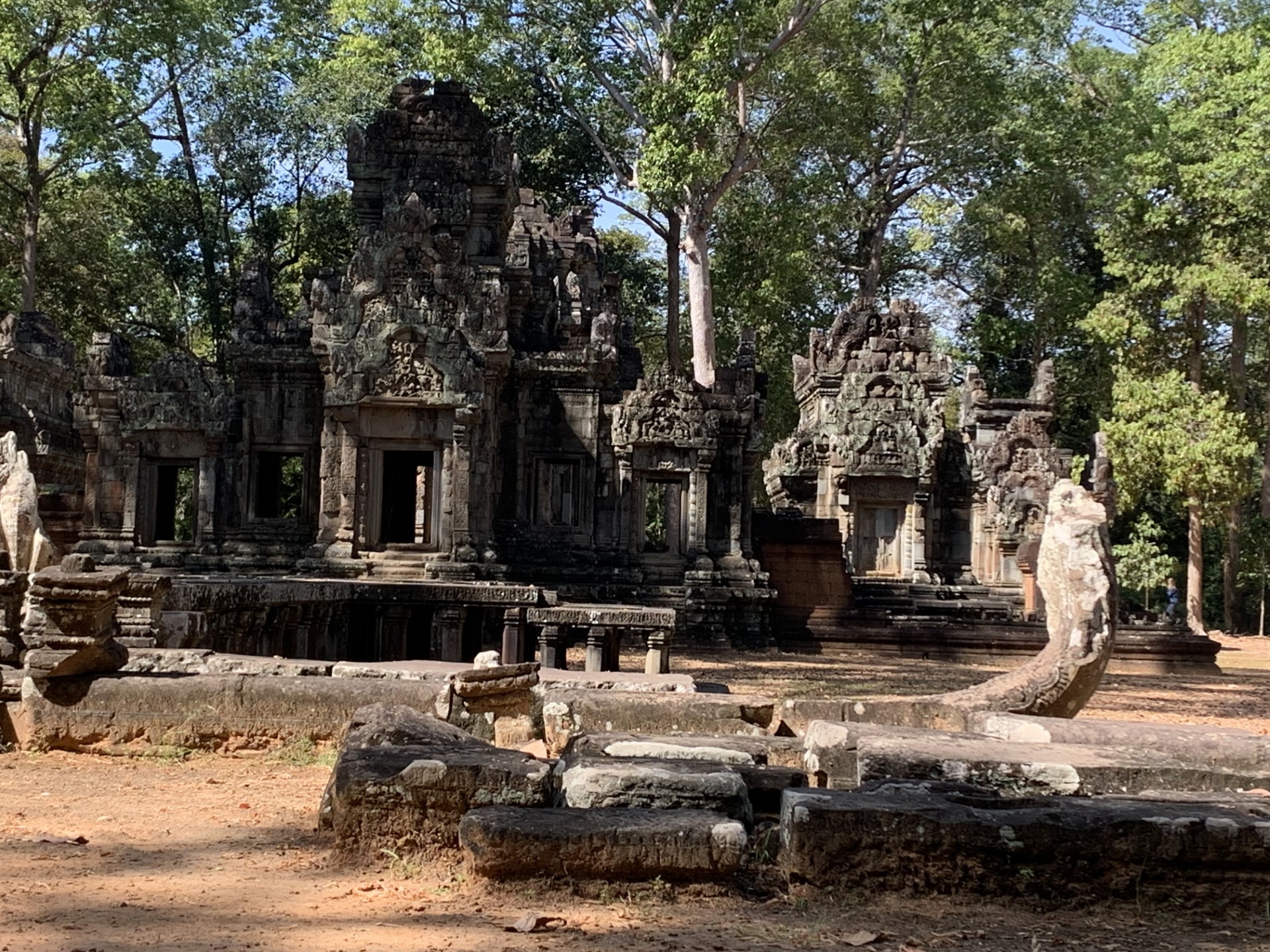
The first palaces and temples around Angkor Wat date back to the beginning of the ninth century, some seventy years before Alfred the Great became a king in England, just for context. They continued to be built for the next 600 years and hundreds of them survive today. At its peak, some one million people lived here at a time when London was just a small town of 50,000 inhabitants. Weathered to a shade that blends in well with the surrounding jungle, the buildings are at various stages of restoration and strangulation by the vegetation. They are mostly Buddhist, judging by the carvings, but there are some Hindu icons and even some ‘fusion’ temples. The construction of the famous Lotus Flower Temple of Angkor Wat, the mausoleum of King Suryavarman II, began in about 1140 CE: about the time of the Crusades when Philip Augustus, King of France, and his lover, Richard the Lionheart, were falling in and out with each other. So, in terms of timescale, the austere Crusader castles in the Middle East are pretty much contemporaneous with what would have been the magnificently guilded, graceful, golden almond-shaped domes of Angkor Wat. All of the statuary and bas reliefs we see today would have been painted too.
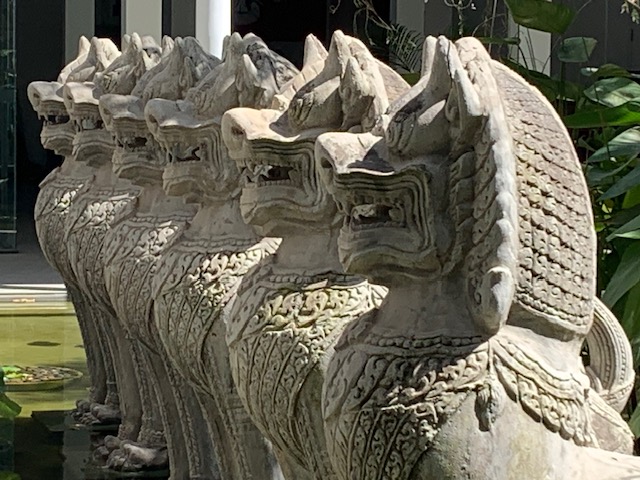
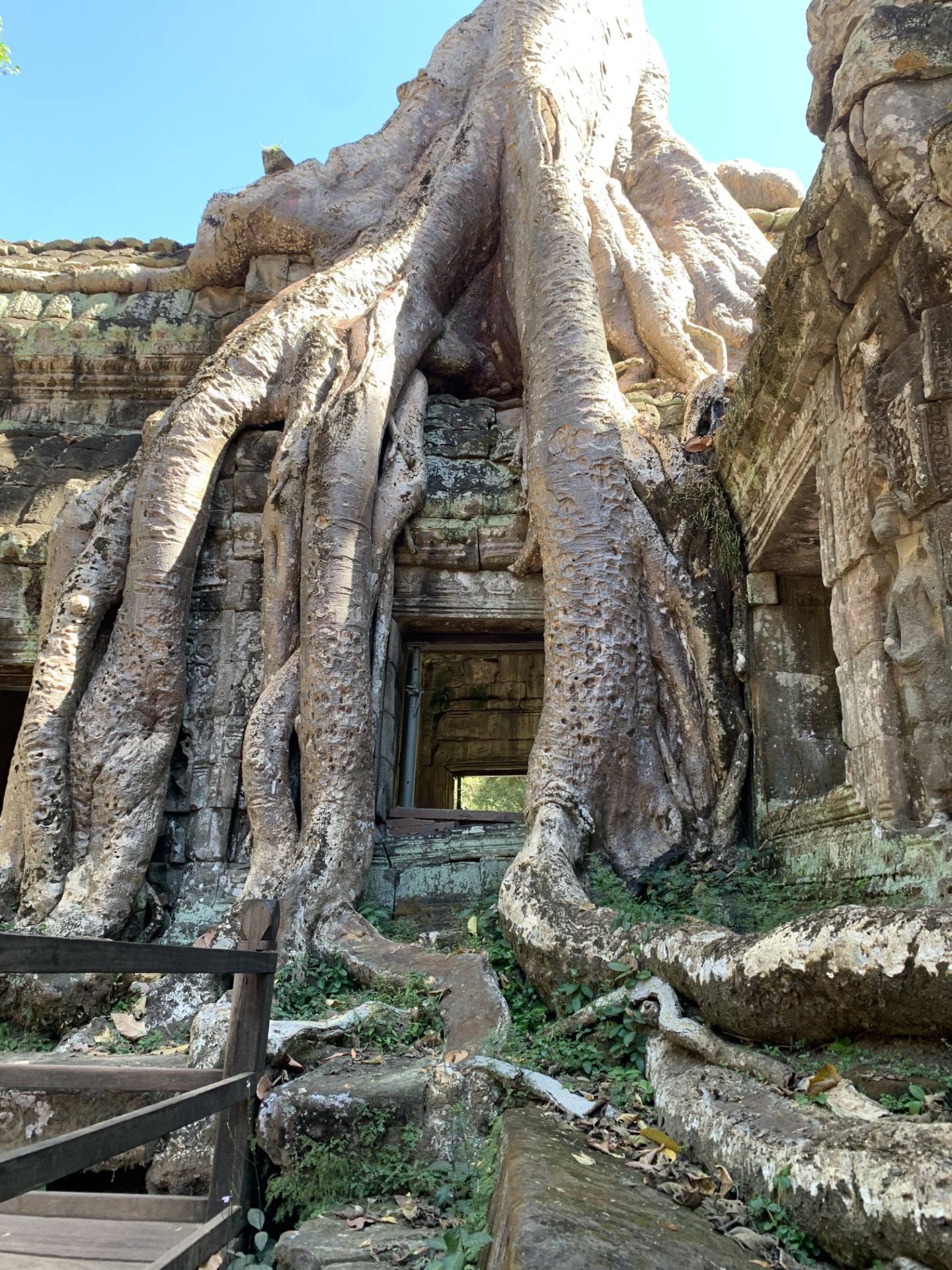
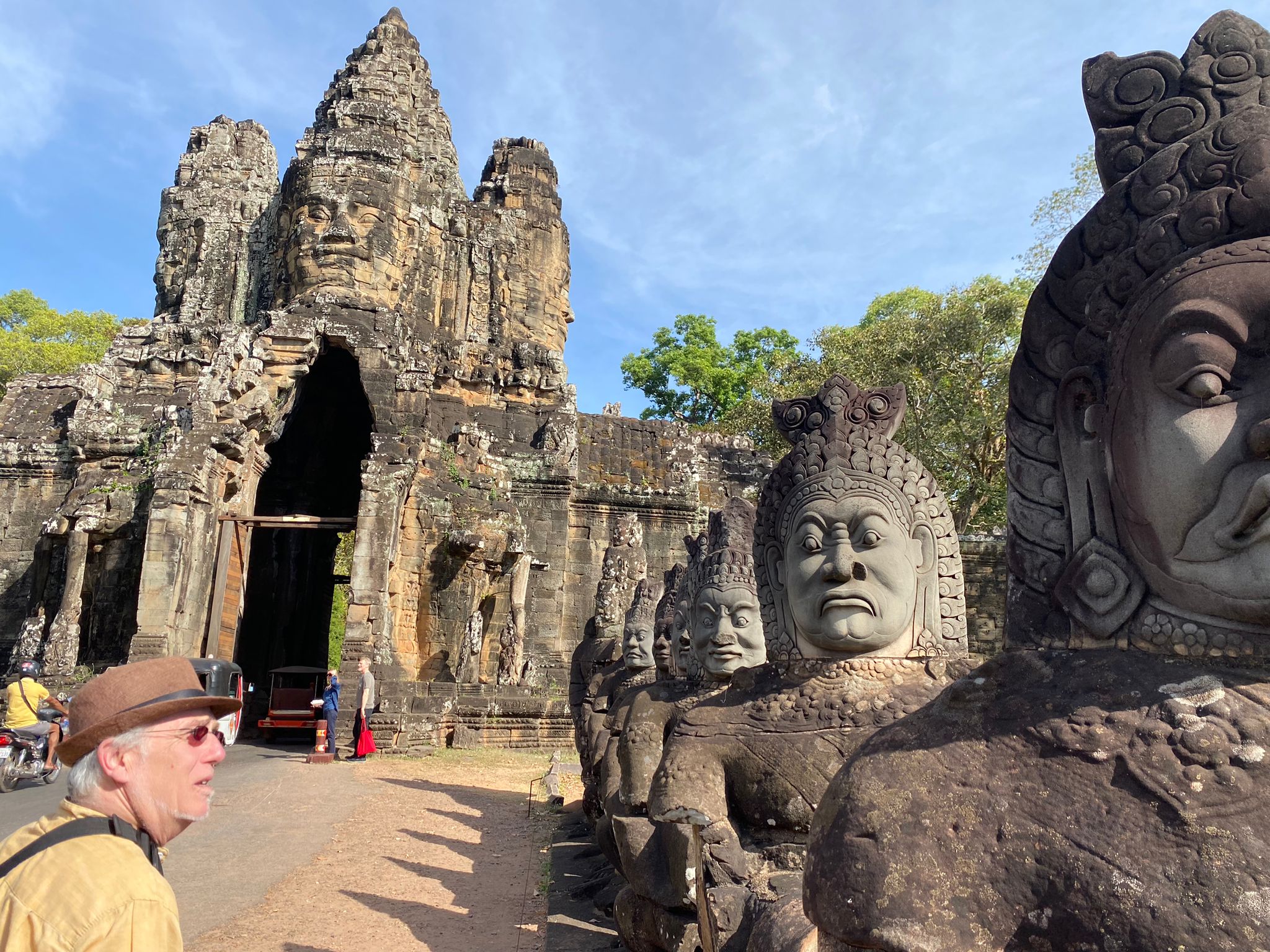
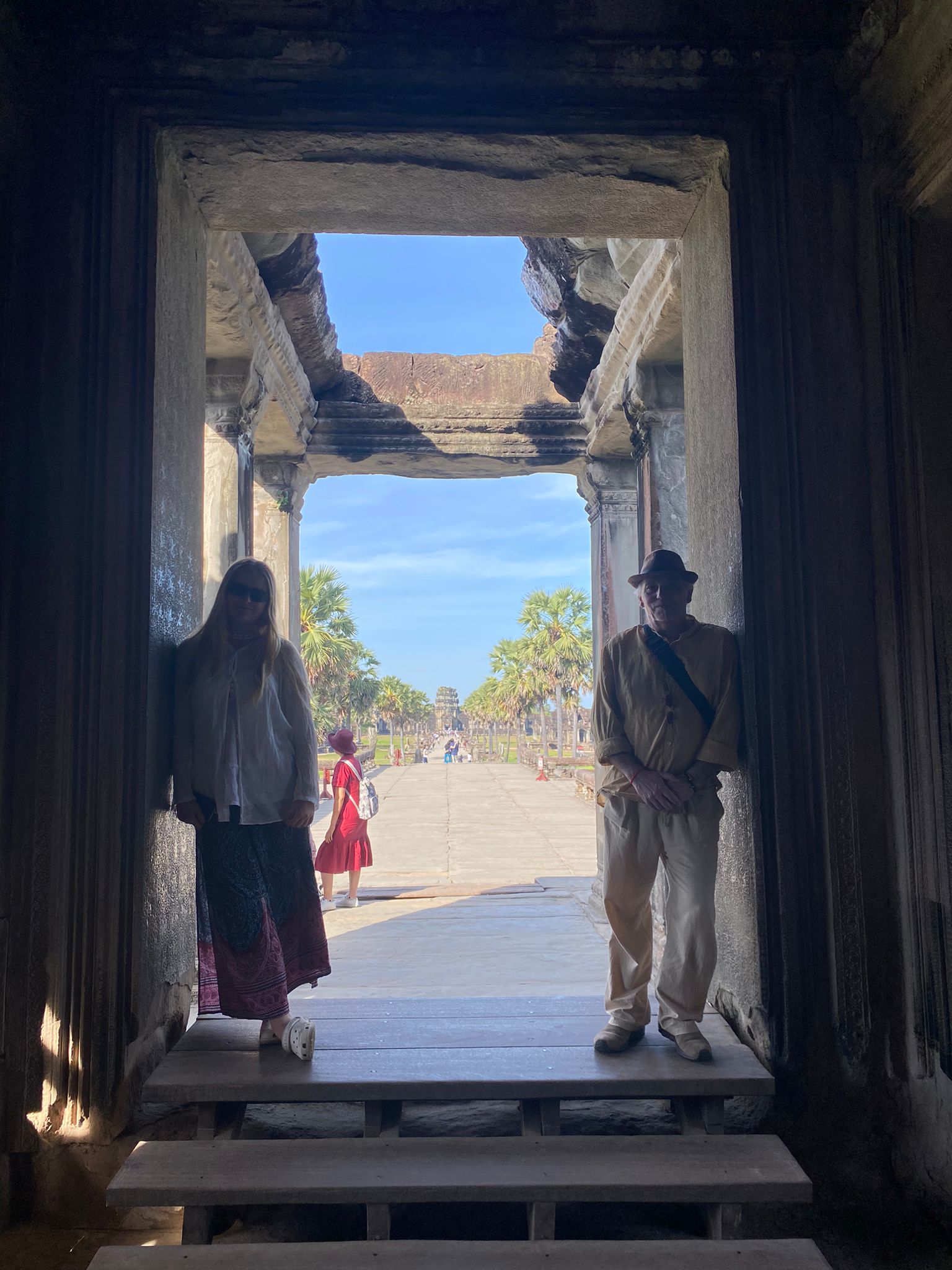
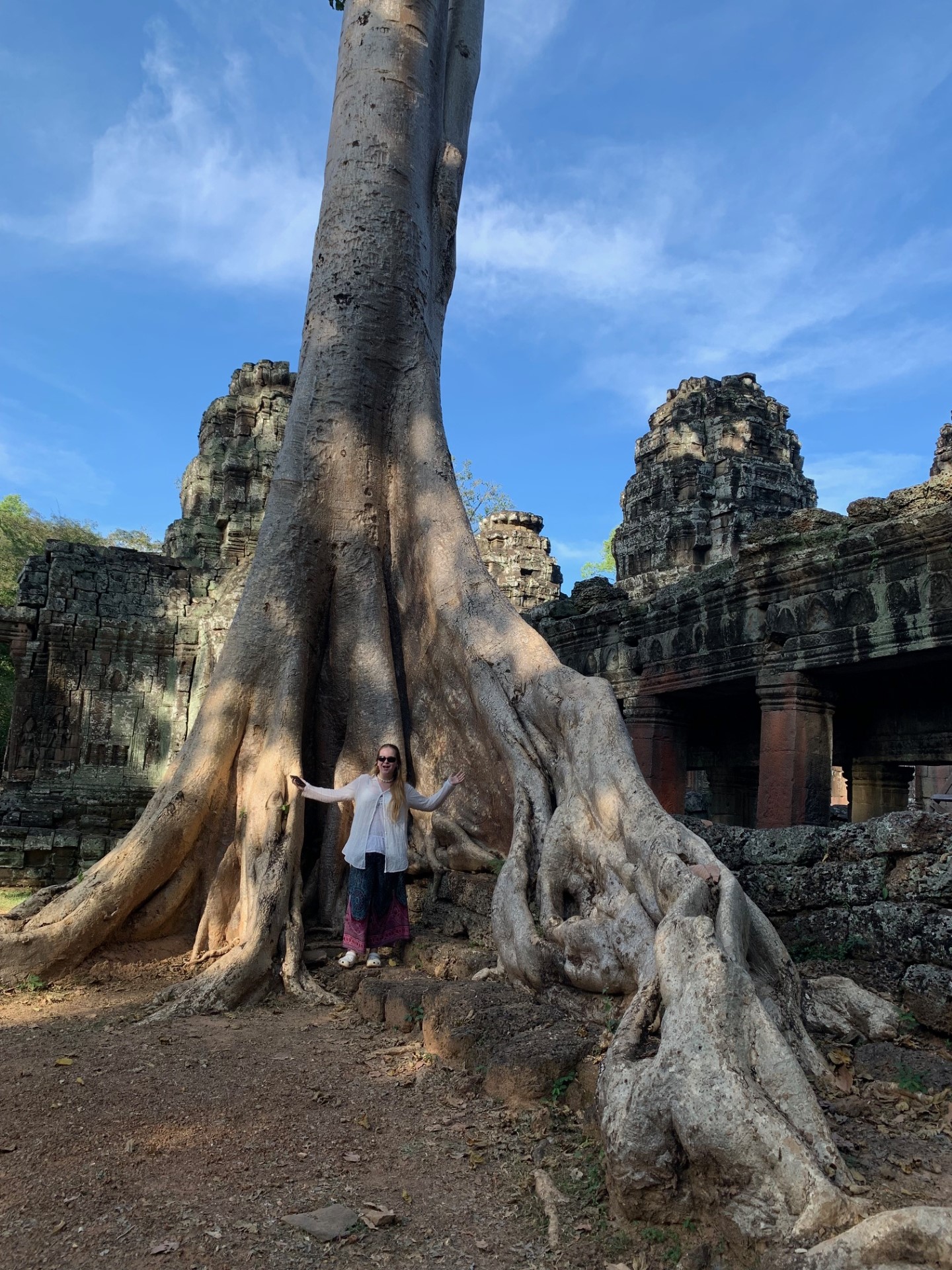
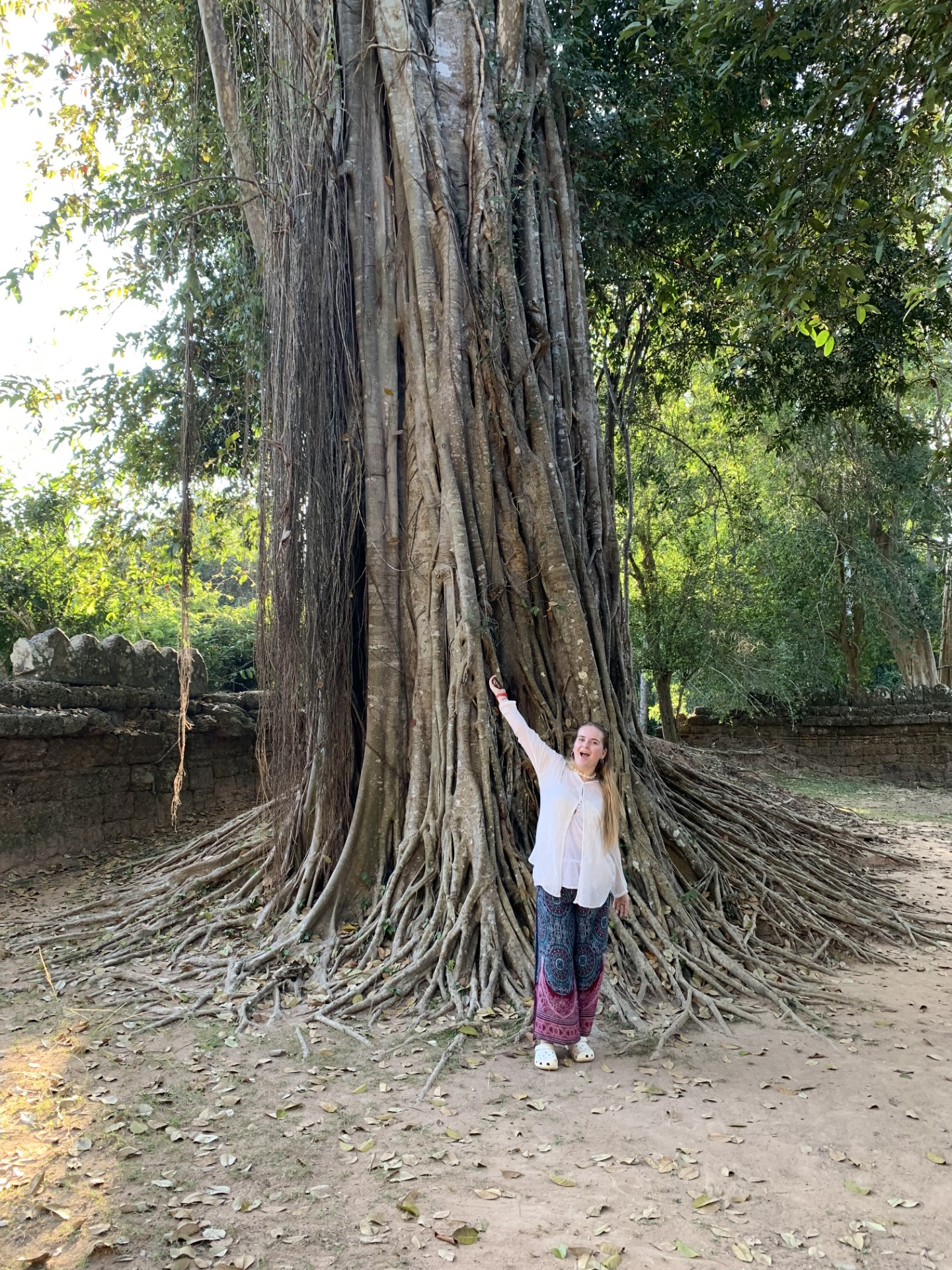
The site is so immense that it’s best to hire a friendly tuk-tuk driver for a couple of days, which is what we did, spending a couple of hours here and there at various temples in their glorious jungle setting (the high-pitched whine you hear in this video is the sound of the afternoon cicadas), enjoying the contrast of the bright orange robes of monks against the pastel hues of the backdrop and crossing bridges where lines of demons guard the entrances to structures or devas (deities) pull the tail of the Naga serpent (a symbol for the ‘churning of the ocean of milk’, or the precession of the equinoxes according to some). The temples are in various stages of their valiant attempt to withstand the invasion of the jungle and sometimes huge, ancient trees have merged with the walls and seem, for all the life of them, to have birthed the stonework from the base of their trunks. Iona, for her part, is delighted to initiate a series of photos of her standing next to some of the stupidly large tree roots.
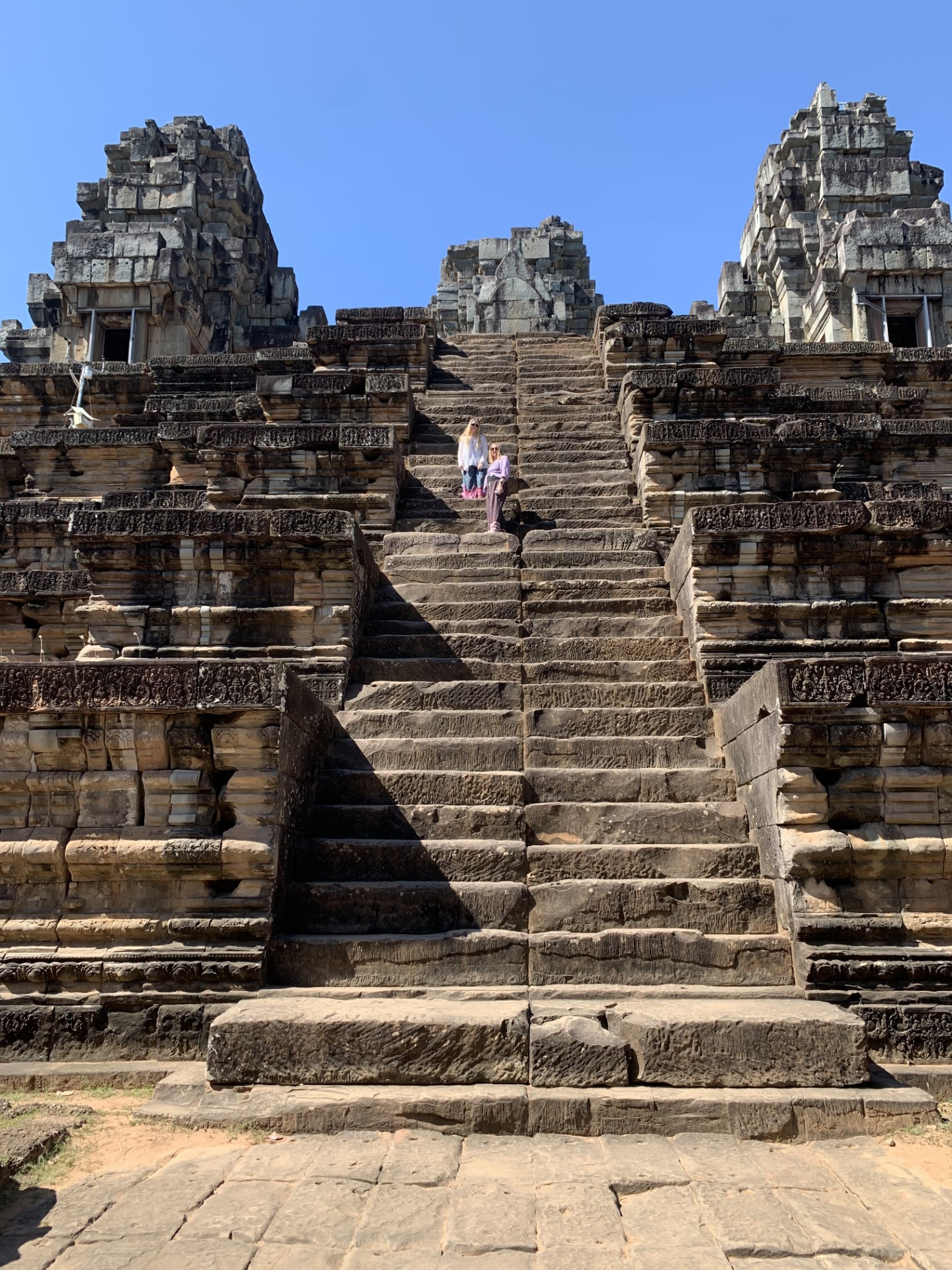
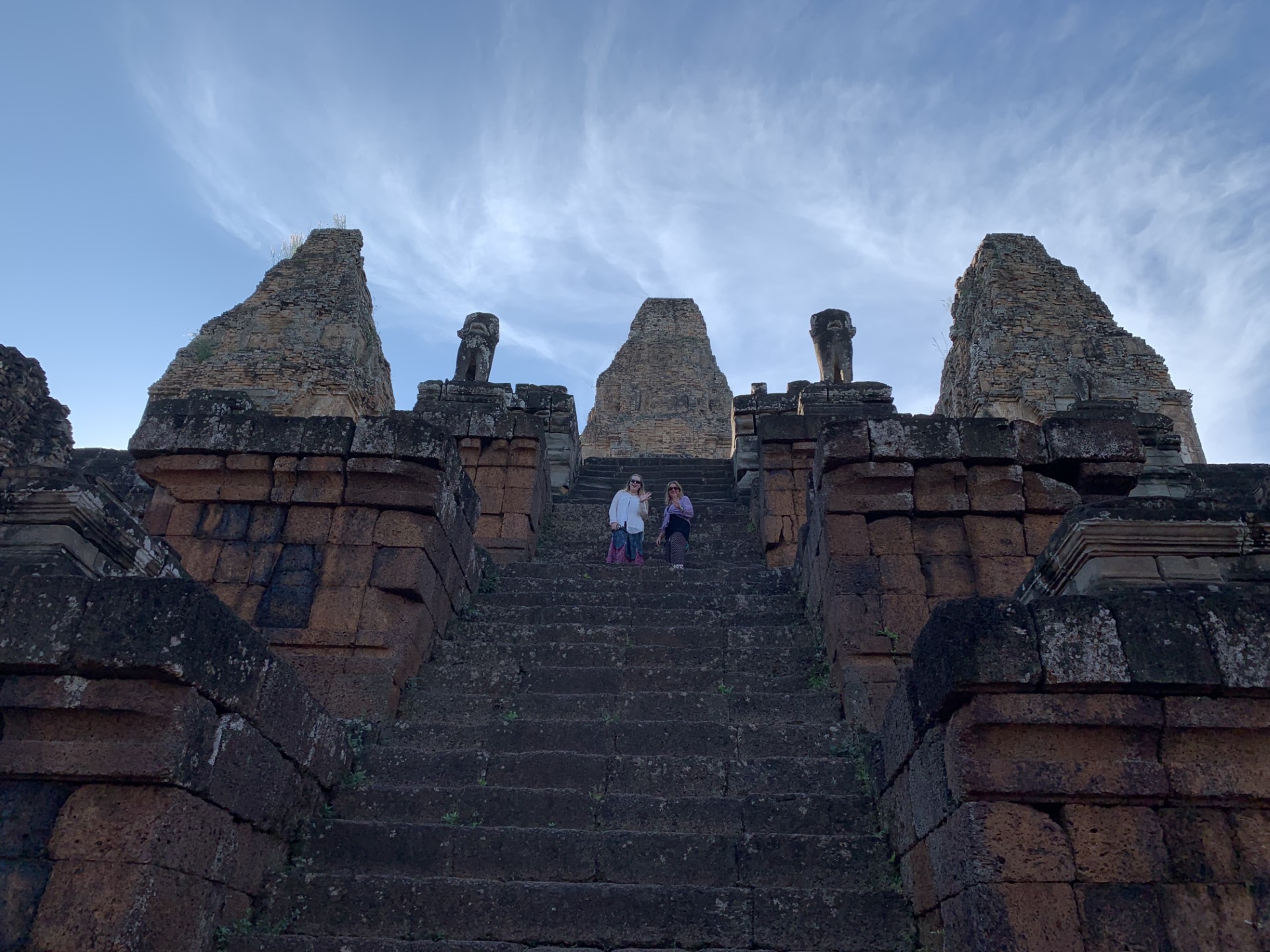
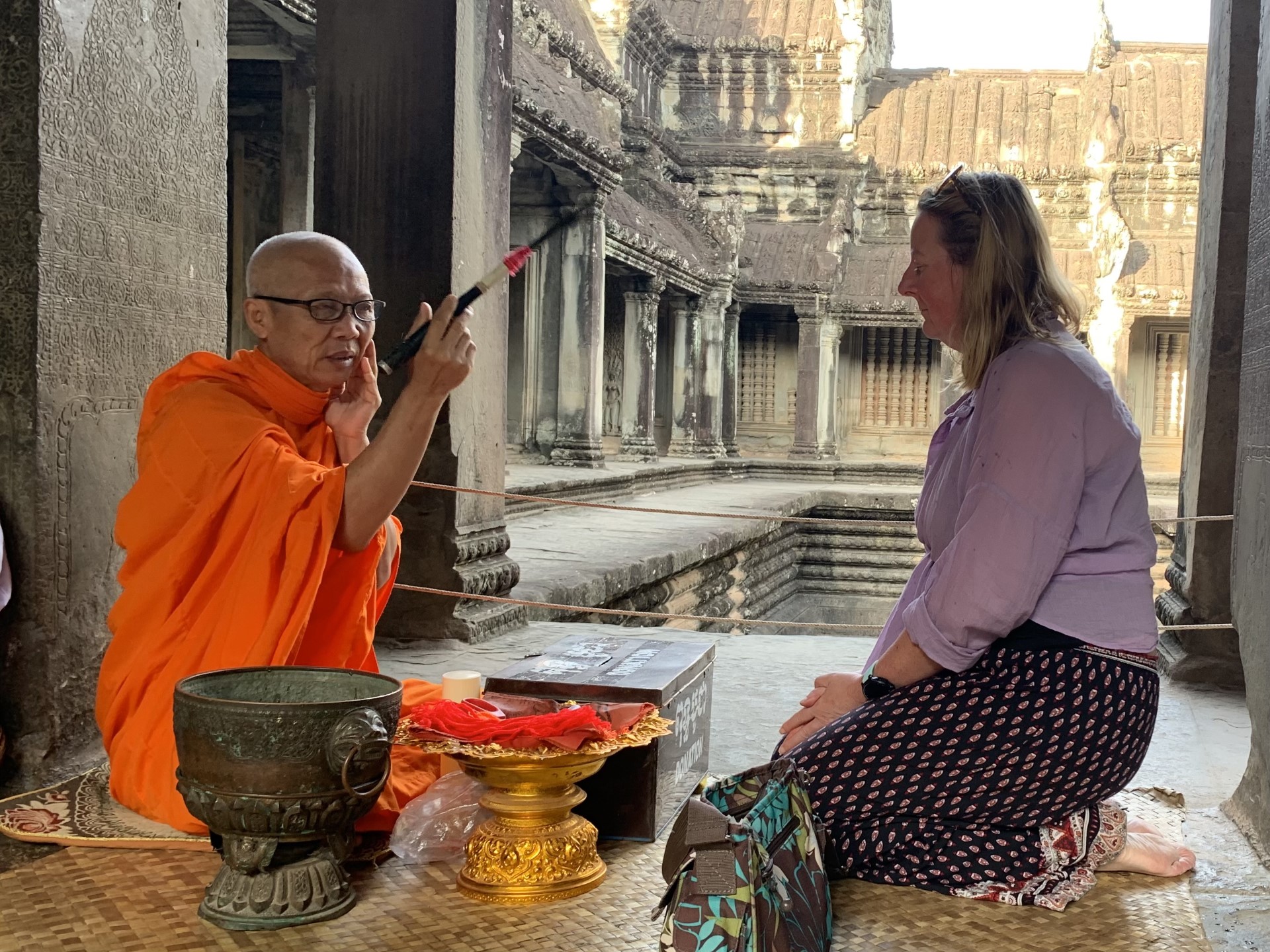
The steps up to the temples are all uncomfortably steep. They are the height of about half your shin and the depth is less than that of the length of your foot. Getting up there is not too bad, but coming down a 50-70-degree stairway with no handrails requires some concentration. Inevitably, it is worth the terror: you get a fabulous view or may get blessed by a Buddhist monk.
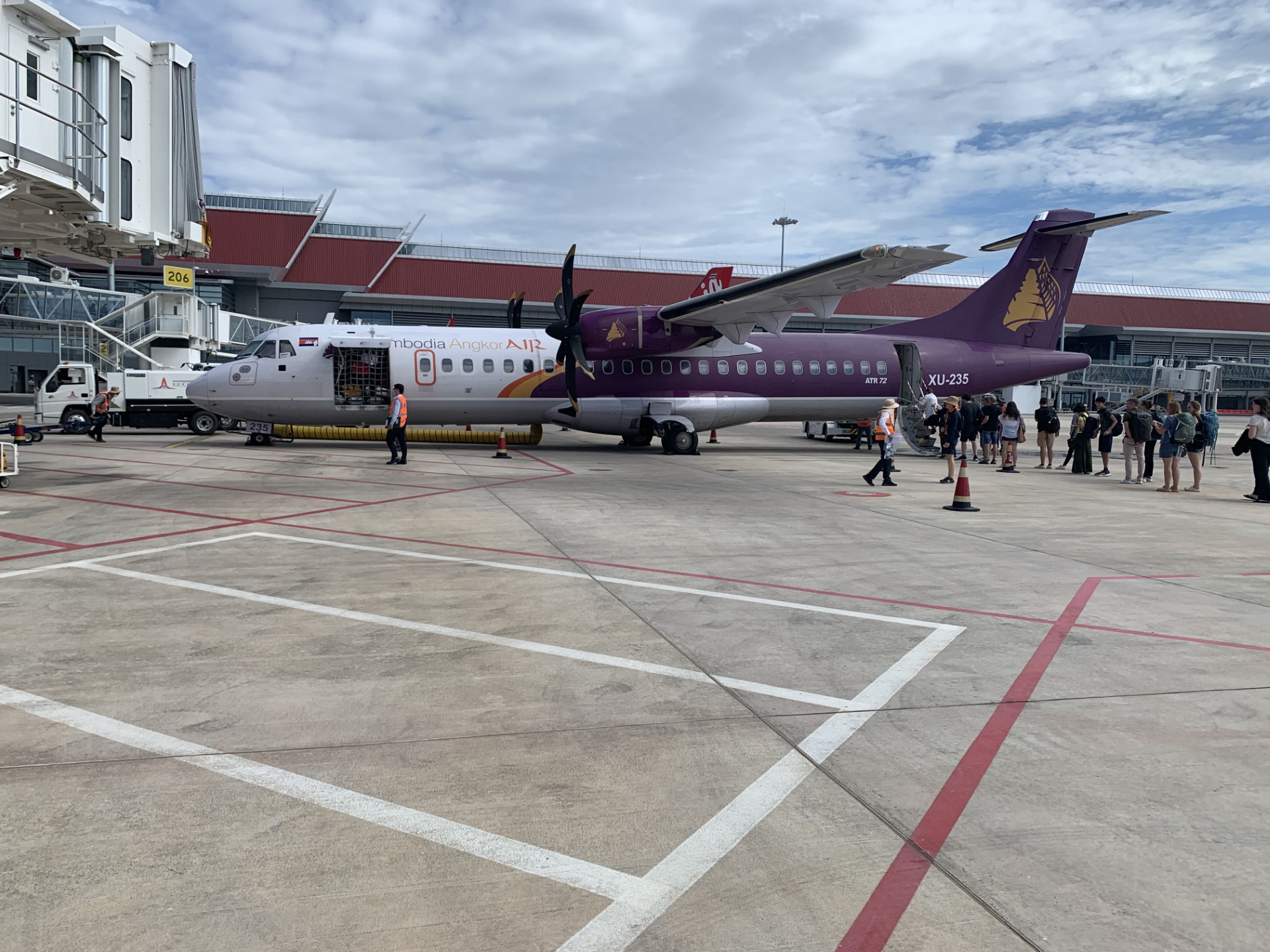
The brand new international airport was built about 55km out of Siem Reap by the (Chinese) Yannan Investment Group and replaced the one in town. They are going to build a whole new city out here. It certainly looks the part, having the appearance of an elegant, symmetrical pagoda, complete with a central spire, in silhouette from the straight new road, which is lined on both sides by cashew nut tree plantations. The flight down south is on a propellered plane – a first for me.
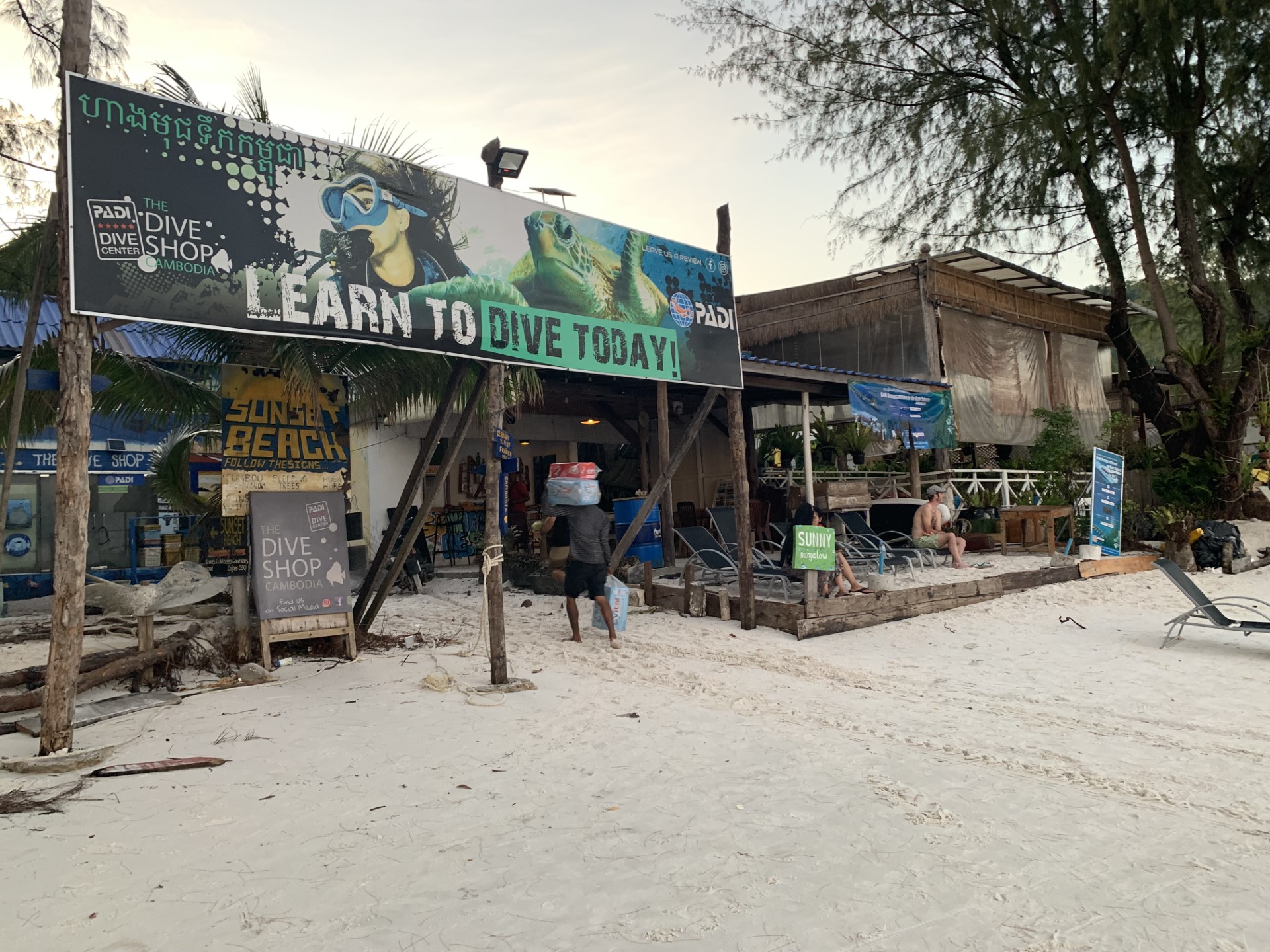
Koh Rong Sanloem
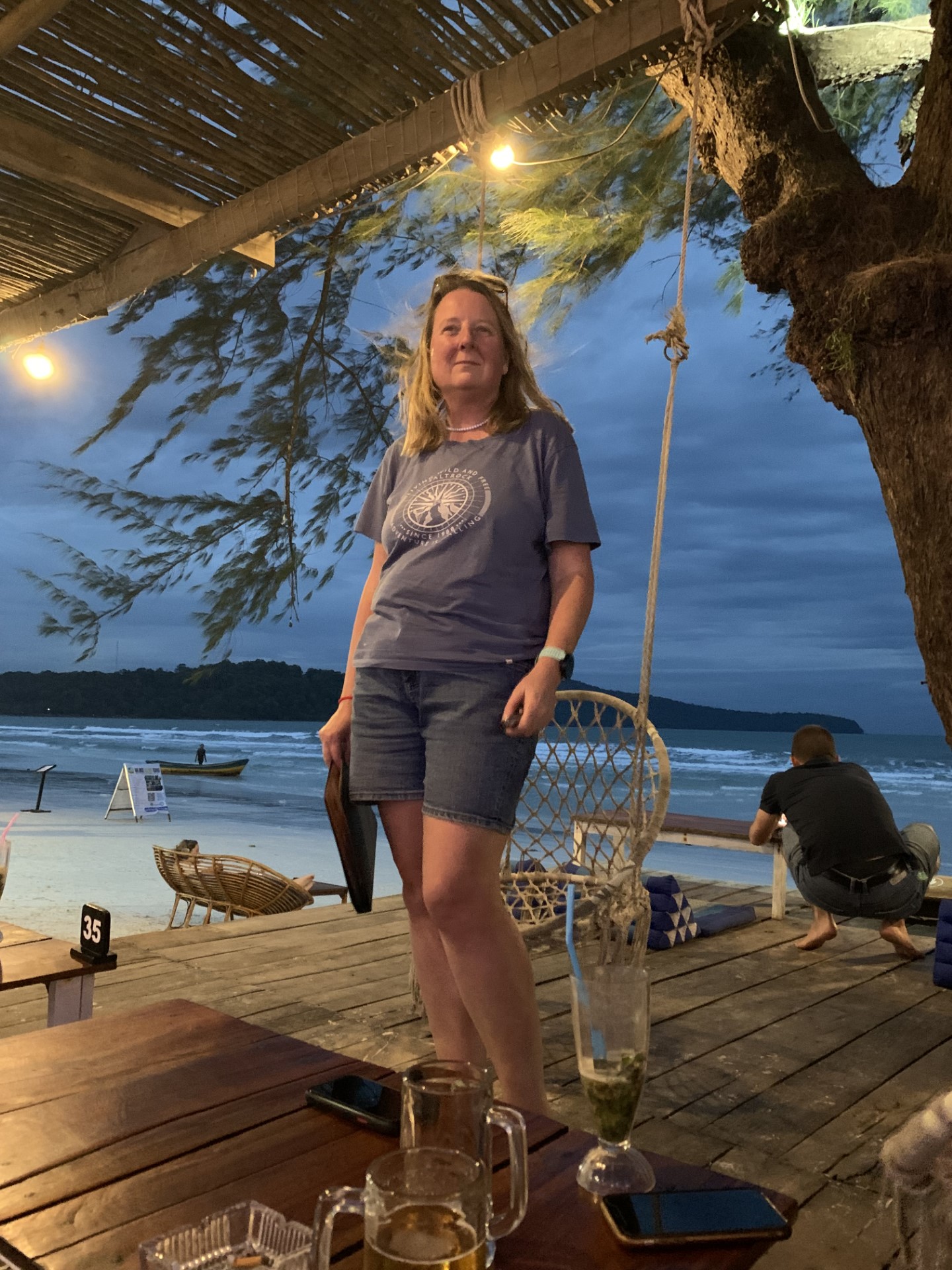
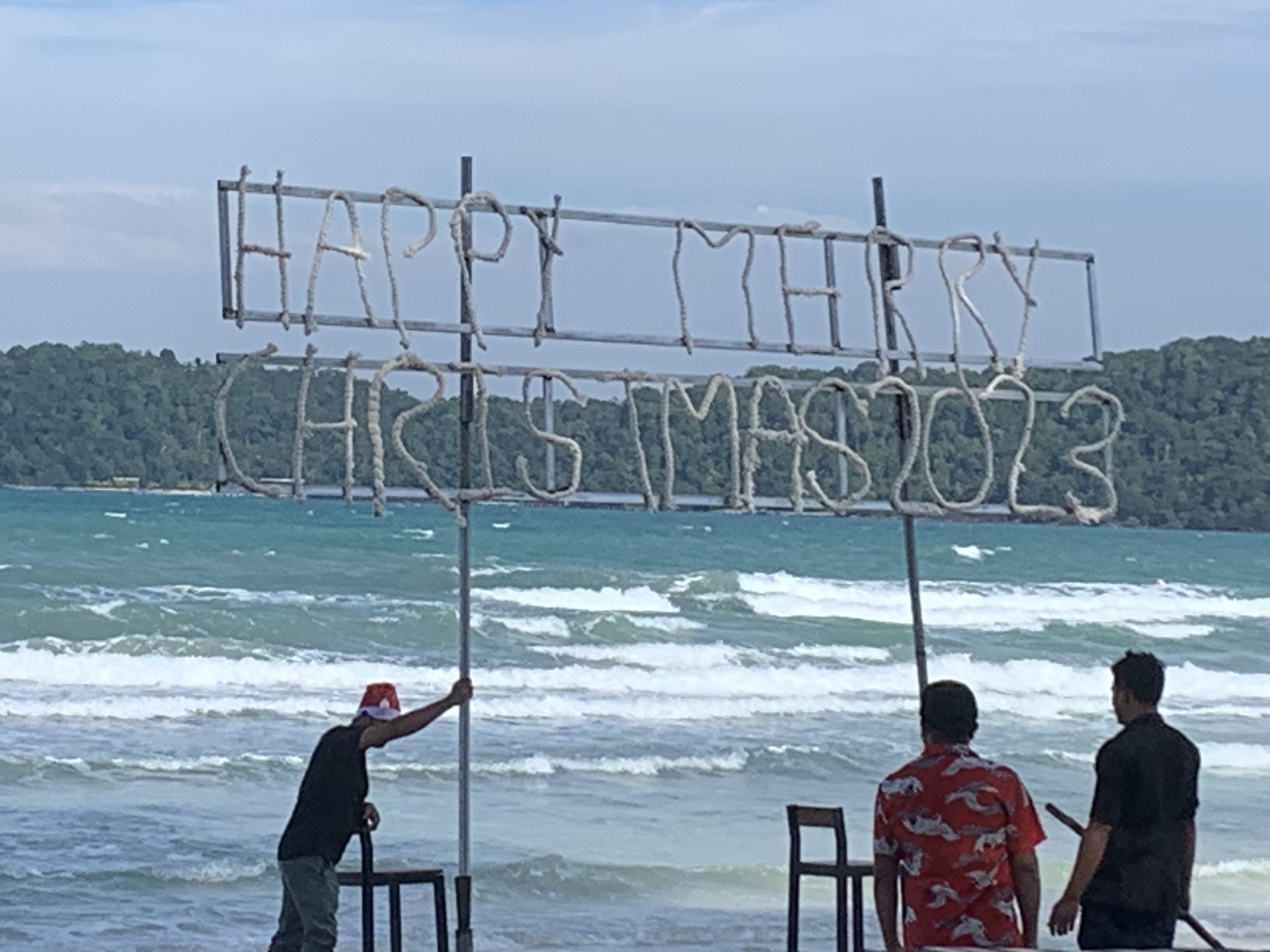
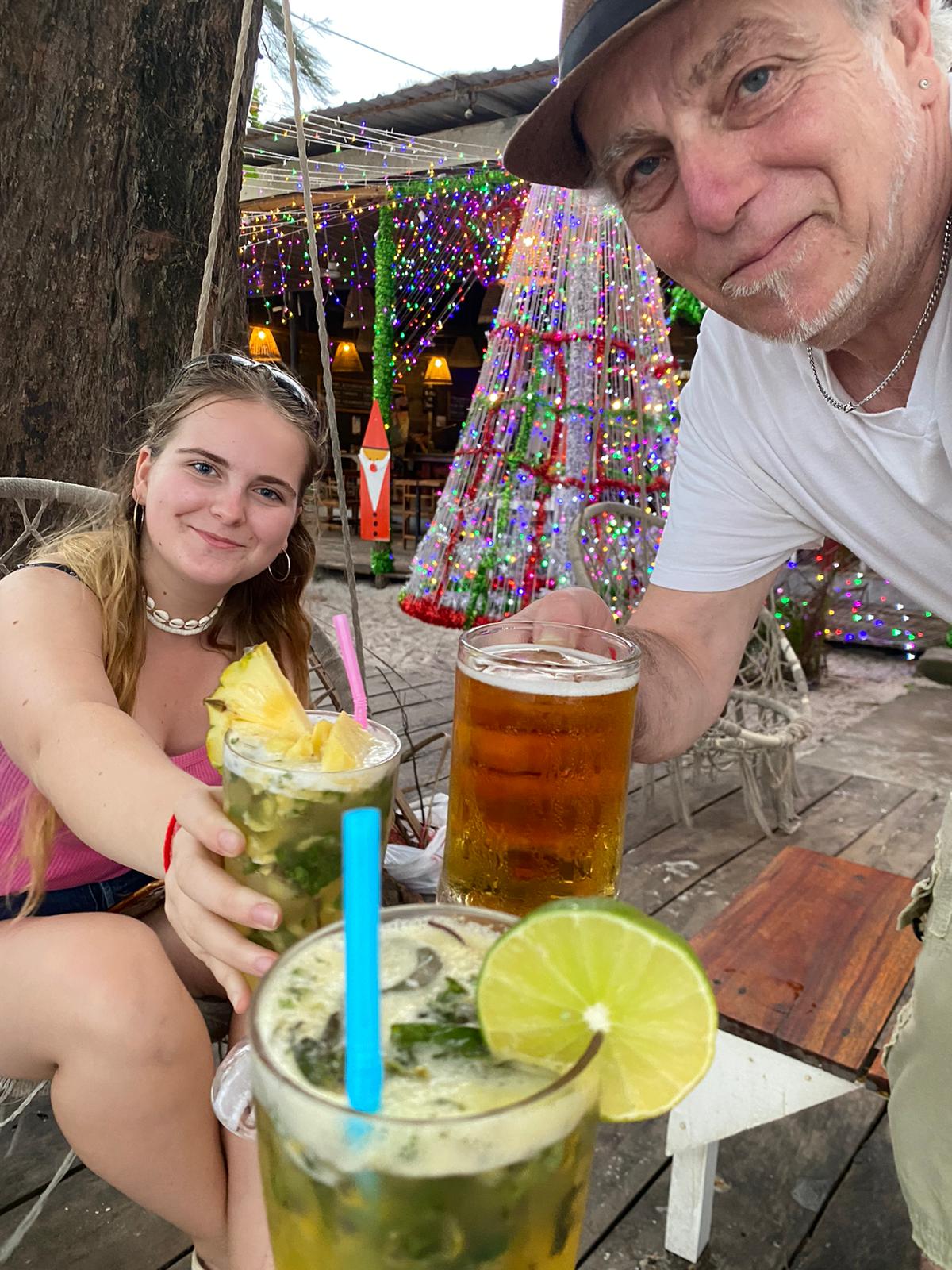
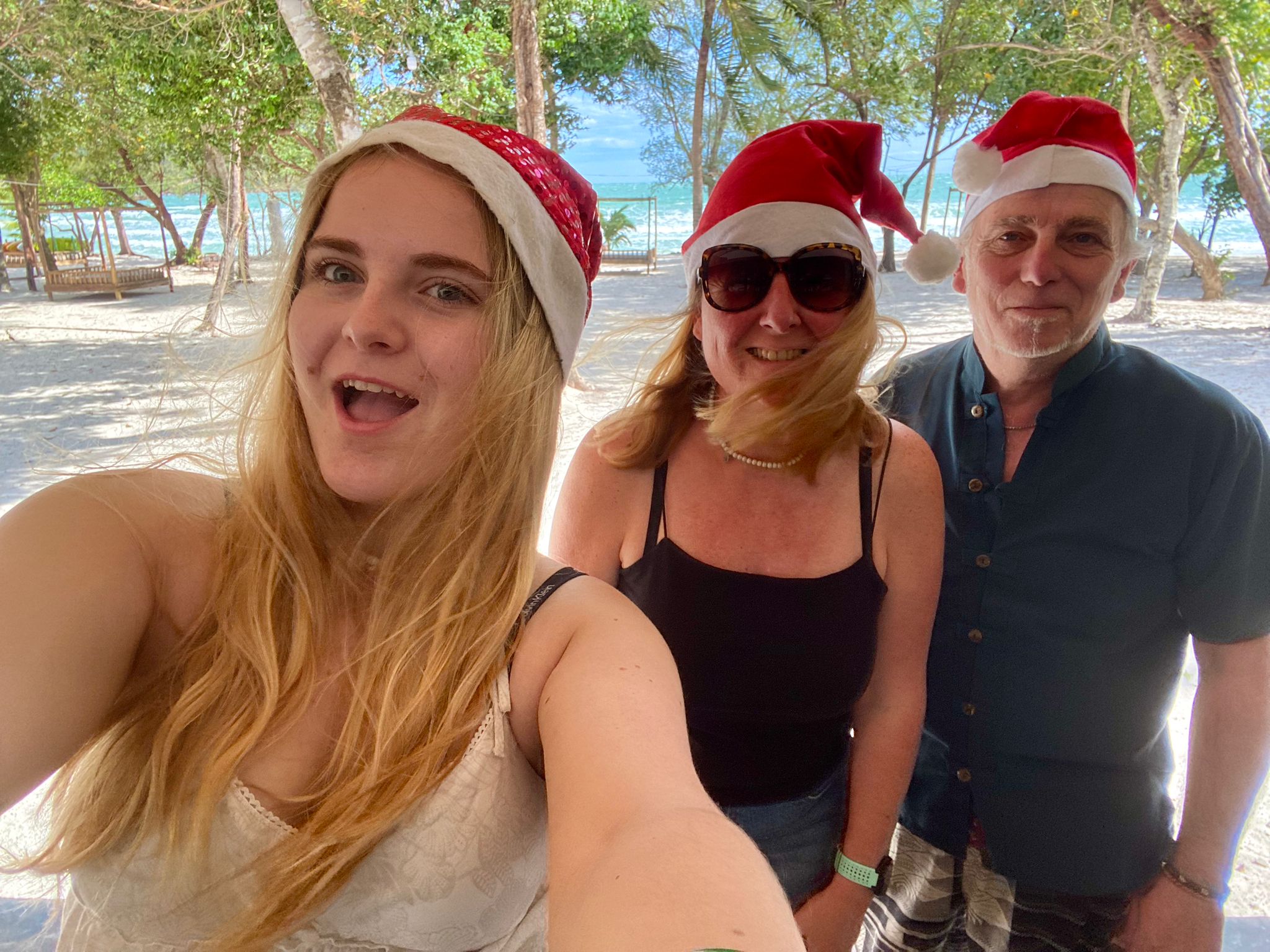
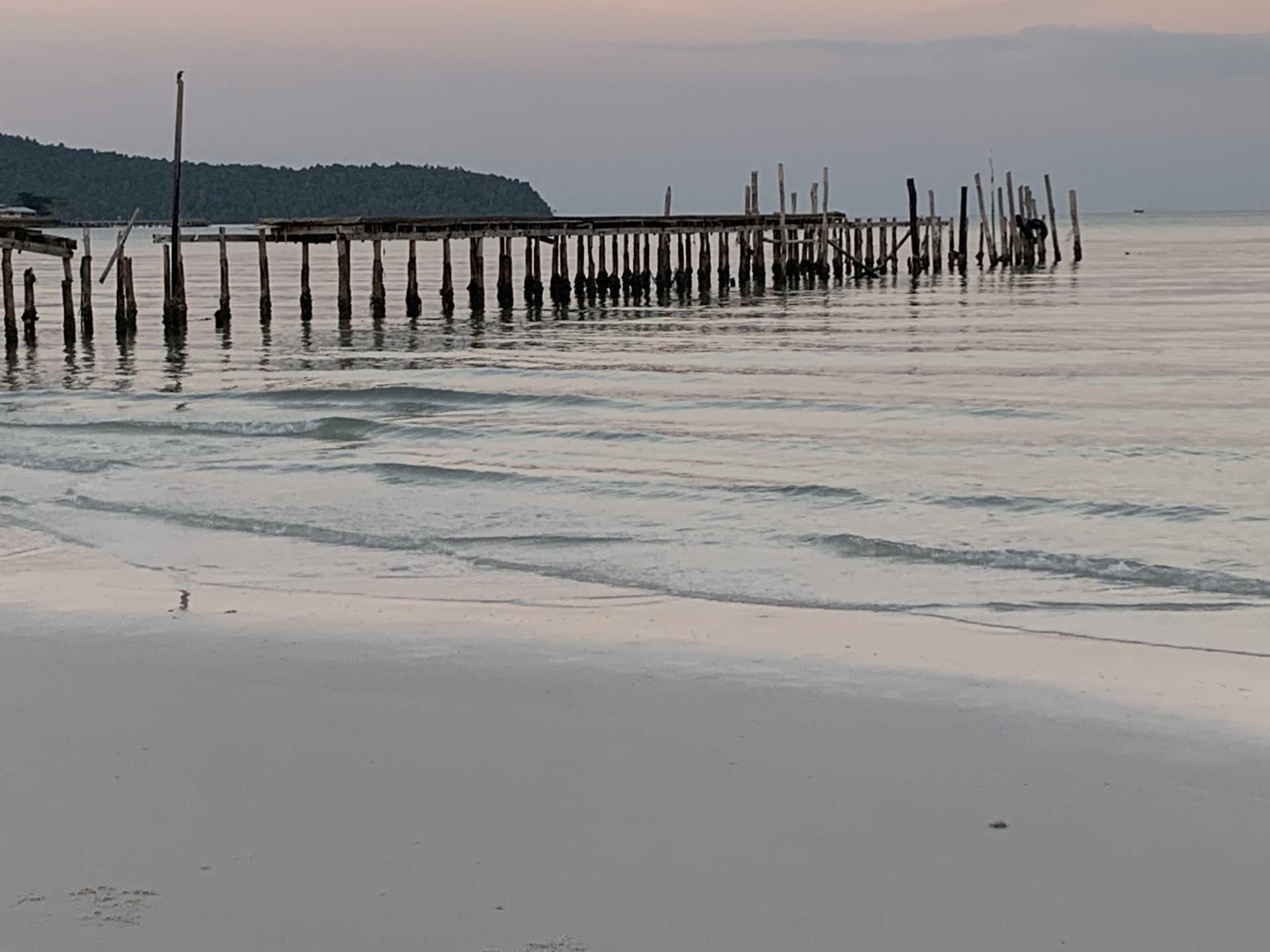
Taking a speedboat from Sihanoukville, we arrived on the island of Koh Rong Sanloem on Christmas Eve where we quickly made best friends with Onederz Beach Bar. With a daily 5-hour Happy Hour that saw you through two mojitos and a beer for $8, what’s not to like about the place? Oh, and of course the stunning beach-front setting helped too.
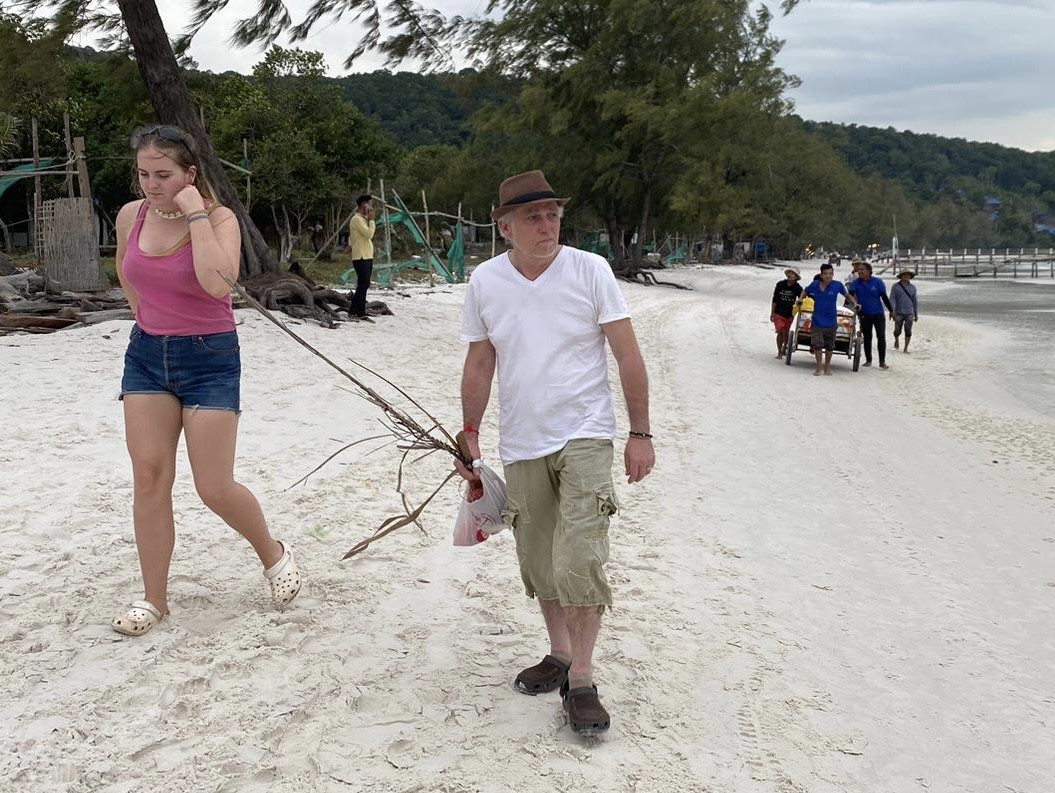
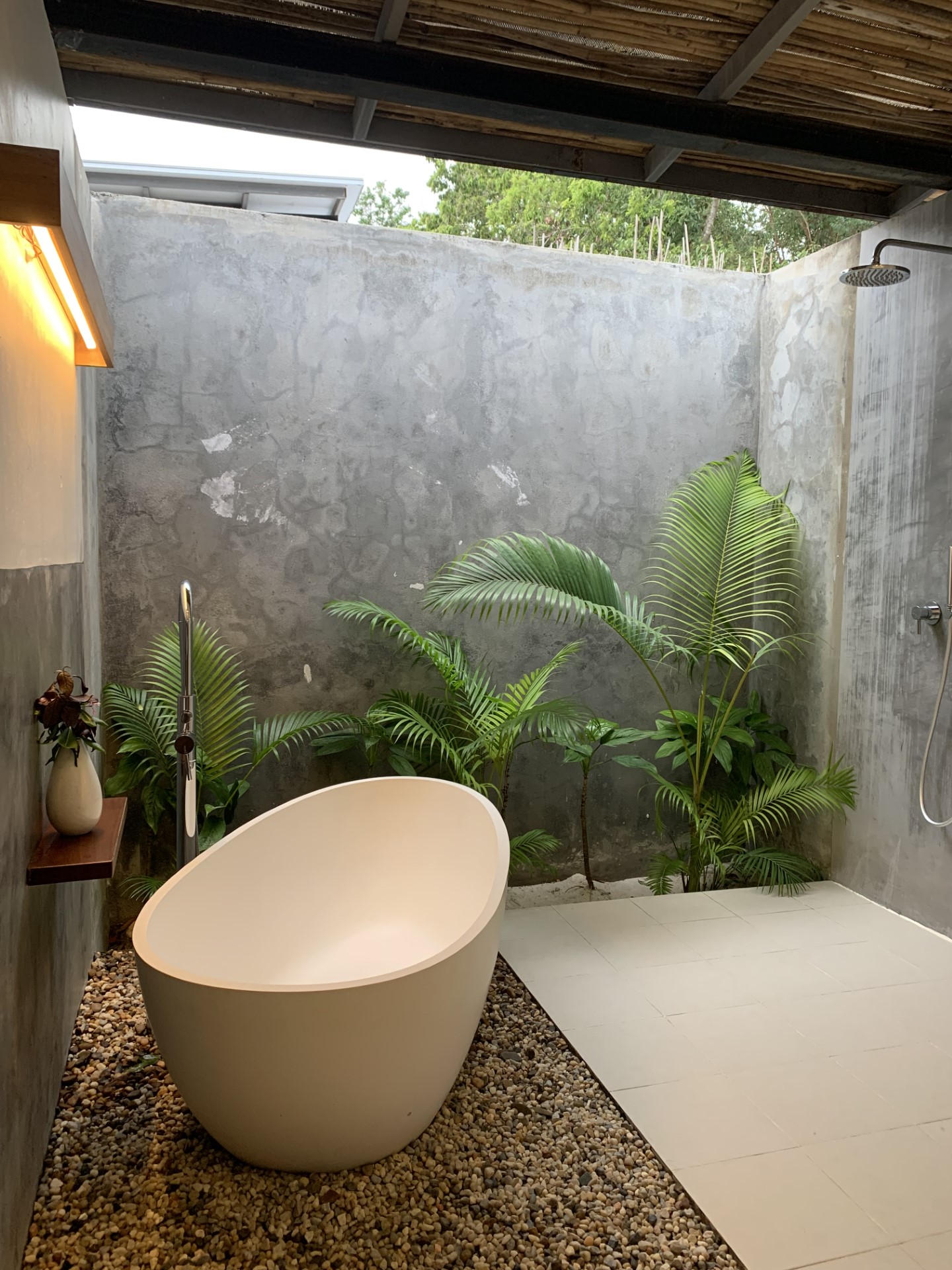
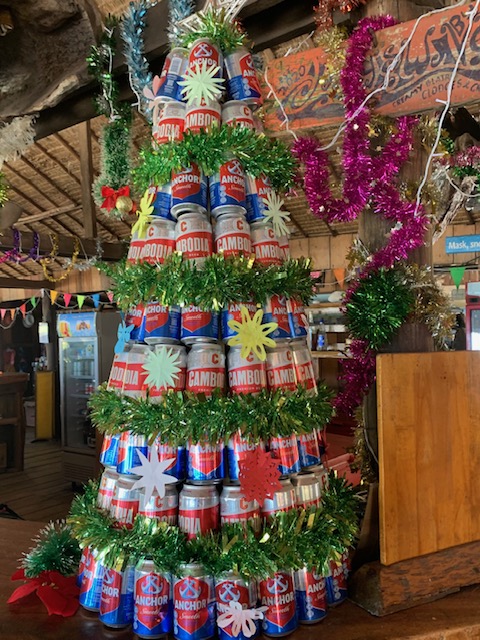
After bonding with Onederz, we went beachcombing to forage materials to make a Christmas tree for the terrace of our room. That was some room! You looked straight out to the palm-fringed beach and the classy bathroom was open at the back to the sky above and a strip of sand below, with young trees growing against the back wall. When you showered, the water drained away to the sand, much to the delight of the frog that seemed to live under the bathroom.
The hotel was on the northern end of a crescent-shaped bay. I saw no cars on the island. Just tractors to get you to and from the jetties when the tide was in and up against the ramshackle restaurants, a couple of small shops, and a few other guesthouses. There were also these curious vehicles which were like girders with a seat on them and a long steering stem. There was a small, scruffy-looking police station on the beach too, which was just a wooden building with a crude, hand-painted sign and a corrugated iron roof. It always seemed to be deserted.
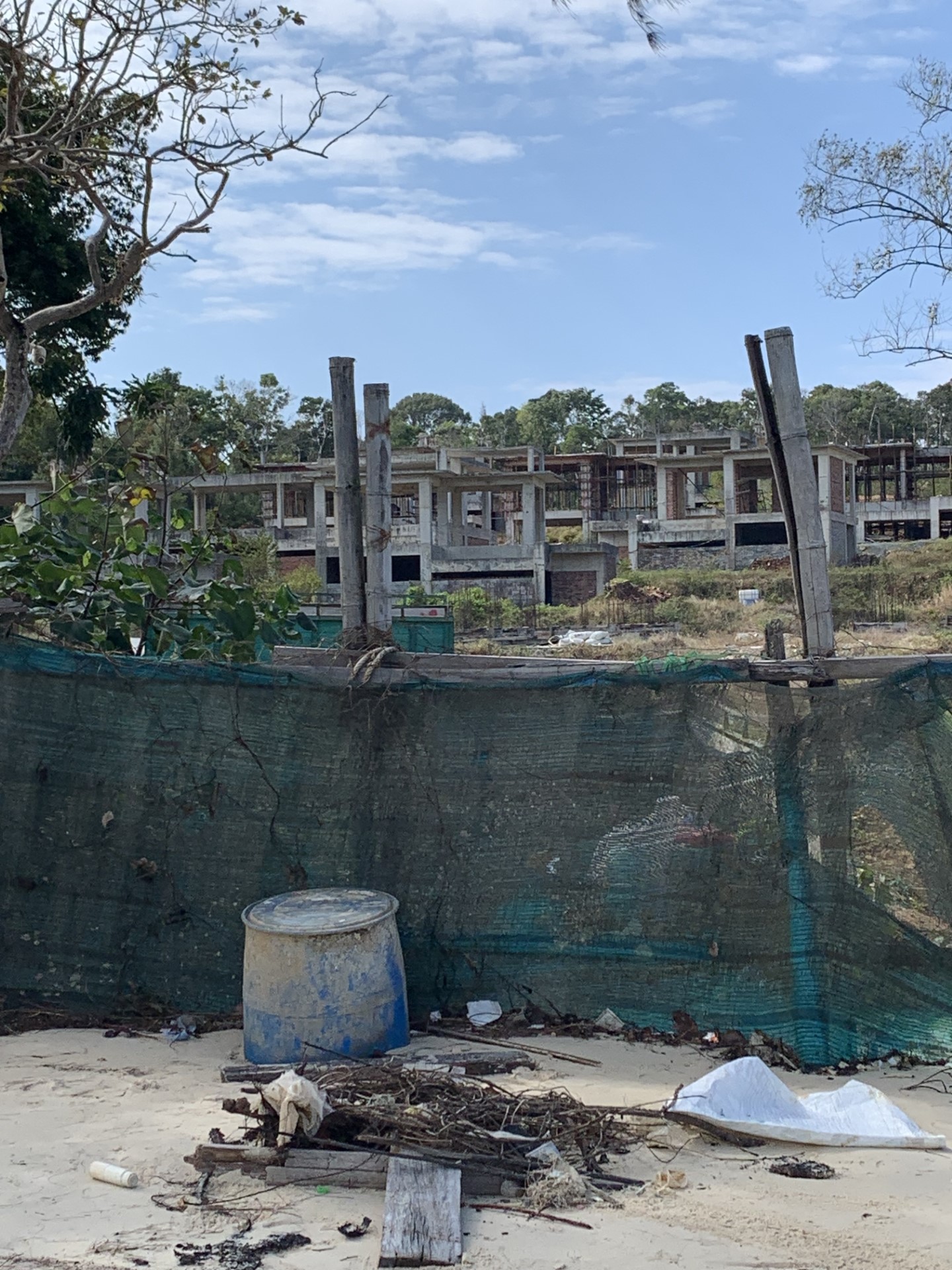
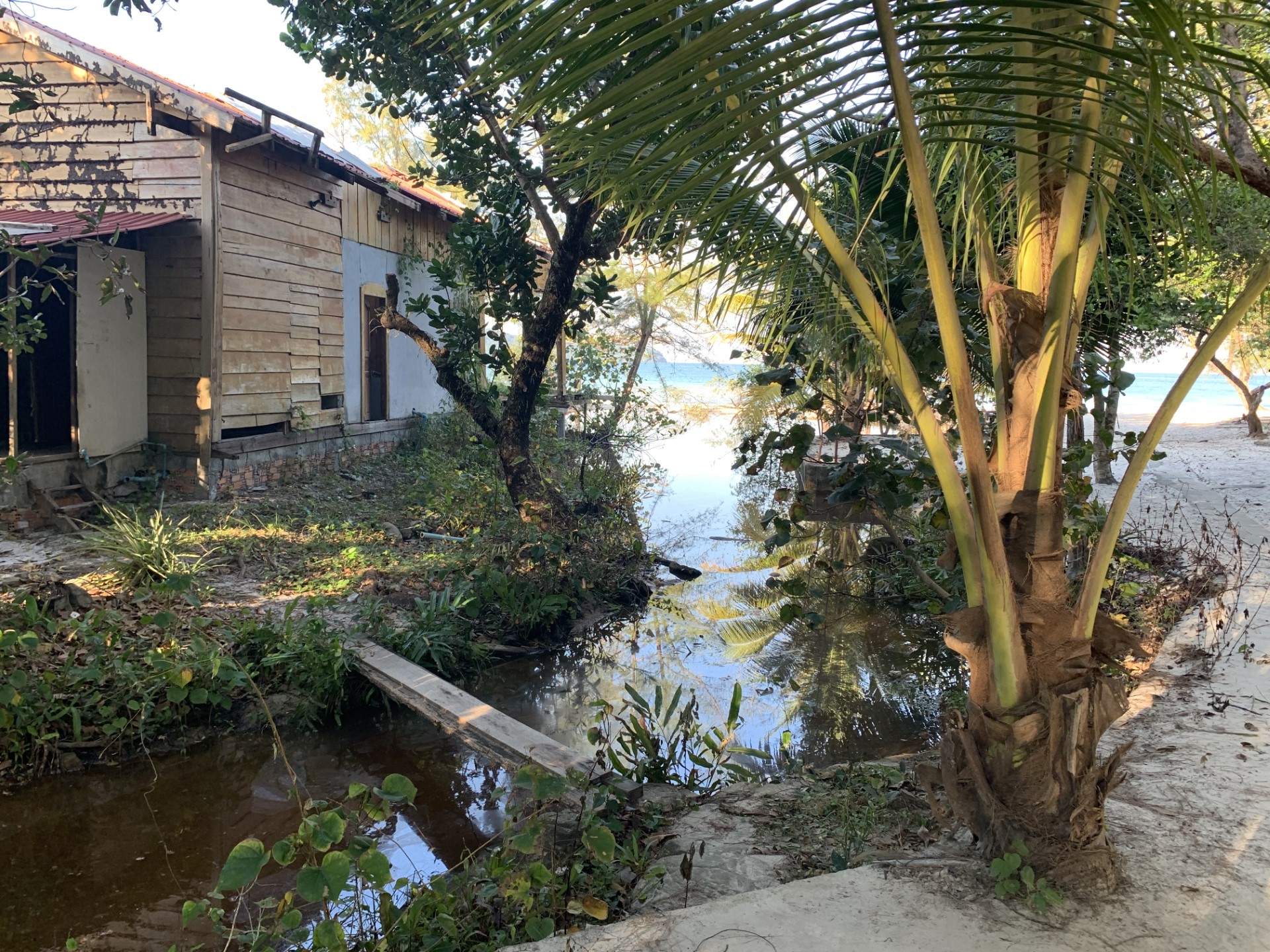
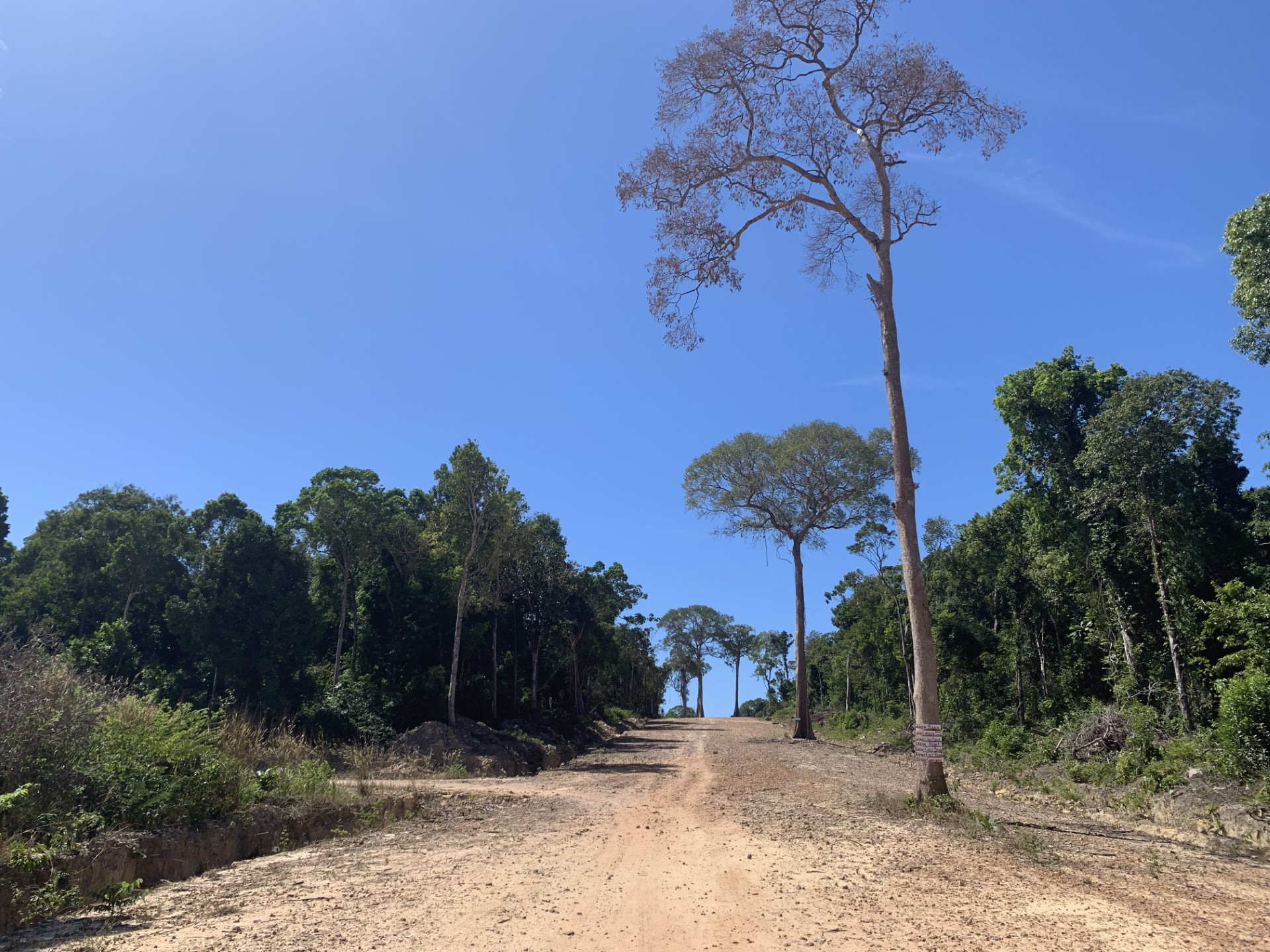
To the south end of the bay, the guest houses were abandoned and some of the beach pods had red graffiti on them. There was the beginnings of a building and a large fenced-off area. The government had leased it to a Chinese investment firm who wanted to build a resort and so evicted anyone who had a business there. The company had bulldozed wide tracts through the jungle for what would become roads to serve the new resort. In fact, the whole northern end of the island was due to become a mega-resort, complete with international airport. Koh Rong Sanloem won’t be like we found it for much longer.
On Christmas day we strolled down to Onederz for a drink after lunch. As I was standing at the bar, watching the barman lick the cocktail spoon after mixing the cocktails and pop it into a glass ready for the next one, suddenly there was a bang and a scream from the kitchen behind him and it immediately burst into flames. Fearing that the gas canisters, jerry cans of diesel, or contents of the bar could catch at any moment Tash called me out. I managed to save the beers I’d just been given and we stood a way away with the other customers on the beach, while people ran backward and forward to the sea to collect water and put the fire out. They seemed to have it under control and we went off for a walk along the beach. I went back later to pay for the beers and asked if everyone was OK after the fire. The barman looked at me blankly and shrugged as if he had no idea what I was talking about. Either that or as if I had no idea what I was talking about.
Sihanoukville is Cambodia’s main port and the Lonely Planet guide tells you:
Travellers are advised to spend as little time as possible in this quagmire of construction… Around 2017, everything changed. Cambodian and Chinese politicians made deals then suddenly the entire city was turned over to Chinese business interests, who proceeded to embark on a casino-building frenzy. Today, the city is a construction zone. Cranes dominate the skyline. A gargantuan new ‘city’ is rising behind Otres Beach. Cement mixers and heavy machinery clog roads pockmarked by bathtub-sized potholes. And sidewalks are nonexistent. It all adds up to one giant mess – indeed just getting from point A to point B in Sihanoukville has become almost unbearable.
None of this stops cruise ships from docking at the port though.
The journey from Sihanoukville back to Phnom Penh is two and a half hours quicker than it used to be thanks to the new highway. It costs $12 in tolls. The road was built and is run by a Chinese investment company, who have a fifty-year lease on the land.
Cambodia is a fabulous country to visit. The way people inevitably thank, or greet you with a wide smile, inclining their head and bowing slightly, while placing their hands together in a prayer position really makes you feel welcomed or thanked. We found them to be consistently polite, cheerful and willing to help. Of course, you pay the ‘tourist tax’ on most things you spend your dollars on, but when it’s done with such charm, it doesn’t seem so painful. It’s a country being swept up in the changes brought about by a tidal wave of profit-seeking investment from China, so now is probably a great time to visit.
So if you need the song, or a bedtime story, or the Jerimiah’s Journey story, then you need to contact me. I have not got enough confidence in them to publish publicly, but if I trust you, I can send you a link. https://wheatypetes.world/about/contact/
OK, so this is a big one. I want to talk about the lockdowns. Right now, there are ‘oaf-icial’ inquiries going on into the behaviour of our leaders and lead scientists who flagrantly ignored the lockdown rules they were giving out at the time to the public and into the infighting going on between the medical experts, scientists, Sir-whatever and Professor-this-or-that, and the government. At the time, we were all scared. We behaved in ways that we would never have understood before the lockdowns: going outside and clapping the NHS into the evening sky on Thursdays, hoping they would not be overwhelmed; acknowledging our neighbours who we could only see through each other’s windows and never speak to apart from when we all went outside to do this and shouting cheery messages to one another across the street; feeling guilty and risking a fine if we went out for any reason other than shopping or for walking our dogs; going around in face masks to supermarkets where teenagers who were still expected to keep working on a minimum wage were becoming our heroes (in masks and tee-shirts proclaiming their newly-elevated status, but still on a minimum wage); making lessons online for children and having meetings with them online lying on our beds while talking to them.
Wow, that was a long sentence!
I was listening to the radio today and they were talking about the memory loss that we are all suffering from because of these lockdowns. And the reason for this is that our familiar reference points simply just disappeared. We don’t have the memory of the normal Christmas, Glastonbury festival that year and so on. So when we try to recall things, we tend to underestimate how many years ago that was because to a certain extent those lockdown years have been wiped from our memories. Our normal reference points are missing.
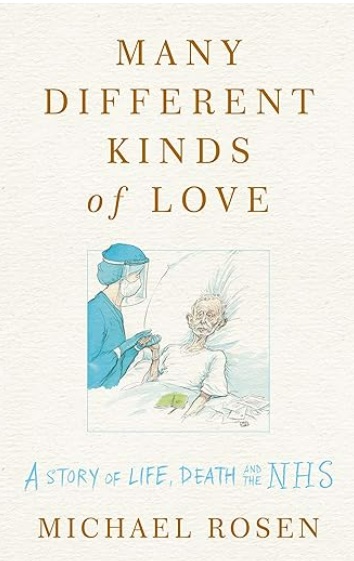
Michael Rosen’s Lockdown Diary (linked)
I wrote lockdown diaries throughout the period because there were no travel blogs to be had. We couldn’t even leave the house unless for very prescribed and specific purposes. There was a rota to go into school to look after and teach the children of ‘keyworkers’, which was flagrantly abused by some of the parents who could not hack their children being at home during the week and in some cases inconveniencing their drug-dealing or dodgy eBay store activities: “I’m a key worker because I work down the corner shop on Sundays so my child has to be at school all week.”
I, like many others, felt that it could be me or anyone close to me next and my older brother came very, very close. I would not have been allowed to attend his funeral if it had gone down that route. Three of my former schoolmasters were picked off by Covid19, probably because they were thumbing a tooth at the pandemic (in a Shakespearian way – an obscene gesture in Elizabethan times) and got picked off as a result. Sure, there were tragic deaths at our school back in the day. A master lost his wife. A student got kicked in the head on a rugby field and there was a cup and a plaque named after him. Cracknell his name was, I think. But we were never expected to show emotion about this just like people could not find closure and attend the funerals of loved ones they lost during lockdown. The only way you could show that was taking it all out on the rugby field. It was the 1970s. That’s what we did and were expected to do. But looking back at my lockdown diaries I wanted to republish here with the benefit of hindsight and to try to make sense of it all.
We all thought that we could be the next one down so did unusual things. We put up our glamping awning for the V-dub in the garden and lived out there during the summer lockdown. It has a wood burner in it so worked in the cold too. I got my younger daughter to record me singing a songI liked at the time on her phone… just in case… It’s not very good, but I was thinking… just in case I need to leave something of it behind.
The school encouraged us to record bedtime stories for the children. There was an issue with copyright, and I had to contact the daughter of the (deceased) author, who had the rights to the story, to get consent to put it out as a video. But if you ever need a bedtime story for your littl’uns, then this is a great one.
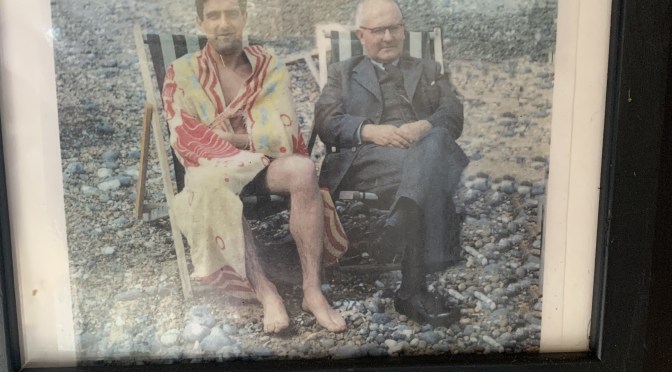
And, very sadly, we lost a much-beloved colleague at school during the lockdowns and they asked me to record this story. Jerimiah’s Journey is a Plymouth-based charity that supports children who have lost close family members or loved ones and gave us permission to record it. I hope you never need it. I still grieve for my Dad and whenever I am overly-sad, or overly-happy, I take out my hip flask and raise a ‘glass’ of his favourite tipple (a good malt whisky) to the picture of him wearing nothing but swimming briefs and a towel, at the seaside with his dad, my grandfather, who sports a 3 piece suit, wry smile and a tie on the shingle beach, both sat in deckchairs, back in the 1950s, on the wall of my man cave, always on my own, and toast the old buggers. It looks like my young dad had just gone for a swim and my grandad was smiling at the youthful exuberance of his son who had just gone and thrown himself amongst the cold waves – the stupid boy. In this way, their spirits are always with me, just like in the Jerimiah’s Journey story. I worked that one out for myself. I still think about my dad pretty much every day. And every day he walks beside me. Maybe those lockdowns taught us to walk hand in hand with those that are no longer by our side.
It really was berserk, lost time. My younger daughter was at home trying her very best to follow online secondary school lessons in a way that made me feel very proud of her. My older daughter was in Canada and I told her she needed to fly home while she still could, but she said that she was fine: the food shops and the weed shops were still open. She’s not a smoker but said this just to let me know that people in Canada were fine and dandy… and stoned if that was their thing. My son was on his cruise ship in his singing job and was happily confined moored up in some port or other in the Mediterranean and enjoying use of the facilities normally offered only to passengers. My wife was at home making lessons for her school and I was doing the same. What the f*** was all that all about? No wonder people lost that time and think that six years ago was only four years ago. We must all have some worm hole, some period of time wiped from our normality over this. But I do remember that those plastic Covid test gizmos were the perfect spacers for laying decking out in the garden. See what I mean? Berserk. When would we ever have had the time to do that? Dig out the sloping soil by hand, level the ground, lay the decking and build a roofed gazebo over it with the aid of a potential-death test.
And then I looked back at my lockdown diaries published previously on this site. And there are the clues. Some good things did happen during the lockdowns. Things were done that we never would have thought we had time to do. Lives were reassessed and we found some of the gallows humour that sees us through situations like this. And when I read them back, I think I can start to make sense of it all, how it affected us, and how it changed and grew us. But nevertheless, it’s certainly still like a hole in our histories. It is as if there were a period of our lives in which we were zapped into some sort of parallel reality, completely separate from our normal lives before and afterwards. Maybe that is what it was like for people who lived through the terrible world wars of the twentieth century.
My son and my daughters will remember this when they are old. And just like the younger generations blame us boomers (who dried their washing on clothes lines outside, dried the washing up with a tea towel rather than in a washing up machine, returned our glass bottles for a deposit, wore hand-me-down clothes and used a fraction of the electricity that we use today because we played outside rather than on electrical devices – I could go on…) for the current climate crisis, their children will ask them what they were doing during the lockdowns and why their leaders were partying, arguing and abusing the very rules they themselves were setting… and blame them for it. They will tell them: “That was ___ years ago,” but will probably be out by a couple of years because of that hole in their history. In some cases, like my younger daughter’s, it may be a rite of passage – the transition from primary to secondary school and the events surrounding this, that were lost. Forever. There has to be some learning from all this.
So here are the lockdown diaries I wrote at the time and the thought journeys they took me on. None of them are very long, so please take the time to read and think about them. I guess everyone has their own unique story from the lockdowns. Here are a fraction of mine:
OK, so stamina is what is needed here because these are loooooong clips. But I have been flirting with this sort of stuff since the early ’90’s when Graham Hancock (with his book ‘Fingerprints of the Gods) set me off on a quest for something which still leaves me a bit unsure of exactly what it is I am searching for. But it is probably just some sort of Truth. That book quite simply blew my mind. What if even a small part of it were true? Randall Carlson takes up the mantle of Graham Hancock in these videos.
So it starts with understanding something along these lines:
But this has relevance for us today. Did you know that there is technology here and now that could transform all our carbon-based engines into something like ‘mobile trees’ and ‘pollute’ our earth with the oxygen of pure alpine meadow air instead of Carbon monoxide/dioxide? If this is true then why is this not being shouted from the rooftops?
But all this may not be so new. We have just been led to believe otherwise. And the evidence is getting stronger and stronger day by day. All this freaky shit is still being denied by those with a vested interest: mainstream archaeologists with their careers built on ‘clever’ reputations and those who profit from our dependence on fossil fuels. Yet we still can not understand how ancient people did some of the things they did and that we would be hard-pressed to do today, even with all our ‘clever’ technology. I believe that the timeline of human history has been misrepresented and still is being. But the evidence to suggest that what we have been taught is just fundamentally wrong is compelling:
If you watched all of these, then you will understand what I am getting at. These sort of things are what sent me on a quest to Gobekli Tepe this year and to Angkor Wat this Christmas coming.
So my plea to you is to open your mind to the possibilities and capabilities of our species. And I for one believe that we have only just started to scratch the surface of where we came from and our past. And Hancock, Carlson and others are the leaders of this movement and the thing is that they are peaceniks. Both believe that if we could learn from our past then we would cease to be driven by greed, self-centred egotism, and a belligerent outlook that is leading us into a state of continuous stupid, pointless wars across the world. I’m with them.
It’s posts like this that offend Palestinians and Israelis at the same time. So be it. We are talking about the ‘P’ word. The dirty word. PEACE. I see you both as my brothers and sisters. And this matters to me. But I still believe that violence and the language of hate simply lead to more violence and more of the language of hate. Steve Earle puts it perfectly here in his introduction, but this is not the best version of the song. Go to the version on the home page for that. I apologise to my Palestinian friends and to Israelis, but I still do not believe in the actions nor the language of violence. If that were the starting point for both sides, then many lives would be saved. Many innocent lives of decent people on both sides.
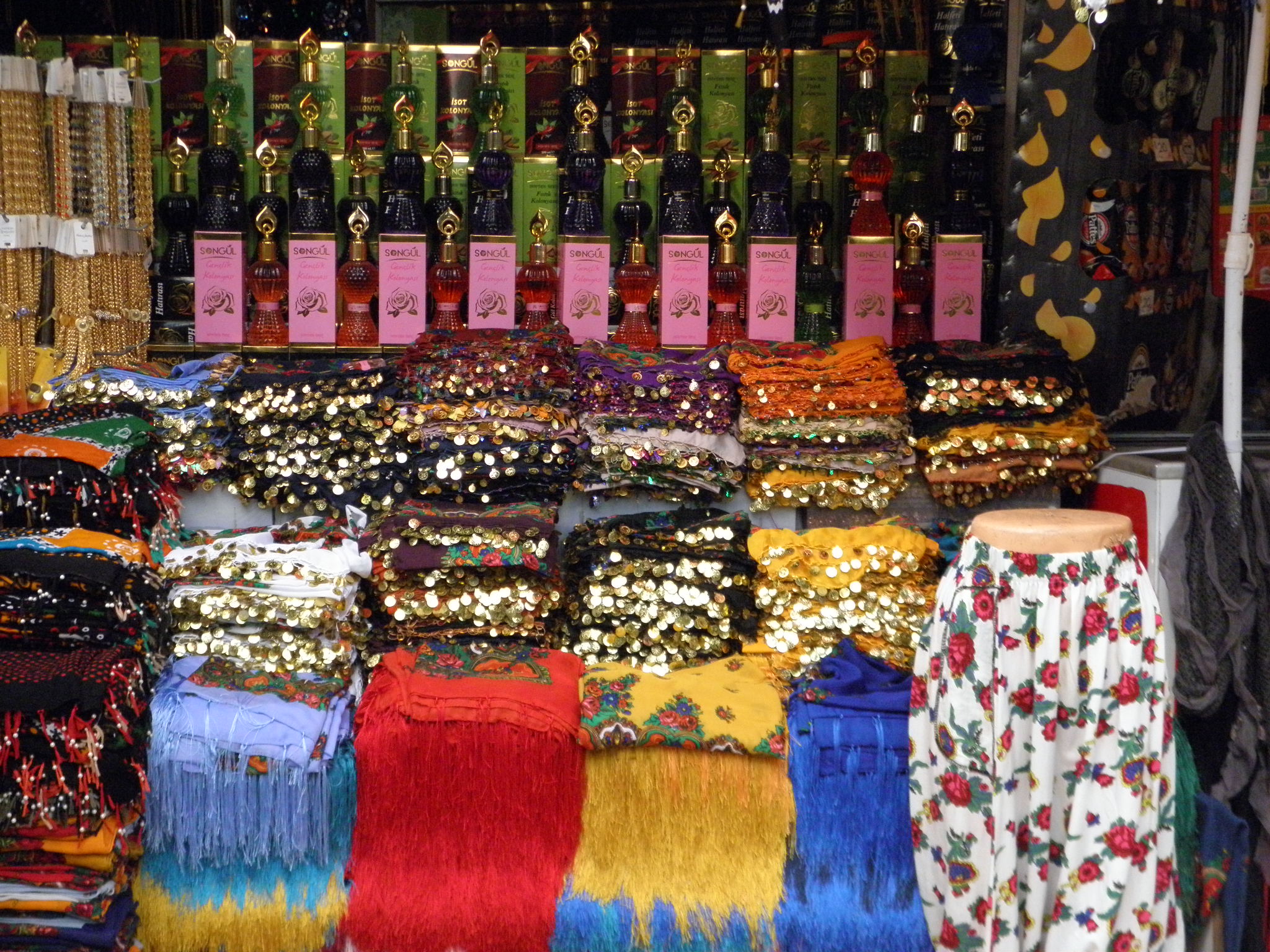
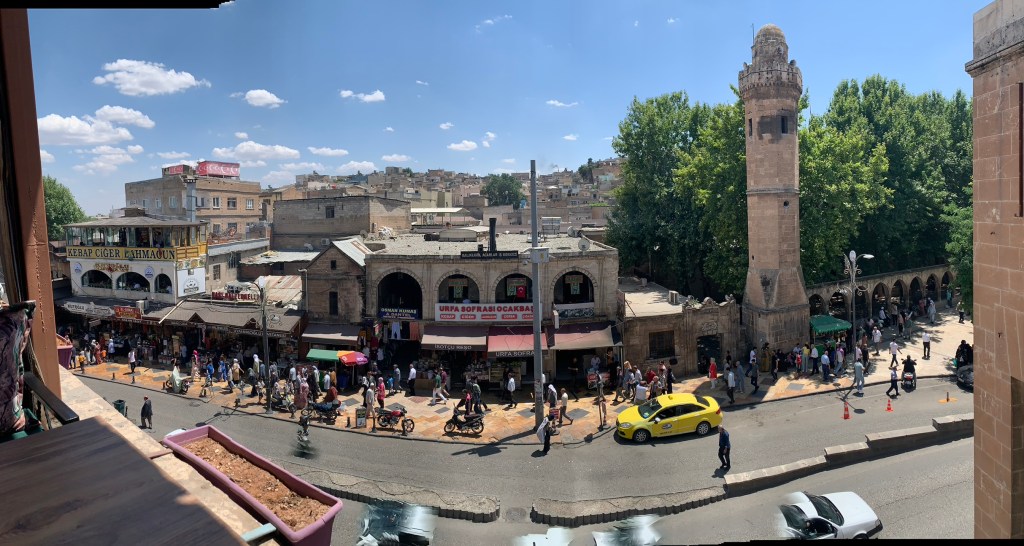
So the quest was successful. We got to Göbekli Tepe and that is where it should end, right? Well not quite. After our stay in Antalya, a fabulous road tripwhere we saw some really mind-blowing sights and met some interesting characters, and after we Tepe’d(here I make up a convenient verb), there was so much more to see on the long road home. Let’s start with Şanlıurfa, where there is a great souq, and where we really lucked-out on the hotel. The Turkmen Konagi is run by Burak and his Dad, Kamil. I can give you two very good reasons to visit this hotel and these will be enough to make you want to stay there should you ever find yourself in Şanlıurfa:
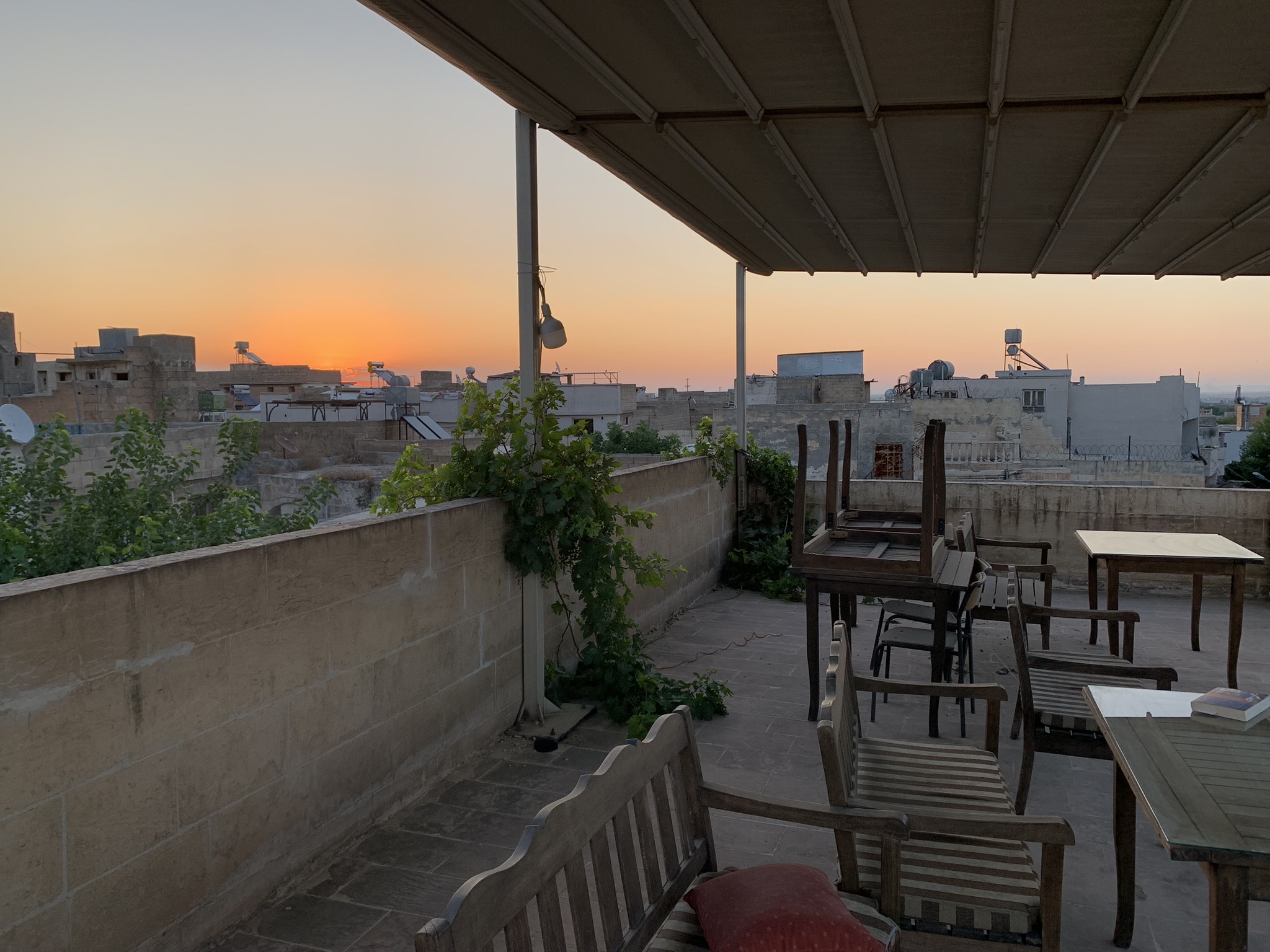
The Roof Terrace
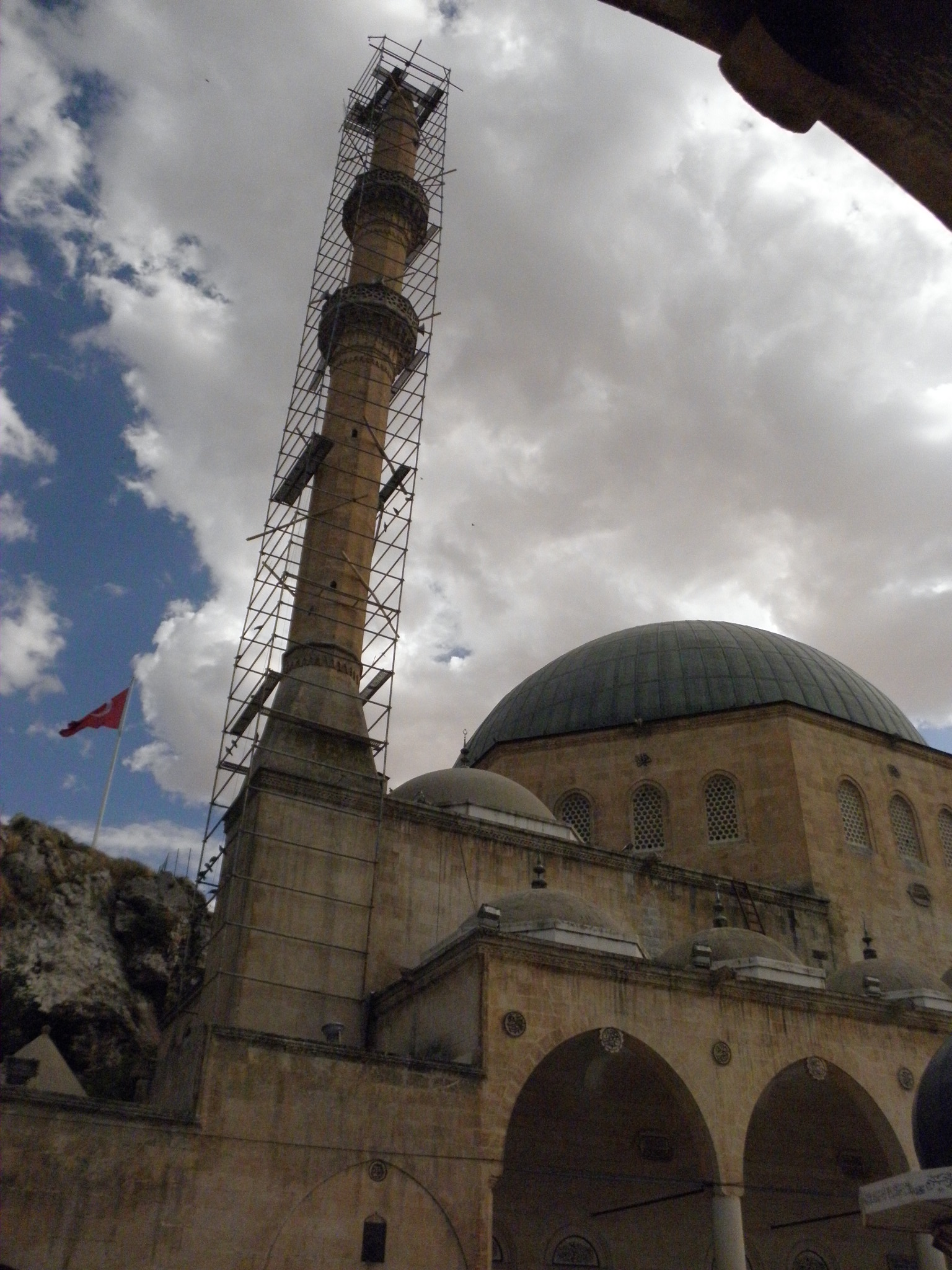
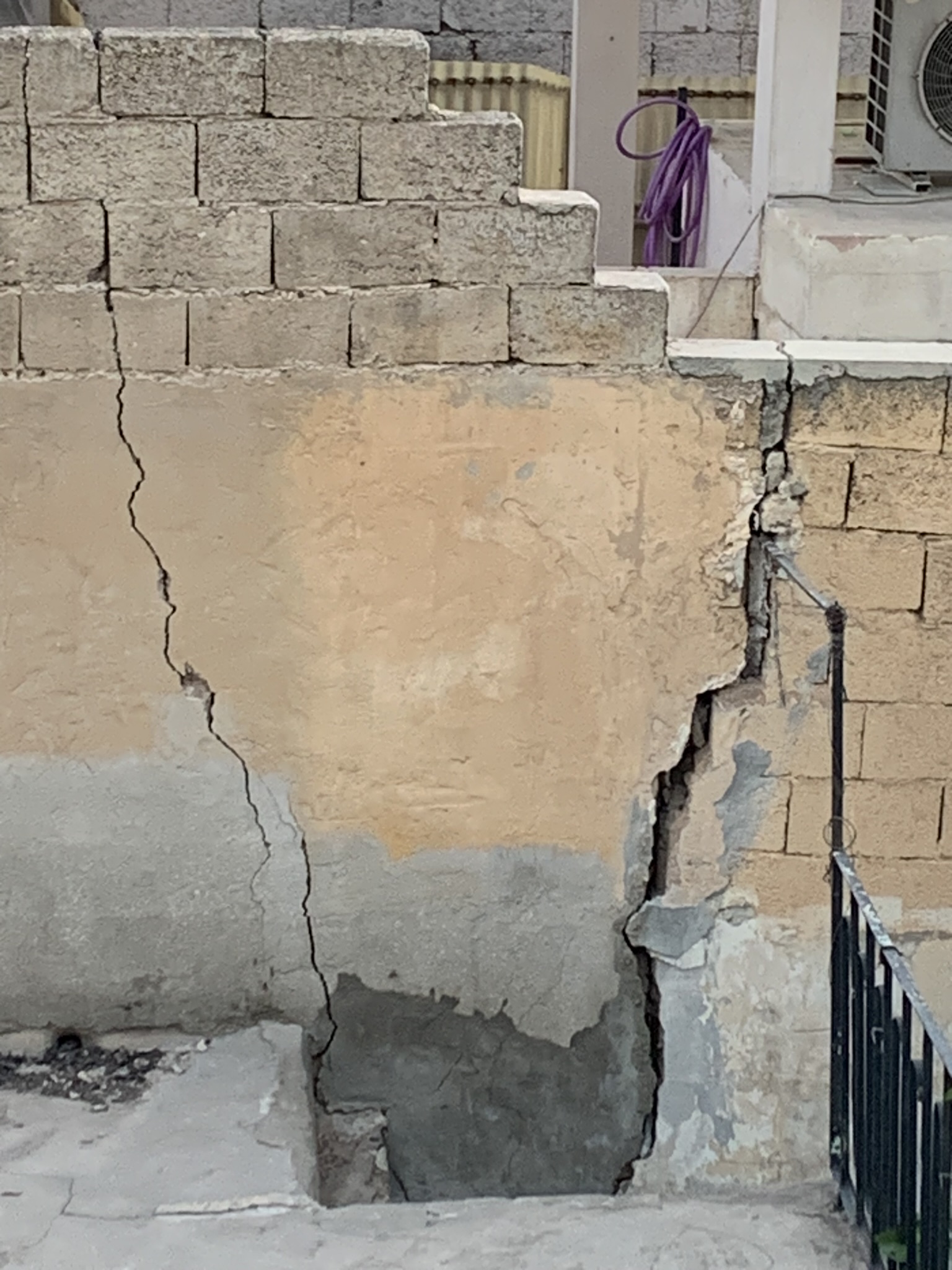
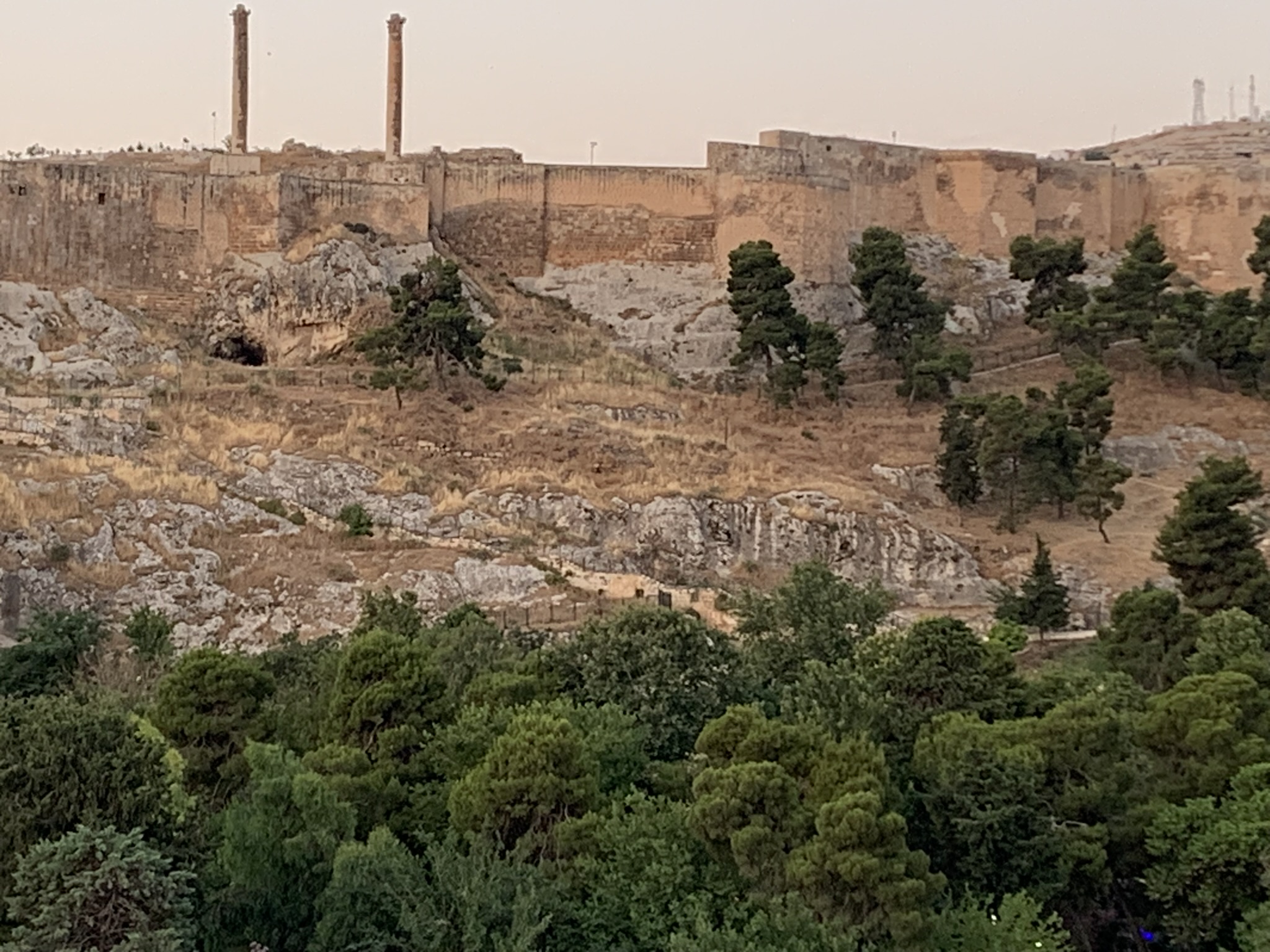
It has the best view in town. You look down over the city rooftops where people sometimes sleep, towards Damlacik Hill opposite, topped by the castle that is still nearly still standing and a couple of Roman Pillars are silhouetted against the horizon. Below and to the right is the citadel to one side, a ramshackle desert-coloured splash of old houses. To the left is a mosque with two minarets, one clad in scaffolding after damage from the earthquake.
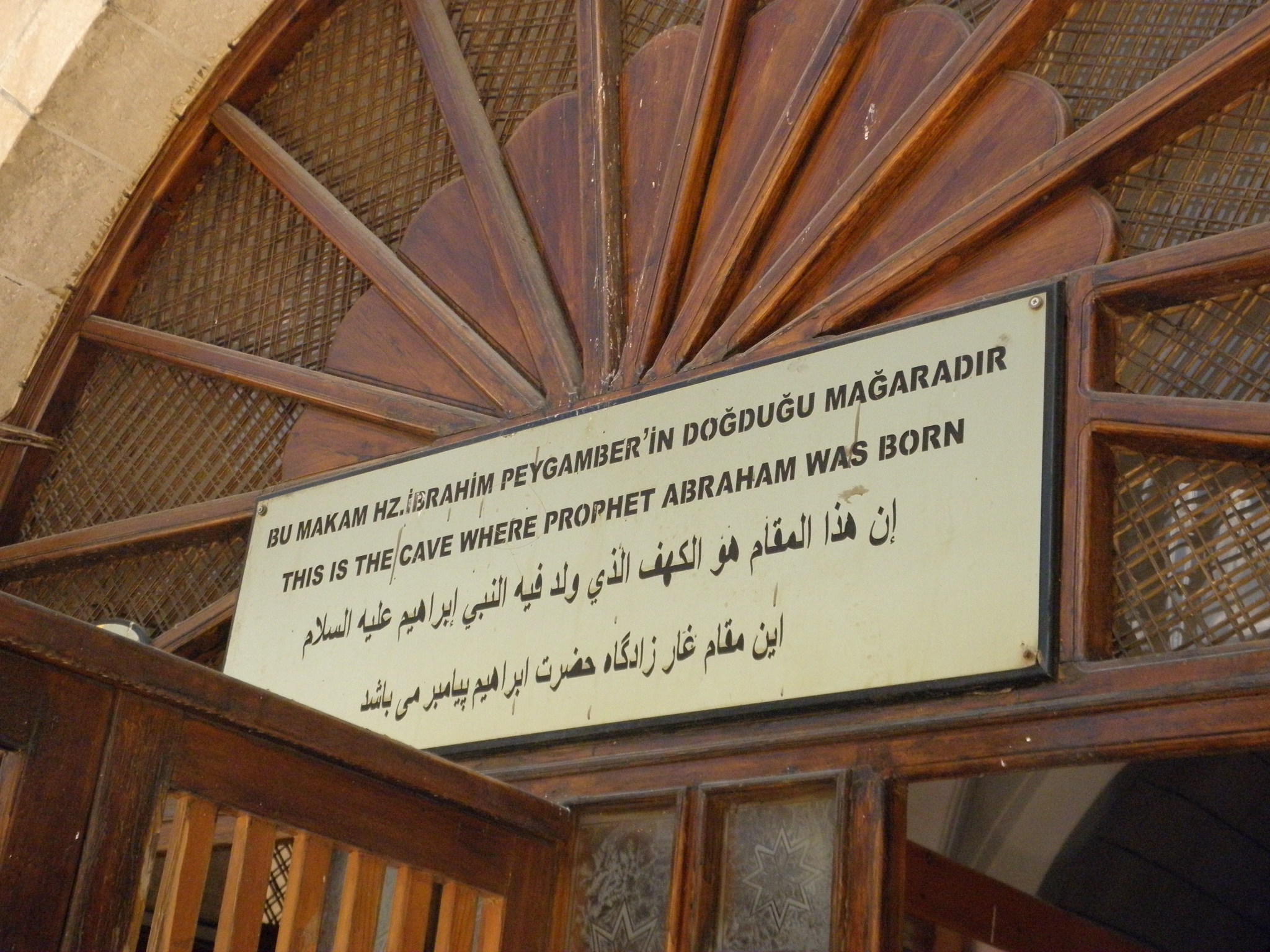
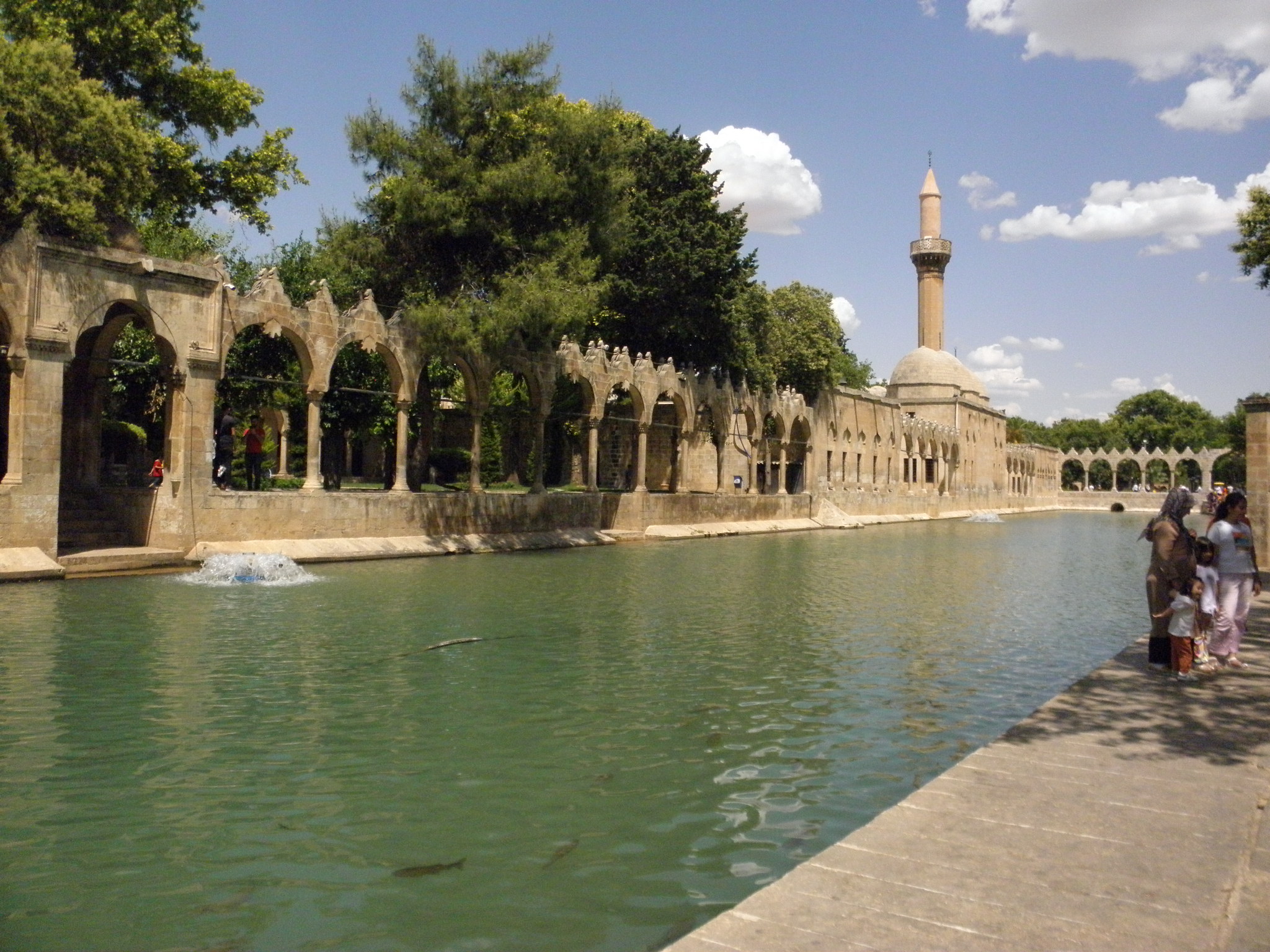
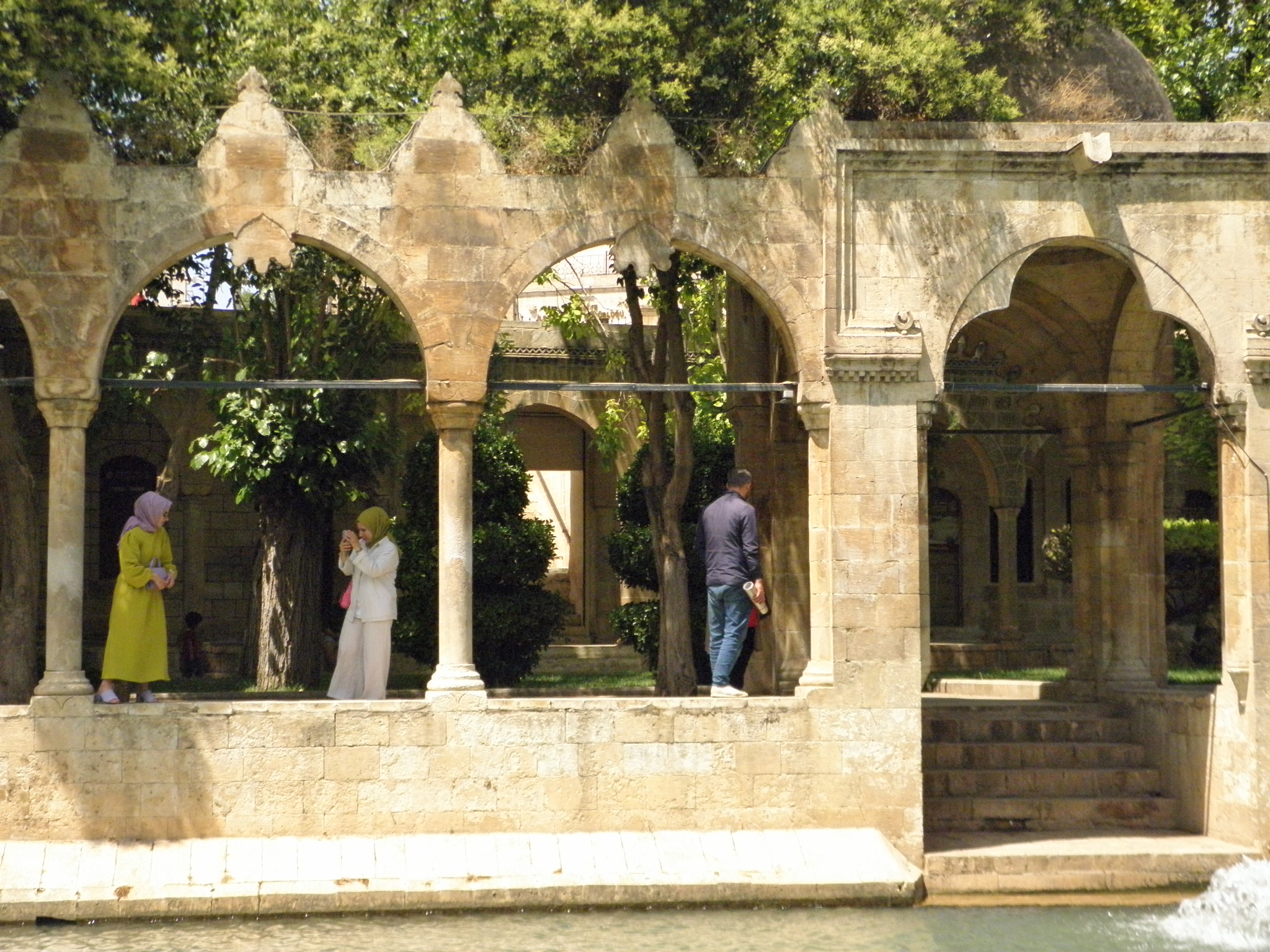
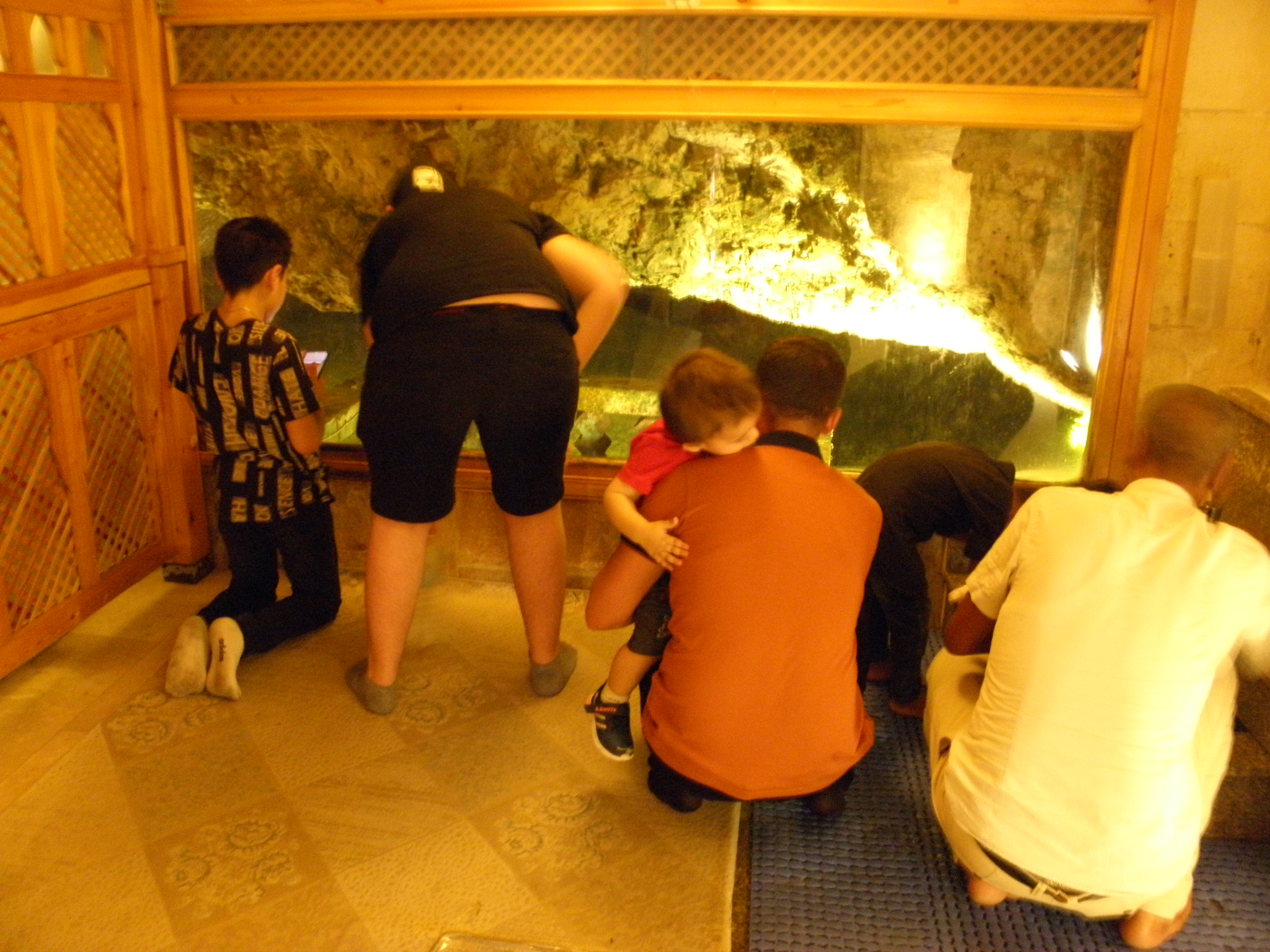
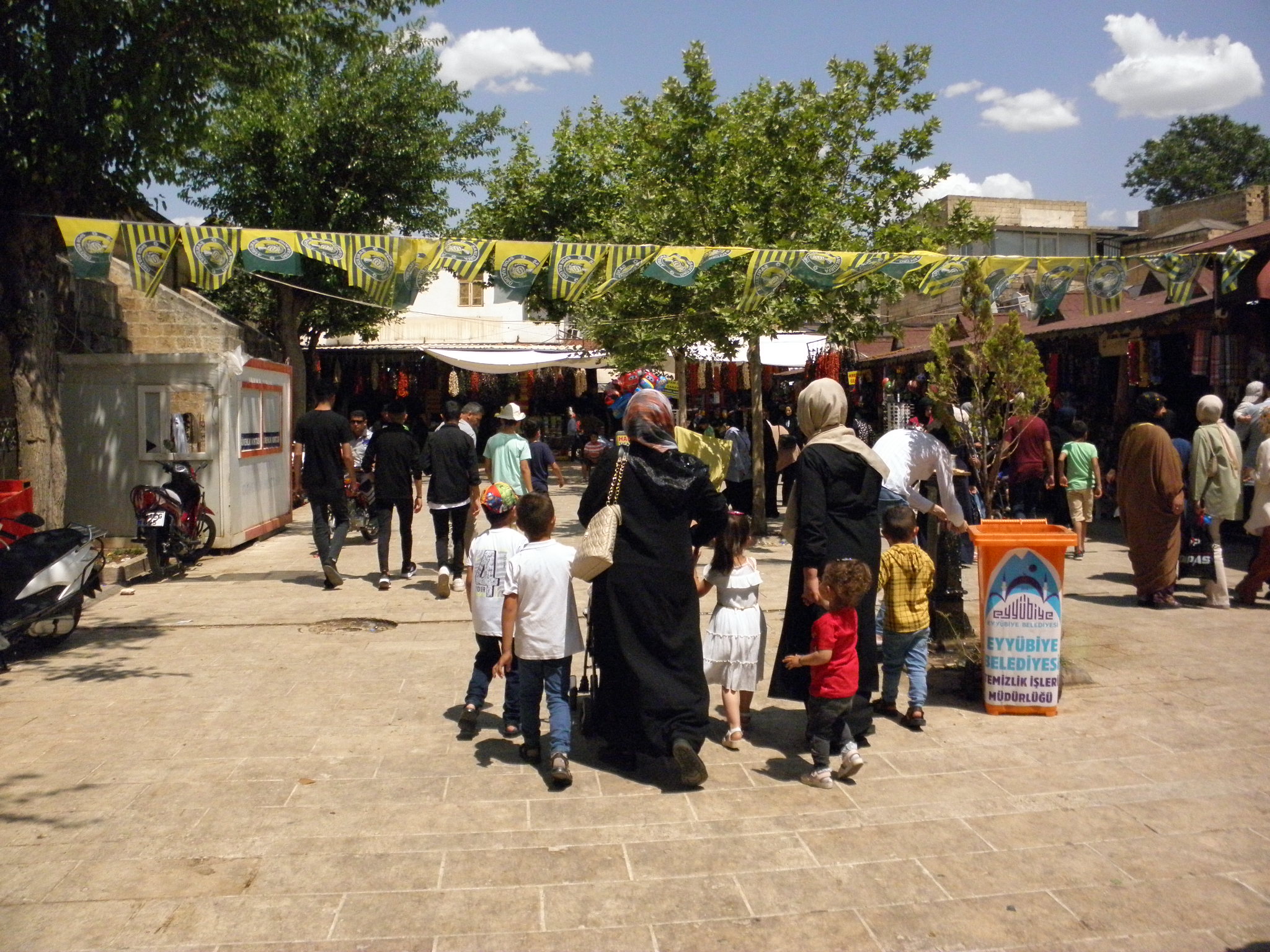
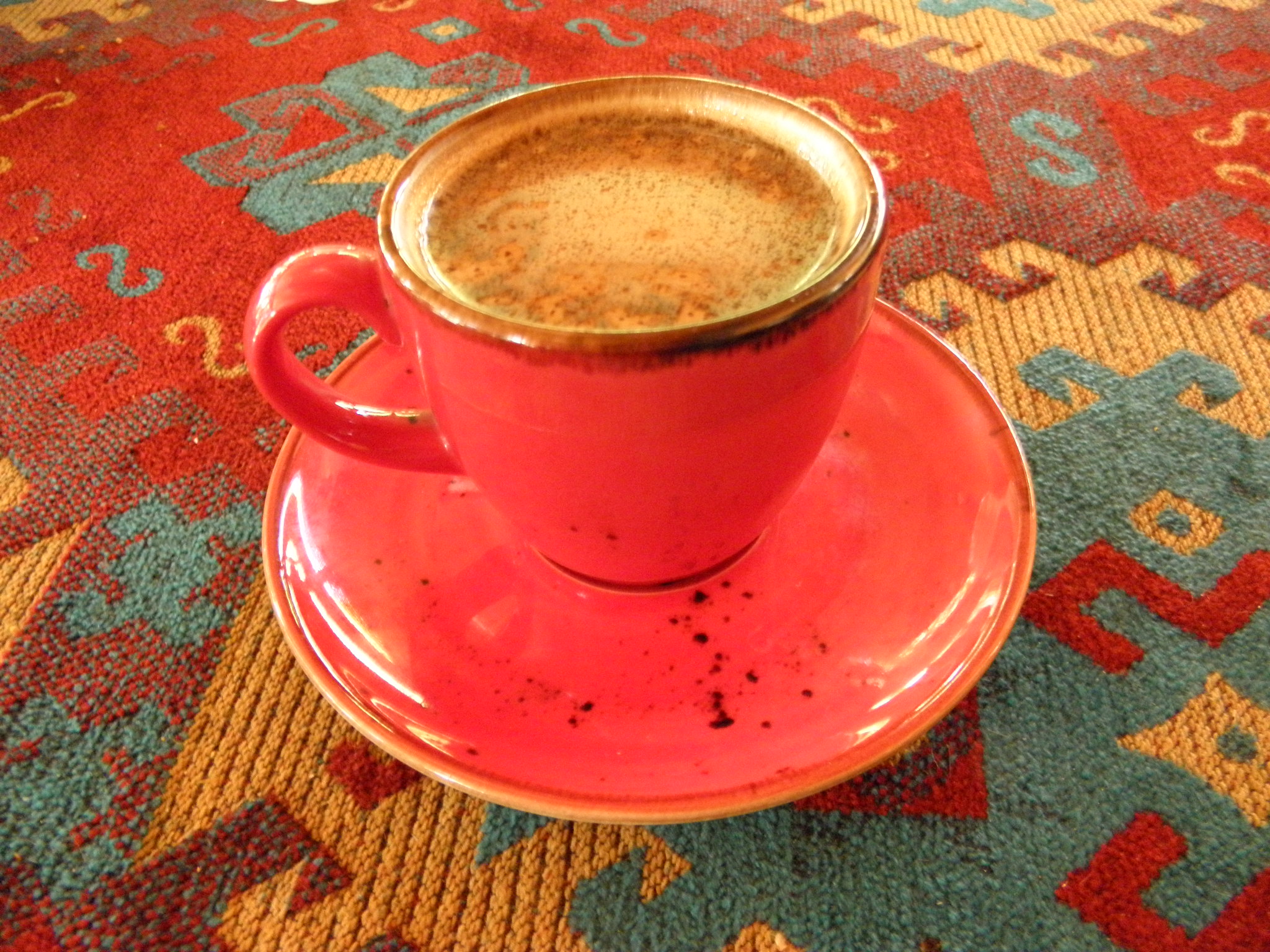
Between them, under the hill, lies Gölbaşı. This area commemorates the Prophet Ibrahim (PBUH), who was born in a cave over there, where his mother hid him for fifteen years from the Assyrian King Nimrod. Nimrod was told that a new leader had been born but failed to sort it despite having all newborns killed. But eventually he caught up with Ibrahim (PBUH). Nimrod threw him into a fire, but the fire turned to water and the coals to fish. So he threw him off the hill, but he landed in a bed of roses and came out without so much as a scratch. This is why today it is a holy site for Muslims. And why there are two large rectangular pools filled with fish backed by an iconic arcaded wall where lots of people are taking pictures of each other. But don’t try to catch a carp here. If you eat one, you will go blind, it is said. And there are carp-food sellers, trinket shops and a rose garden and the Mevlid-i-Halil Cave you can visit and cash dispensers and cafes where you can try the delicious menengiç kahvesi (a sort of coffee made from roasted pistachio beans) so good you end up having it twice.
I watched the sunrise one morning from the terrace.
The Vibe
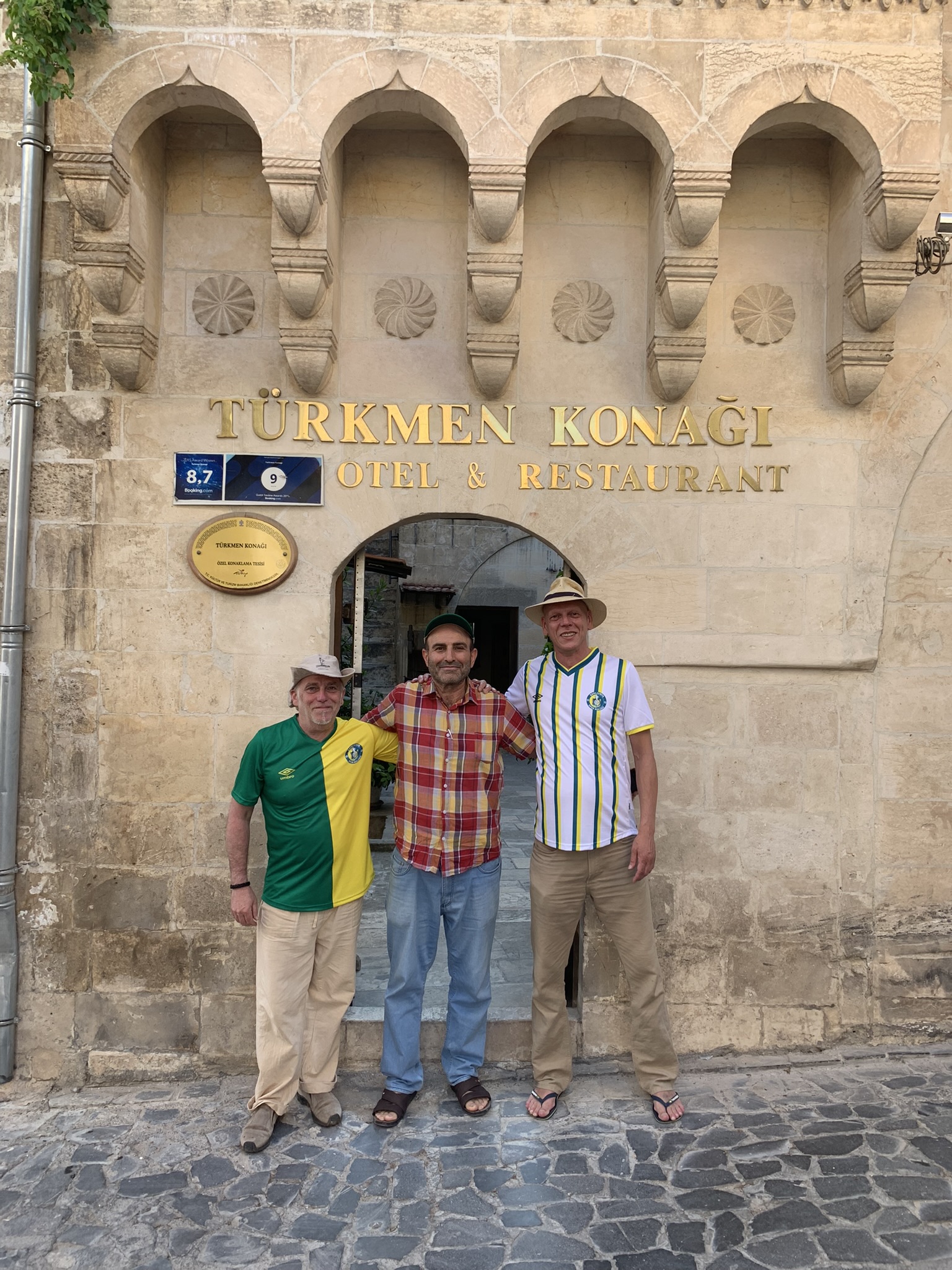
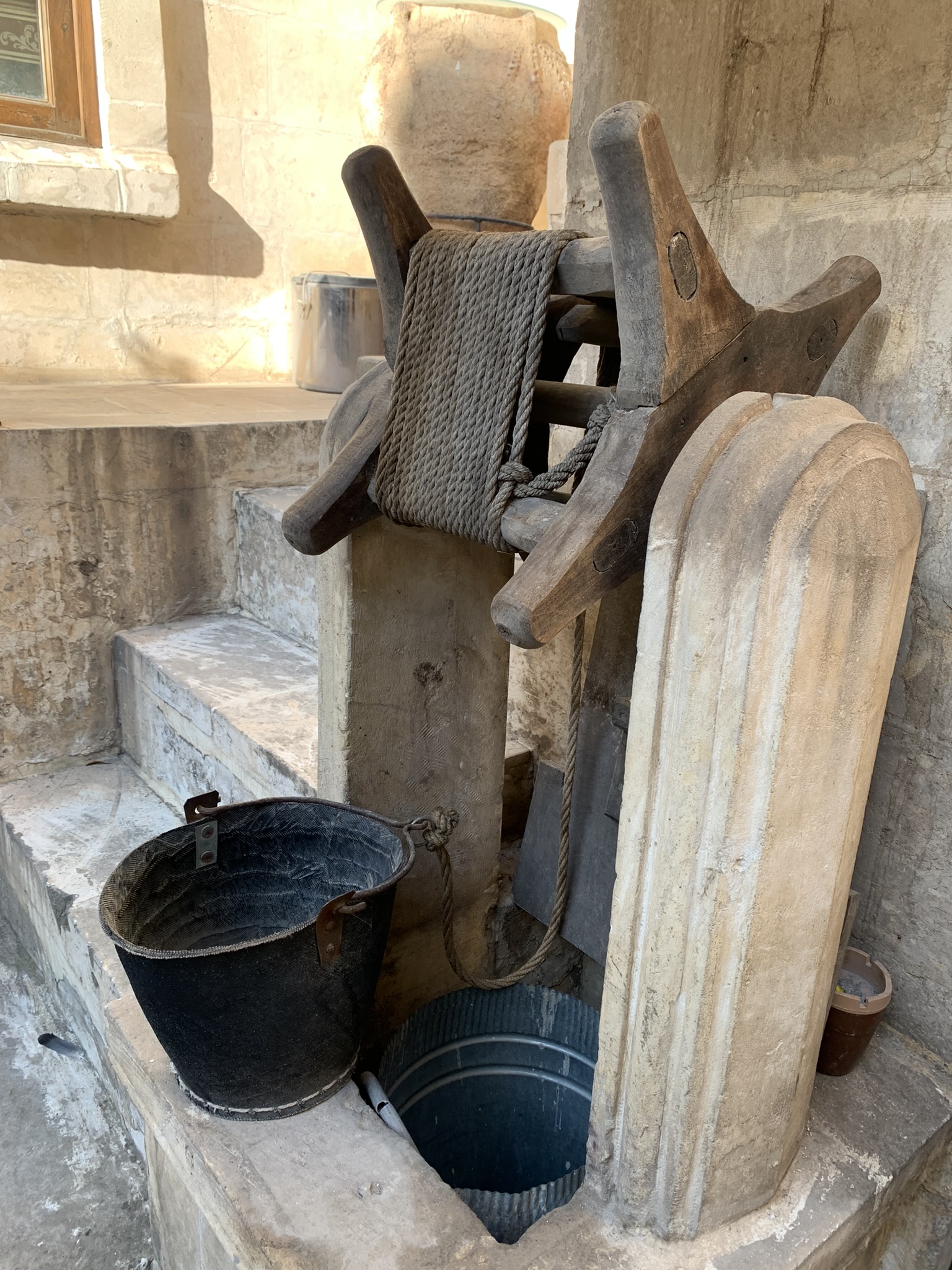
Our room at the Turkmen Konagi is an 800-year-old chamber with a vaulted ceiling. In the courtyard is a 2000-year-old well whose water is still sweet and pure. I know this: Kamil insisted I try it a from the chilled bottle he kept in his fridge. Breakfast is taken in the 800-year-old cellar, where you can also hide and shelter and find yourself safe from earthquakes like Kamil and Burak recently did. Kamil tells us to take whatever we want from the fridge to drink, just remember what you had and tell us at the end. Kamil loves the city, which he describes as a ‘mosaic’ of Turkish, Syrian, Armenian and Kurdish cultures, all happily coexisting. ‘While you are here’ he tells us, ‘this is your home.’
We spent our last afternoon, walking miles in a failed attempt to get Stu a Şanlıurfa football shirt for his collection. As usual, when we got back, Kamil sent us up to the terrace to enjoy the view and brought us some tea. He did this whenever we came back to the hotel. When we told Kamil about our afternoon, he regaled us with stories about his days as a referee and then phoned Burak to go out in a taxi and get one. Burak texted back with a photo to check the size and that the price was ok. In this way, Stu got his shirt, or rather shirts – he ended up with the home and away kits. The team had just won promotion to the top tier of Turkish football. Kamil was delighted and insisted on a photo of us wearing the shirts, and him, in front of their hotel.
In the Turkmen Konagi, we meet an American couple: Jack and his Japanese/American wife, Tomoko. It is not unusual for me to bond quickly to outrageously friendly Americans I meet on my travels. Jack and Tomoko are no exception. Mild-mannered, polite, softly spoken and fiercely intelligent, Jack speaks what seems like fluent Turkish (as well as Japanese and French). He has a shock of agreeably unruly white hair, and a lively glint in his eye, giving him the appearance of a mad professor. This is unsurprising. He is actually a professor. Of linguistics. But certainly not mad. I knew I’d like Jack almost immediately. We got talking about our respective ex-leaders. ‘The thing about Boris is that he’s clever,’ he tells me. ‘I watched him on a debate about whether Ancient Greece or Rome was the greater civilisation. And he was smart. Trump is just all about himself. But you’re right: they are peas in a pod. Compulsive liars.’ Jack was brought up in Turkey. His dad had worked for the State Department in the US Embassy in Ankara (the standard assumption is that he was a spy). Tomoko has an interest in Graham Hancock, so we had a lot to talk about. She finds herself a bit of a curiosity in Turkey as someone from right over the other side of Asia and people marvel about how far she must have travelled and are interested to talk to her about how and why she finds herself here. Jack is shortly coming out of retirement to take up a position in a University in Georgia after extended visits to Cyprus and France (Lyon, where Stu and I did our year abroad during our degree). We get to chatting about the restaurants in Lyon and the merits of French food, but not of the offal ‘andouillette’ sausages (made from pork intestines) and how squeamish people like us are about such foods. Tomoko smiles as she reminisces about brain soup (soup, that is, with a whole pig’s brain in it) or live fish. ‘We eat just about anything, if it is cooked well,’ she laughs.
Mount Nemrut – a Self-Obsessed Royal
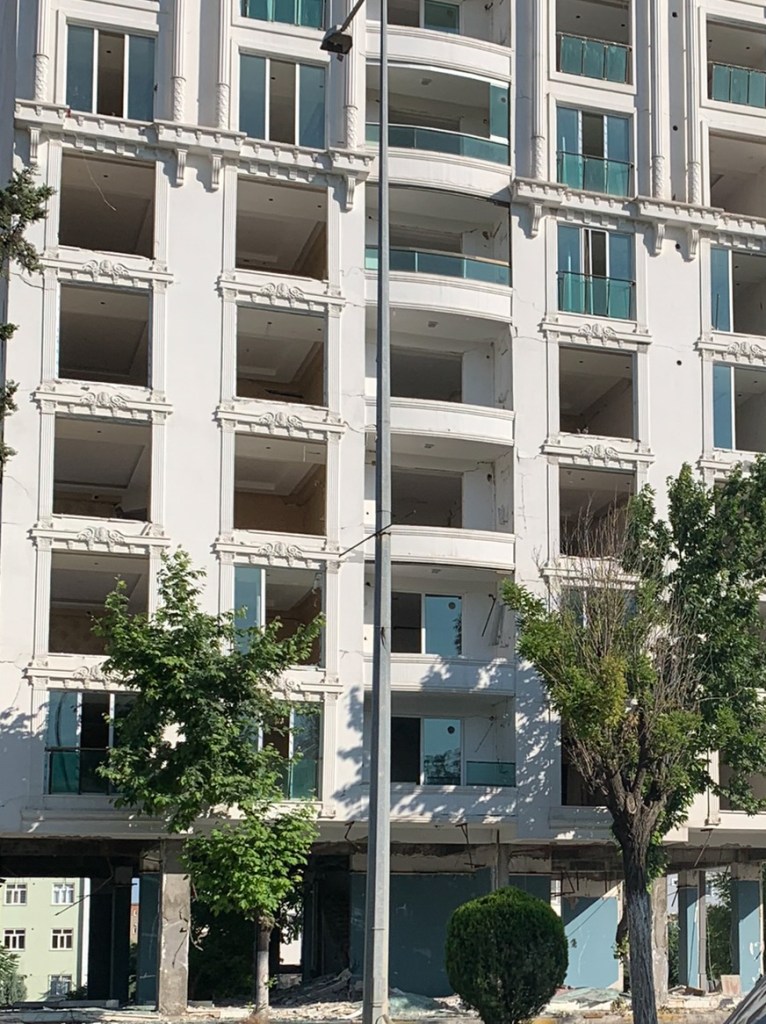
We’re not talking about the House of Windsor here: we are talking about a long day trip out of Şanlıurfa to visit Mount Nemrut, the memorial to King Antiochus. The road took us through Andiyaman, which has been badly damaged by the earthquake and looks like the result of a bombing raid. Stairwells are collapsed and open to the skies. Outer walls have been shaken out and shops and business on the ground floor of the apartment blocks are abandoned. At the edge of town is a new town of tents and shipping containers where people are now living.
Way up in the mountains, in a small village under an impressive hilltop castle, a man waves us down. He asks us to take tea in his restaurant/hotel as the tourists have stopped coming since the earthquake. We tell him we are on our way up to Mount Nemrut and will stop on our way back. And sure enough, he is there in the road on our way back, waving us down again. Stu accelerates and palms him in a firm ‘NO’ gesture, accelerating as we pass him… before slamming on the brakes and swerving back into the car park opposite. ‘I’m sorry,’ I tell him, getting out of the car, ‘my friend is a bastard!’ He saw the funny side and doubled up laughing. We had a cashew nut coffee and some food in his restaurant on a terrace with a sublime view of the castle. He was Kurdish and told us to visit his cousin’s nargileh (hubble-bubble pipe) café in Şanlıurfa which was very near to where we were staying. He even phoned his cousin and gave us a scrap of paper with the name of the place and wrote a short note to his relative. ‘I bet that says Get as much as you can out of these tourists, they tried to run me down,’ I tell him. He just smiles… pauses… and then tells me its meaning. Only a polite greeting. We did go to that café and enjoy a nargileh when we got back to Şanlıurfa. It had a great rooftop view of the hustle and bustle of street life below and people coming out of the mosque on that Friday afternoon. And no one tried to rip us off. So I guess he was right about that polite greeting.
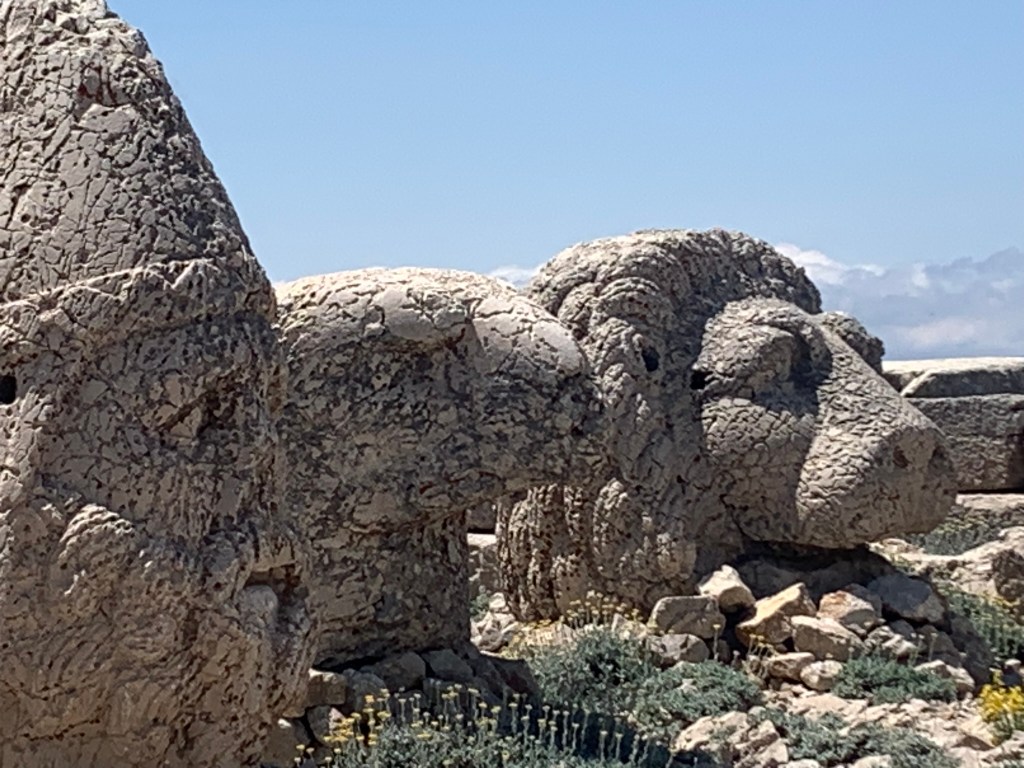
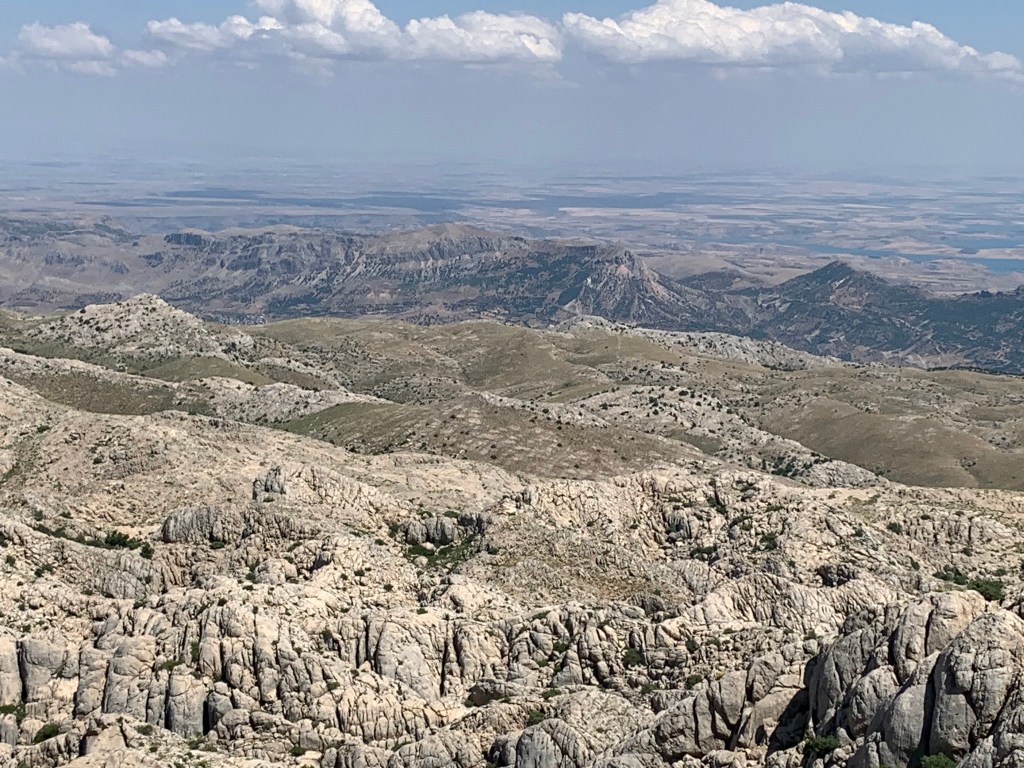
Mount Nemrut is stunning. A huge 50m high cone of small stones sits atop a 2000m mountain and at its base, on each side facing the sunrise and sunset, are lines of statues. It was commissioned by King Antiochus in about 38BC, to commemorate… well himself. The colossal statues show him and those whom he considered to be his relatives: the Commagene Tyche (Goddess of fortune and fertility); Zeus-Oramasdes; Apollo-Mithras; Hercules-Artagnes along with an eagle (representing the dominion of King Antiochus over the skies) and a lion (representing his dominion over the earth). It puts you in mind of a scene from Star Wars and you can look all the way down and across to Lake Van from up here.
OLYMPUS DIGITAL CAMERA
Alihoca
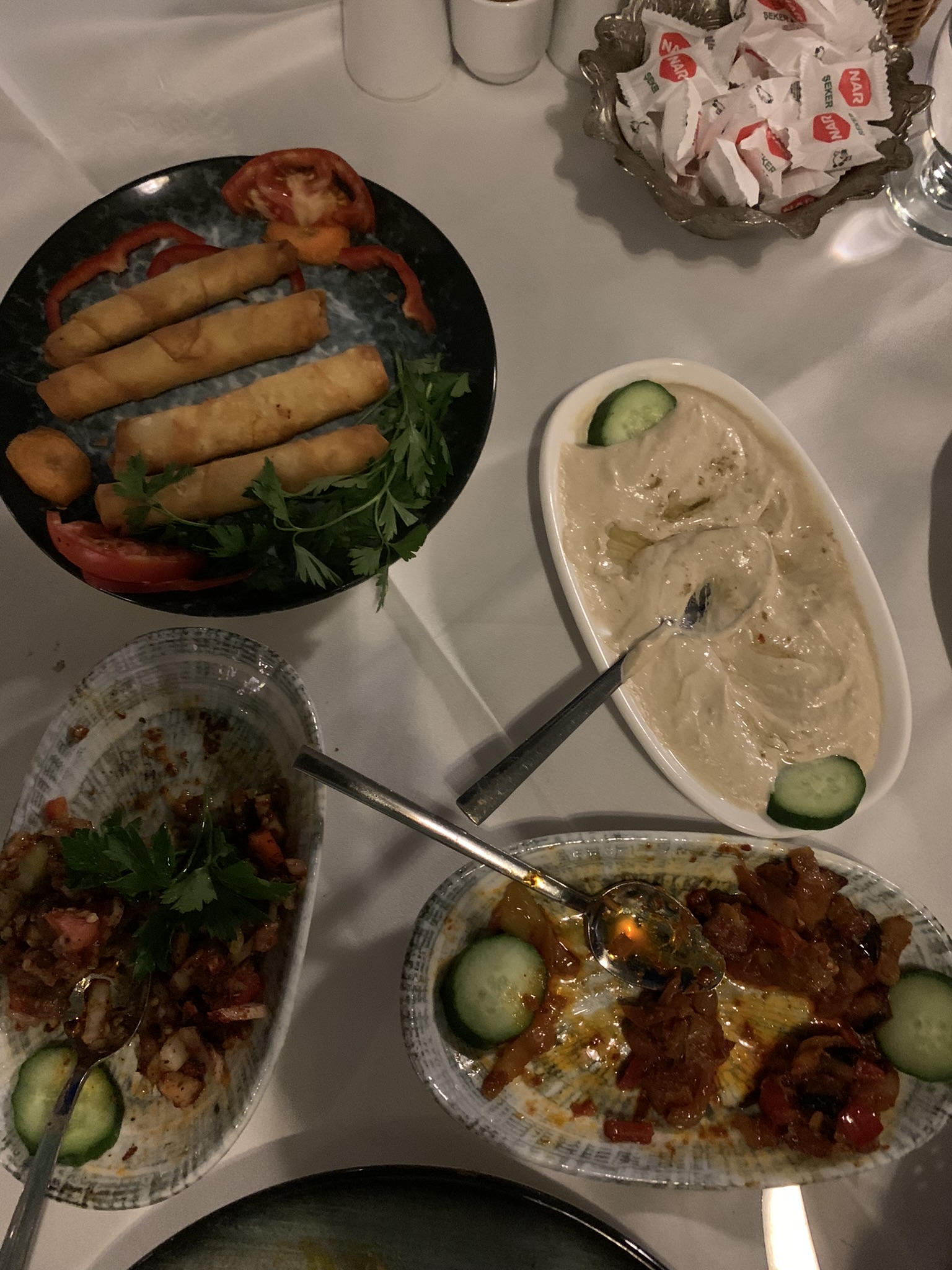
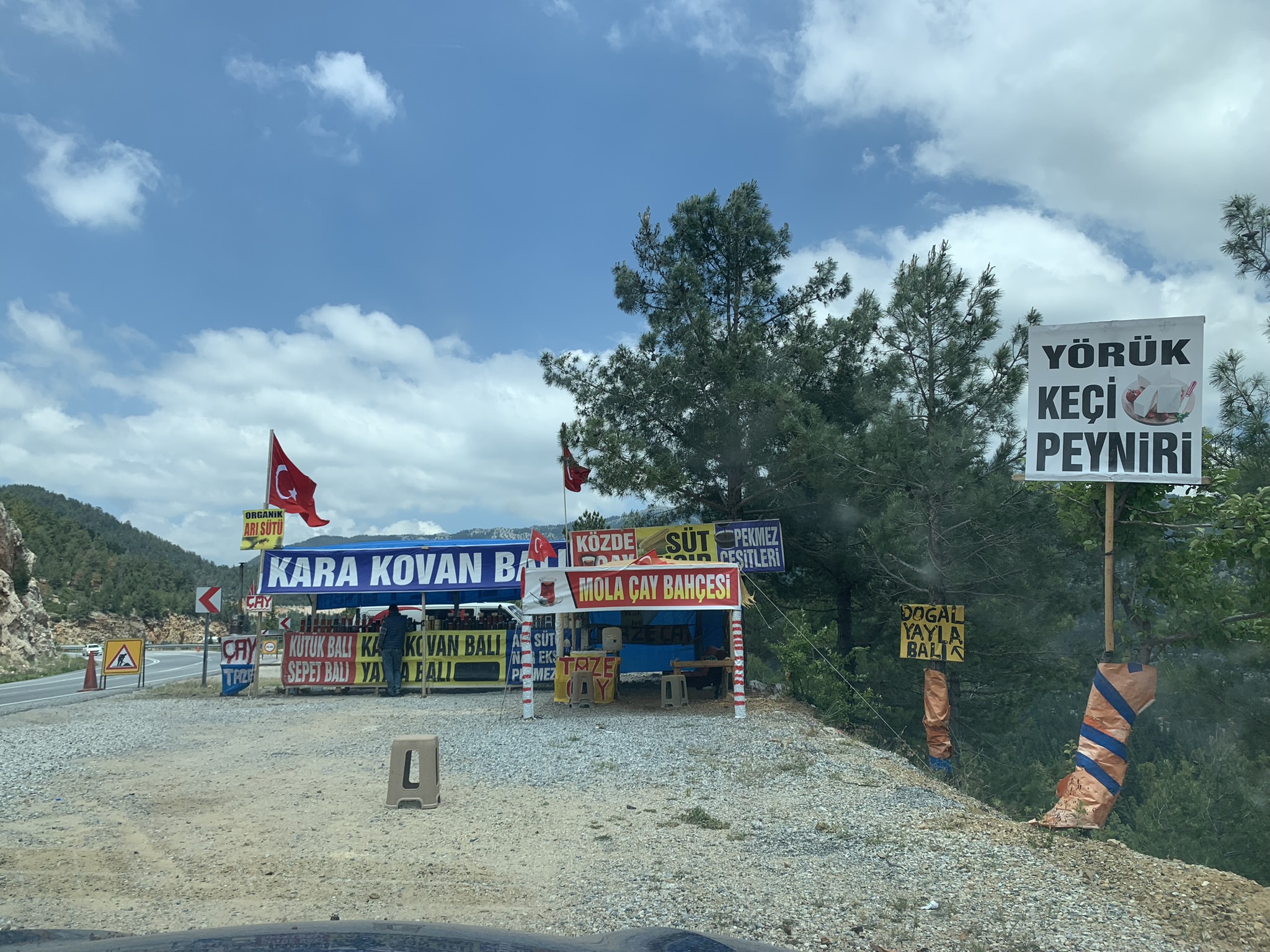
No doubt there are very good reasons for the drums topped with cones of spices that you see everywhere here in the markets. Some of these are familiar, but many are special spice mixes. Perhaps these are the secret special ingredients that set Turkish food apart. Turkish cuisine is quite simply exceptional. They often give names to the dishes that express this: ‘The Imam Fainted’ is one example, the implication being that the holy man was so bowled over by the flavour that he actually fainted on the spot. The ingredients are fresh and burst with such flavour that they make the supermarkets’ offerings back home seem watery and tasteless. The best we found was in roadside cafes and in Alihoca where we had booked an Air B&B night on the way back to Antalya.
Alihoca was on a road in the mountains that simply petered out further along and up. We got to the village and settled at a table outside a çay shop. Between our minimal Turkish and Stu’s A ‘Level German we found out that our B&B was 2 ½ km further along past the village. They wouldn’t let us pay for the tea.
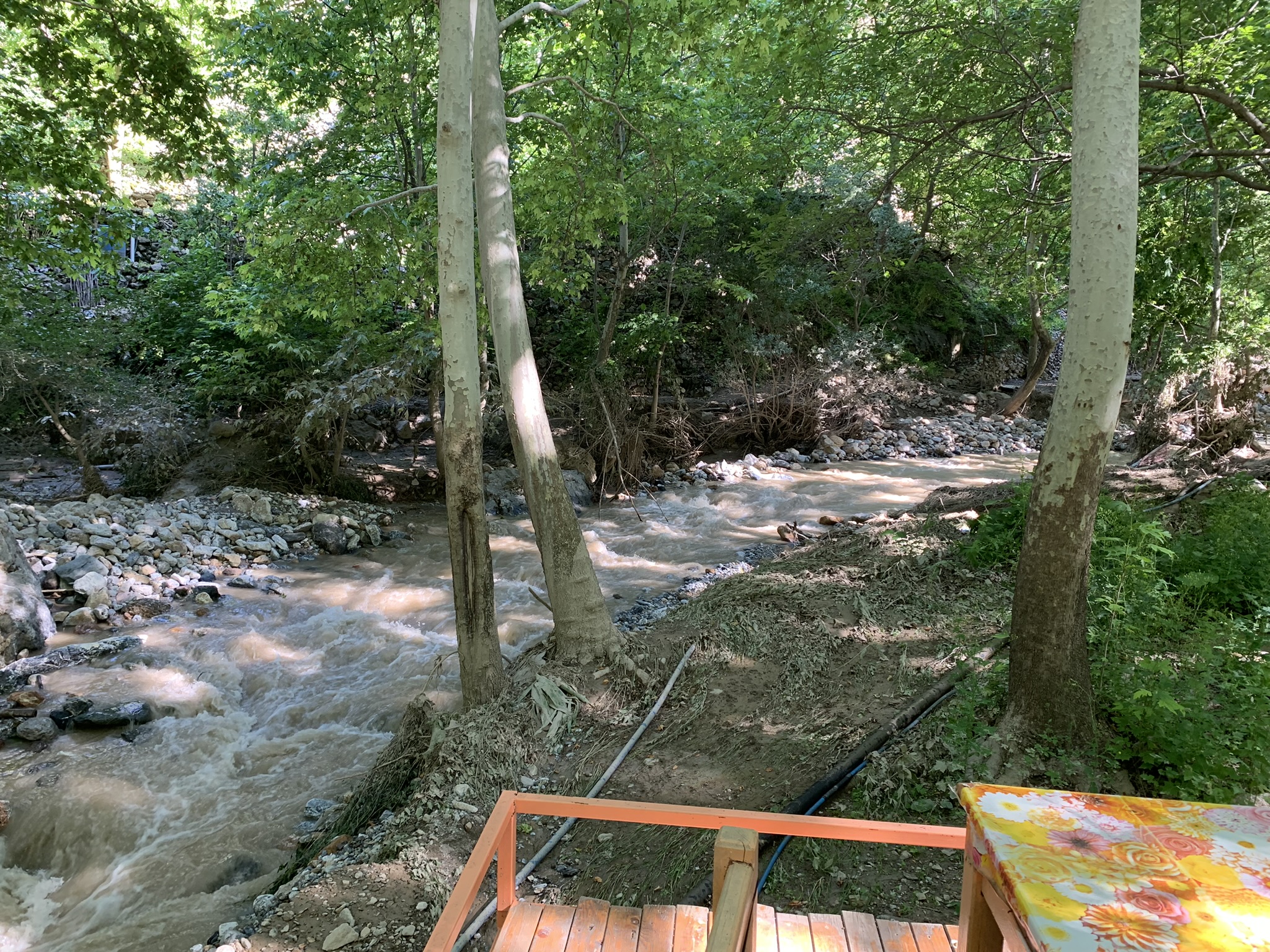
Rustic, rural and ramshackle, Damla’s place turned out to be an idyll: various collections of waterways, buildings and terraces on stilts over the water and a large house, all under a couple of imposing mountains down in a narrow valley, basking in the dappled late-afternoon woodland light to the soundtrack of a lively, tumbling stream.
Damla was actually in Germany and had only been our contact because she was the one who spoke English; the place was actually run by her mum and dad and grandparents. Her proud mum got me to speak to Damla on her phone so that she could welcome us to the family home. Here also was her uncle, Sensu, a lawyer from Mersin who also spoke excellent English, and his Syrian wife with assorted children. They were all back for Eid and as we sat in the restaurant area, we watched the cat asserting itself over the dopey dog while the whole family, six of them in all, worked together, cutting and chopping and cooking and assembling for a good hour and a half. That was what the guy had meant when he said, ‘I am preparing a meal’ after we arrived. It was preparing and some. The result was unspeakably delicious – they had cooked a special vege dish when I told them I was vegetarian.
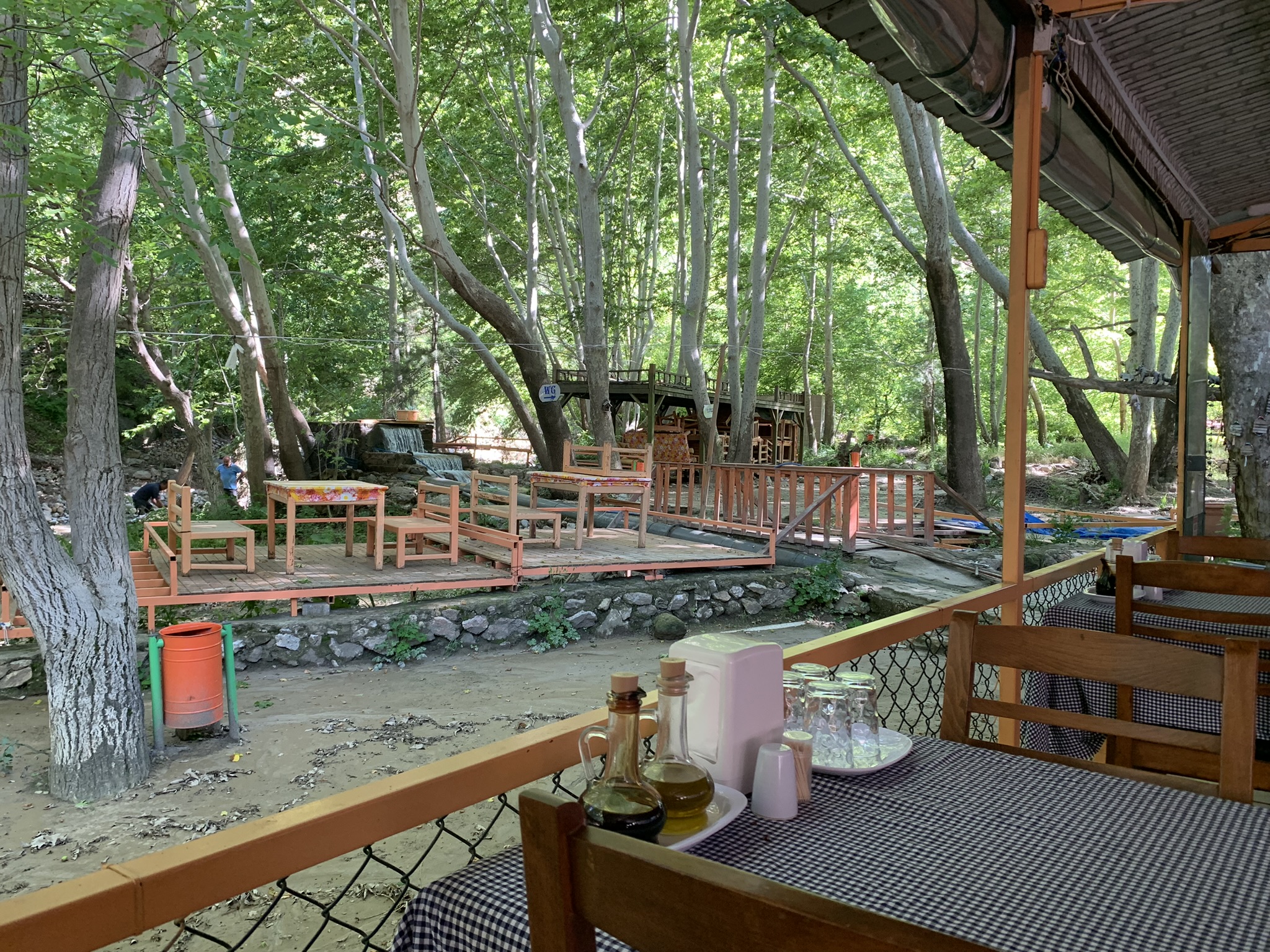
It was an idyllic spot to eat. We had a view of the large kitchen, open to the restaurant, as the family worked and chatted. Outside, a spring was gushing up and had been steered into a tiered waterfall, which in turn fed large pipes into three or four fishponds. There was a flash flood here last week and the muddy stream water got into the spring and the water from the taps was still a bit brown. Everything inside the cabins, which were on stilts above the water, was hand-crafted: from the log bed to the wallflower decorations fashioned cleverly from sawn-up branches. And they even had beers in the restaurant’s fridge. It proved to be easier to find a beer in the mountain villages than in the city of Şanlıurfa.
Taşkent, Butterfly Valley and Termessos
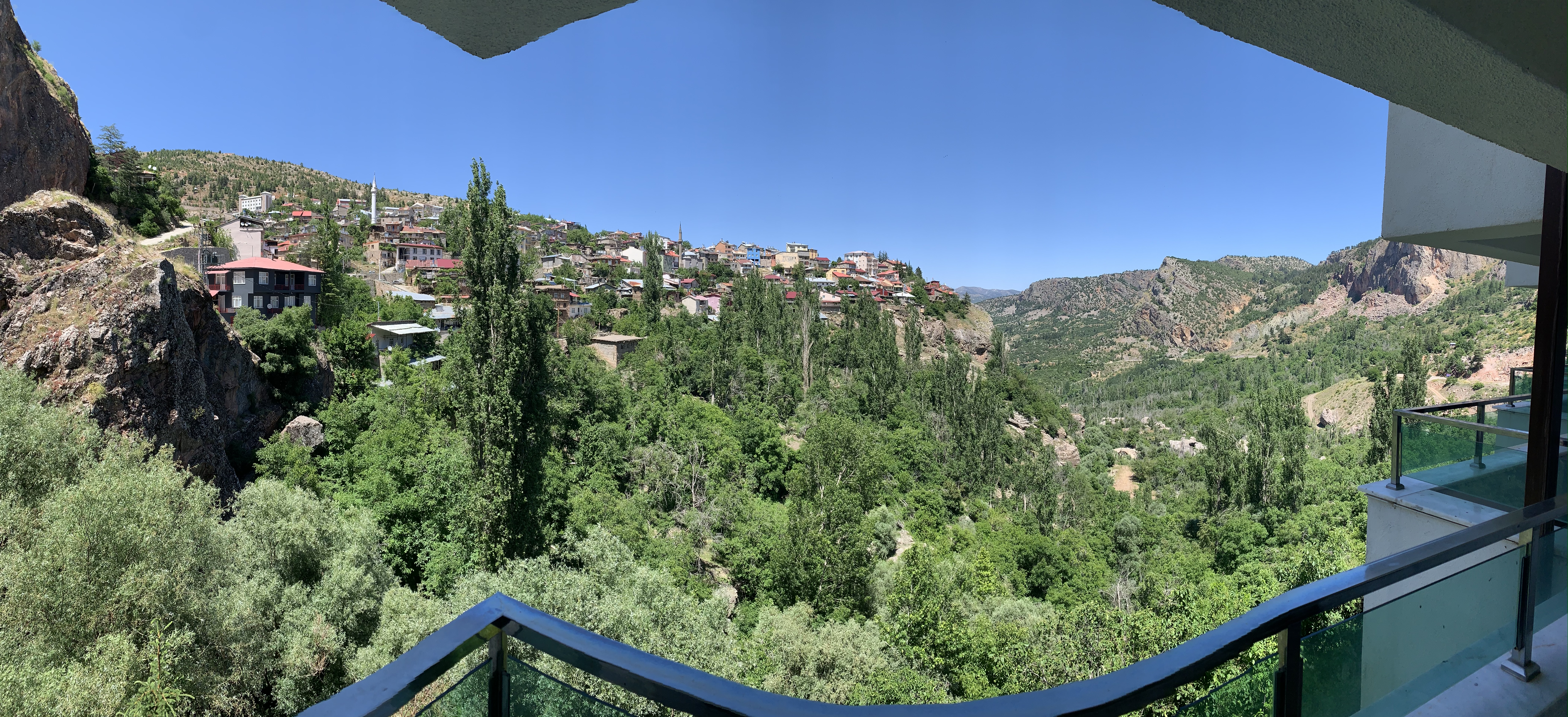
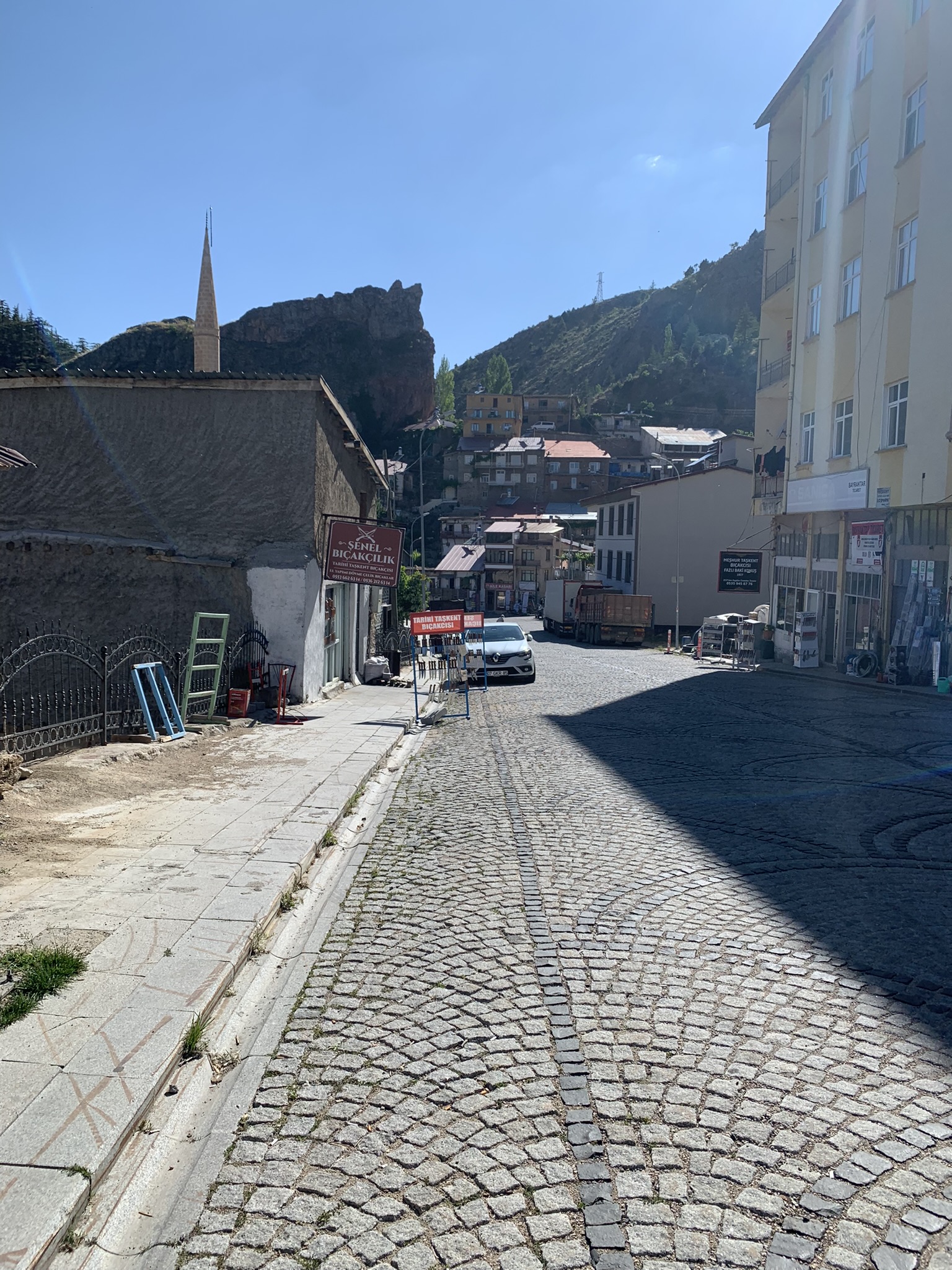
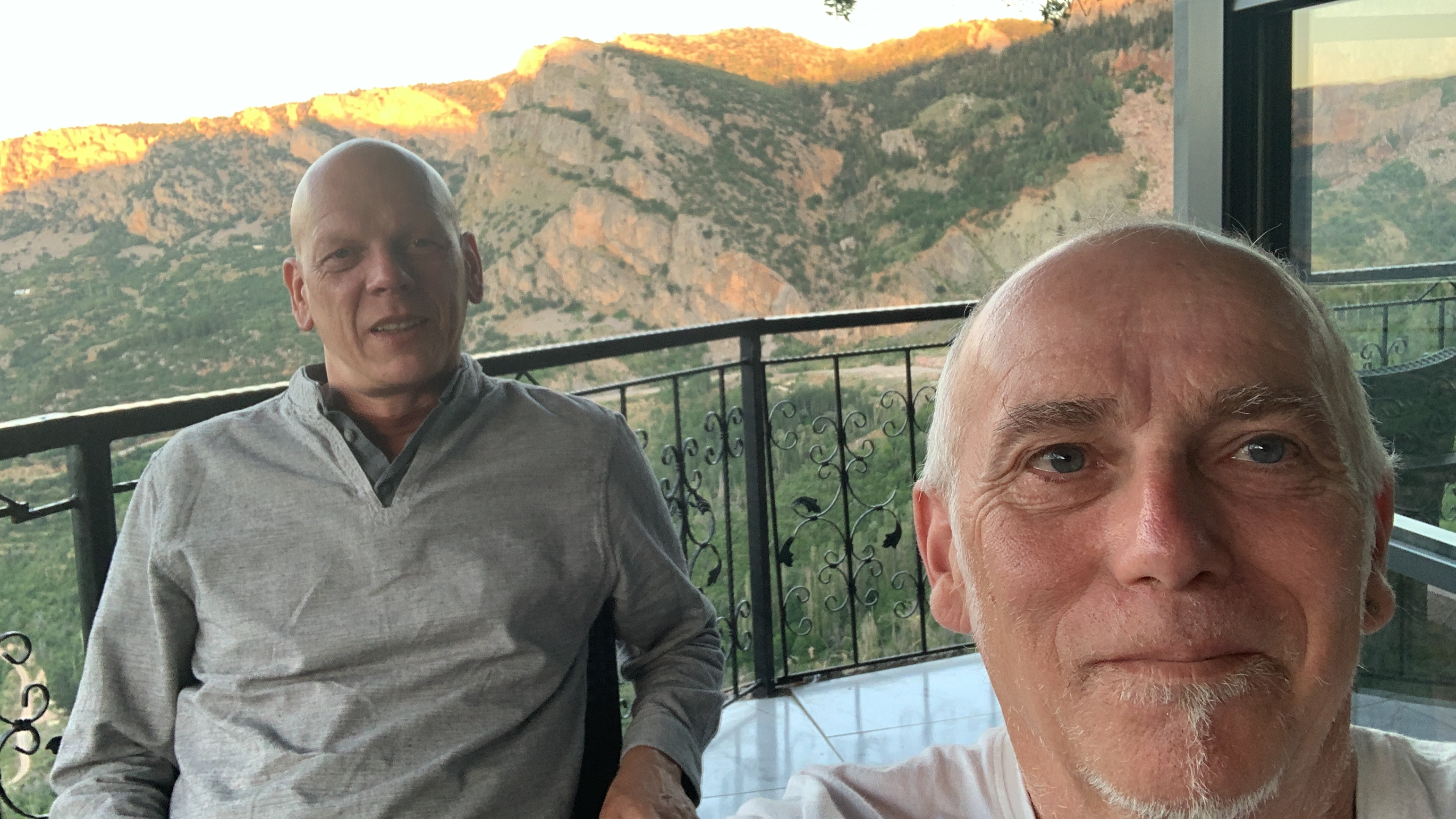
Taşkent is a university village, rather than town. Apart from the university buildings, there is a small shop which sold beer and we spent an afternoon in a park just drinking in the mountain landscape and feeling peaceful. The hotel, like many of the buildings here, clings to the side of a cliff face. In the evening, we watched the swifts darting and swerving in pursuit of their supper. The mosque-call is sent echoing back from the mountains opposite and in town the barber’s shop is doing a roaring trade in cut-throat-razor wet shaves, while the local pack of village dogs are chasing an interloper out of town.
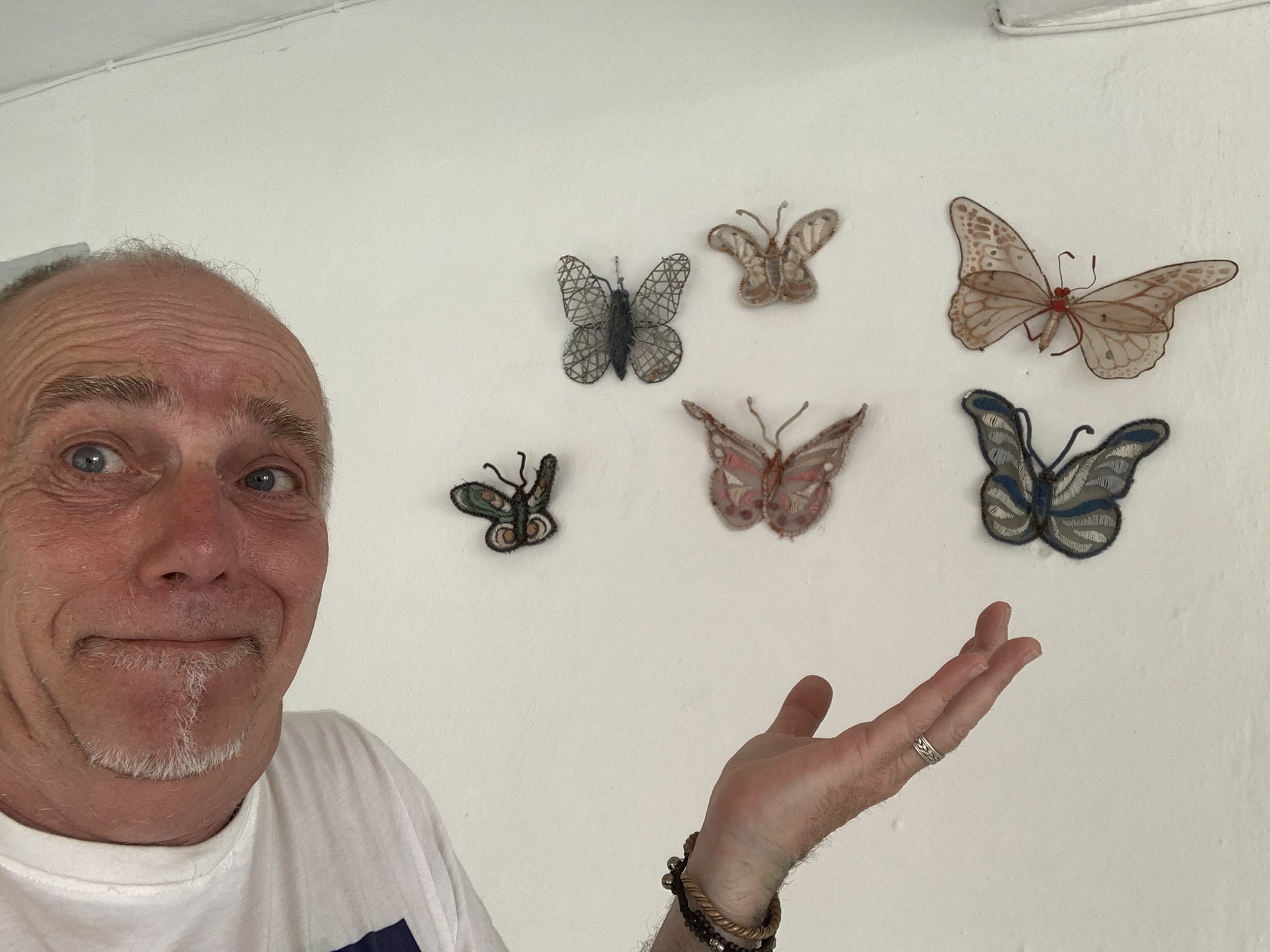
Butterfly Valley was a long drive from here, back past Antalya and we reached there in the early evening. We got to right above the beach where the bell tents were pitched only to discover that the only way to get there was to take a boat from the town up the road and the last one left an hour or so ago. So, our ‘glamping’ accommodation for the last night never happened and we had to improvise a one-night stop in a small guest house. It was disappointing. The nearest we got to the butterflies were the wall decorations in the guest house.
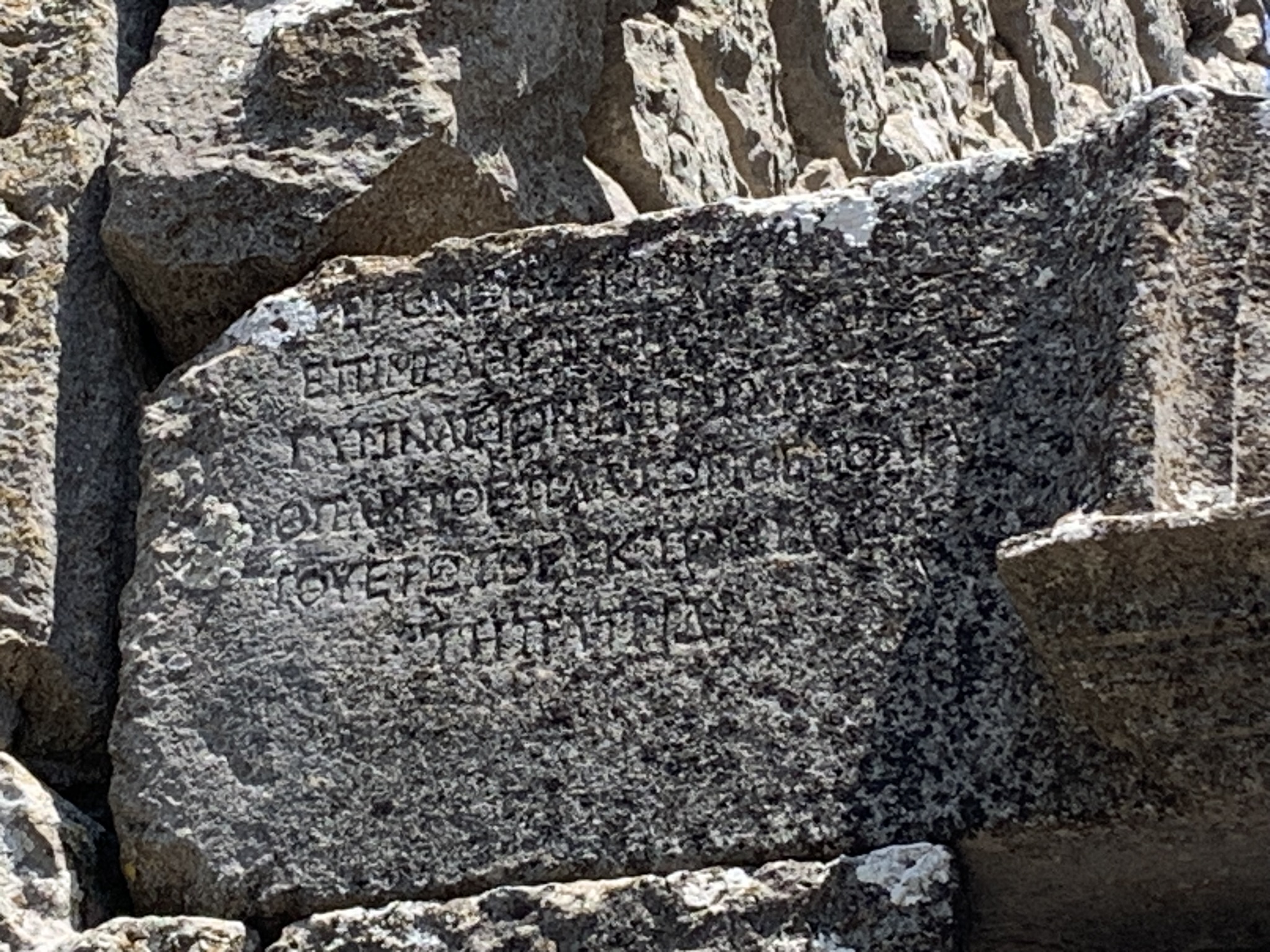
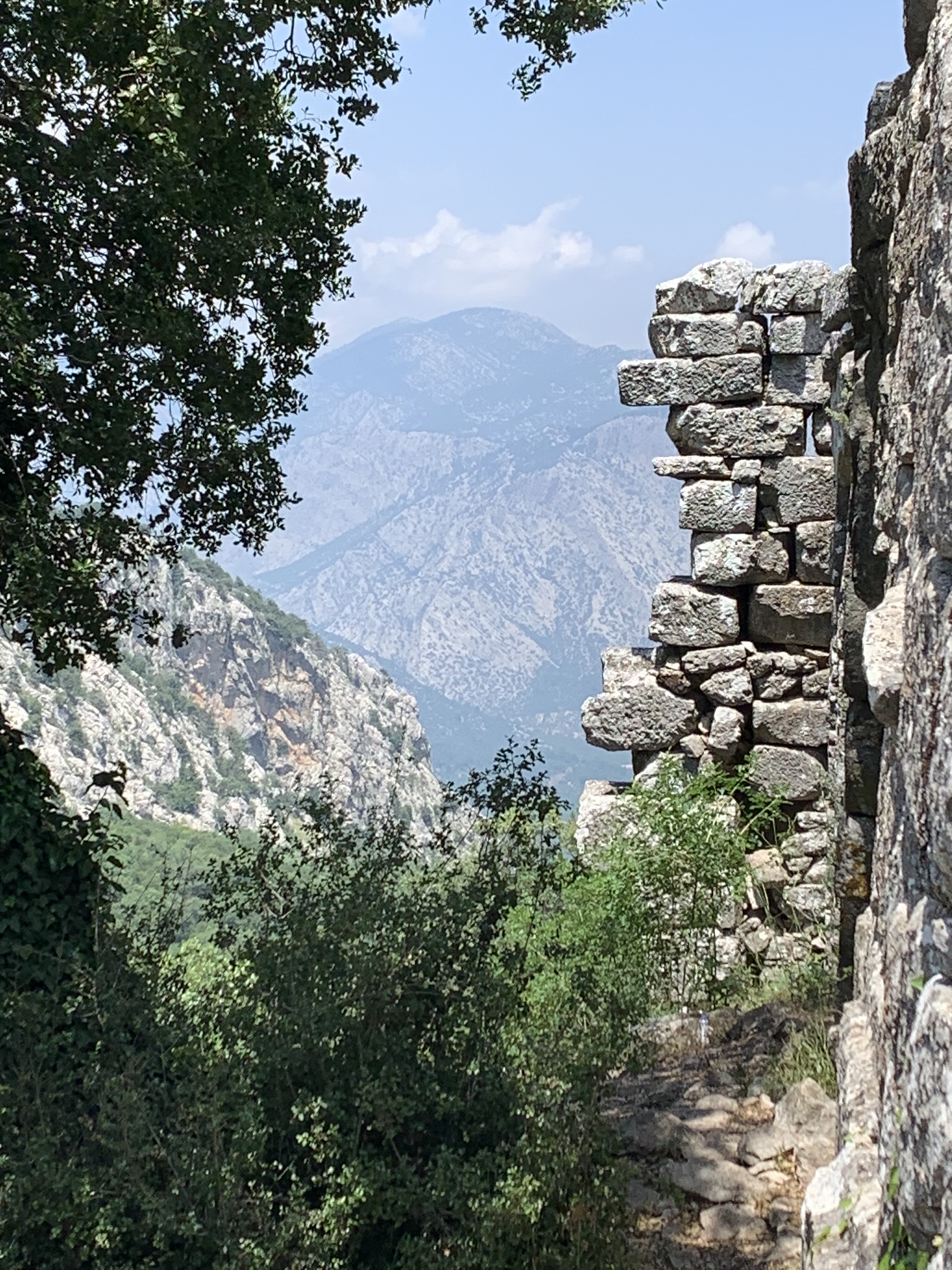
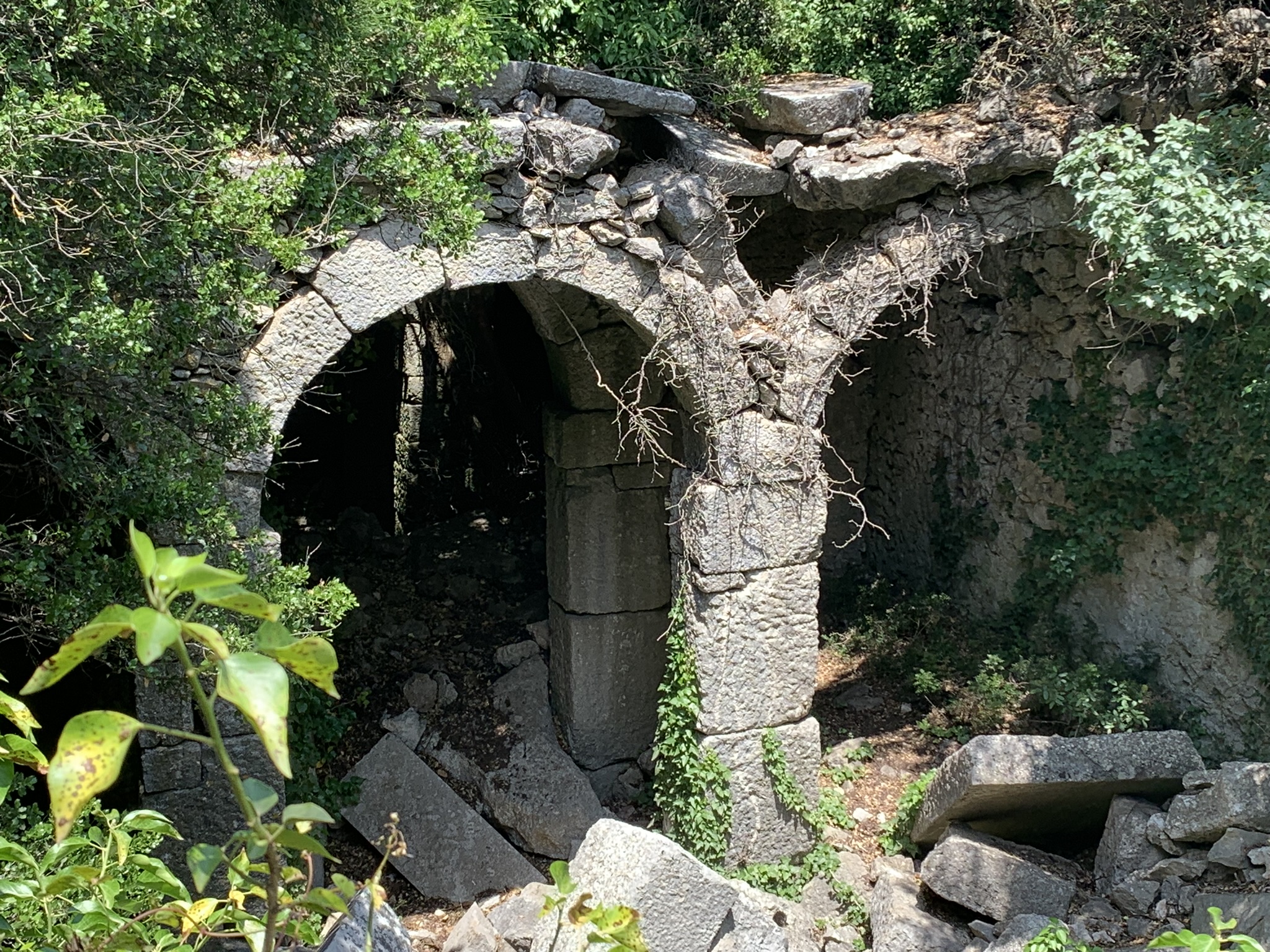
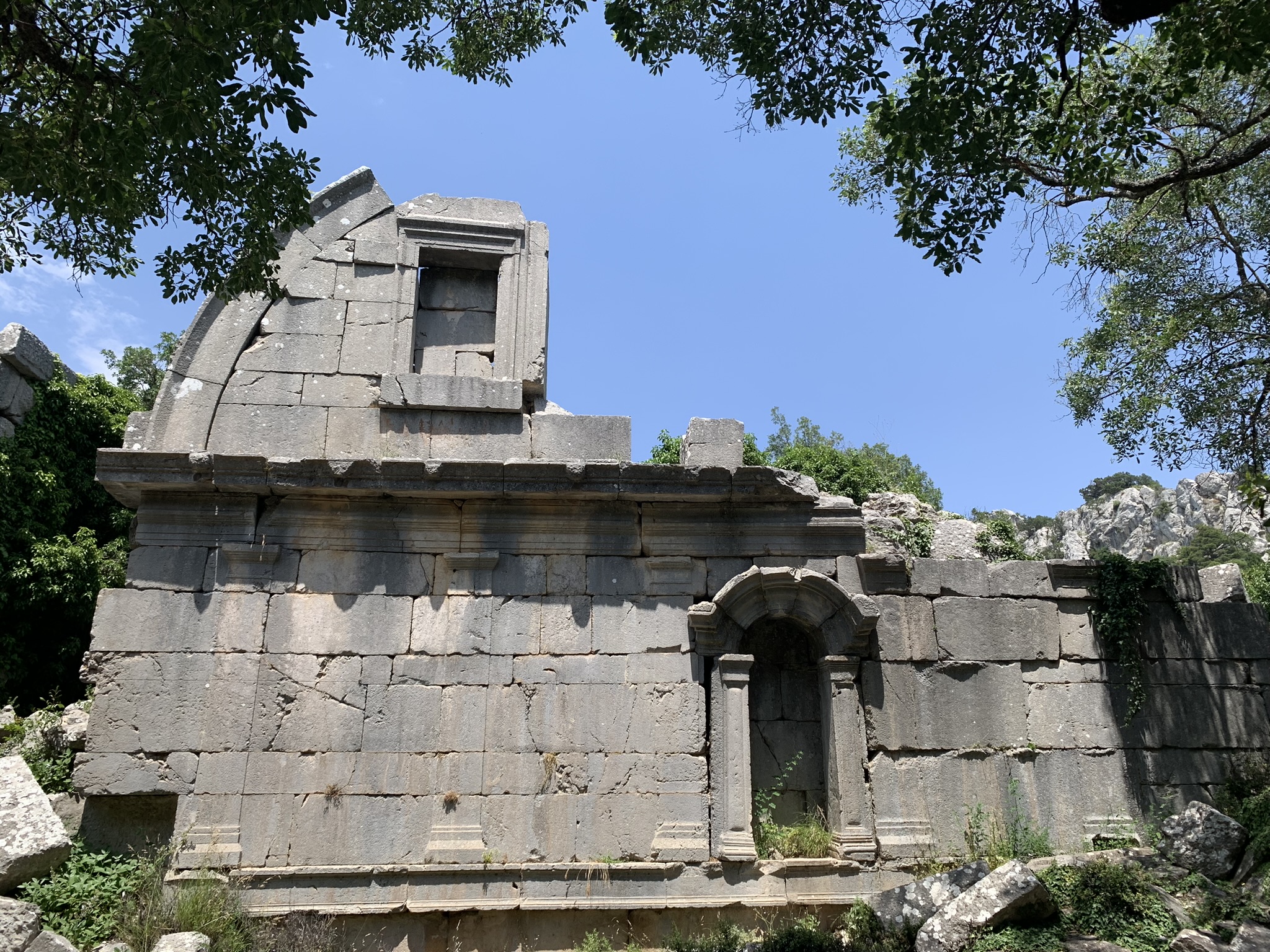
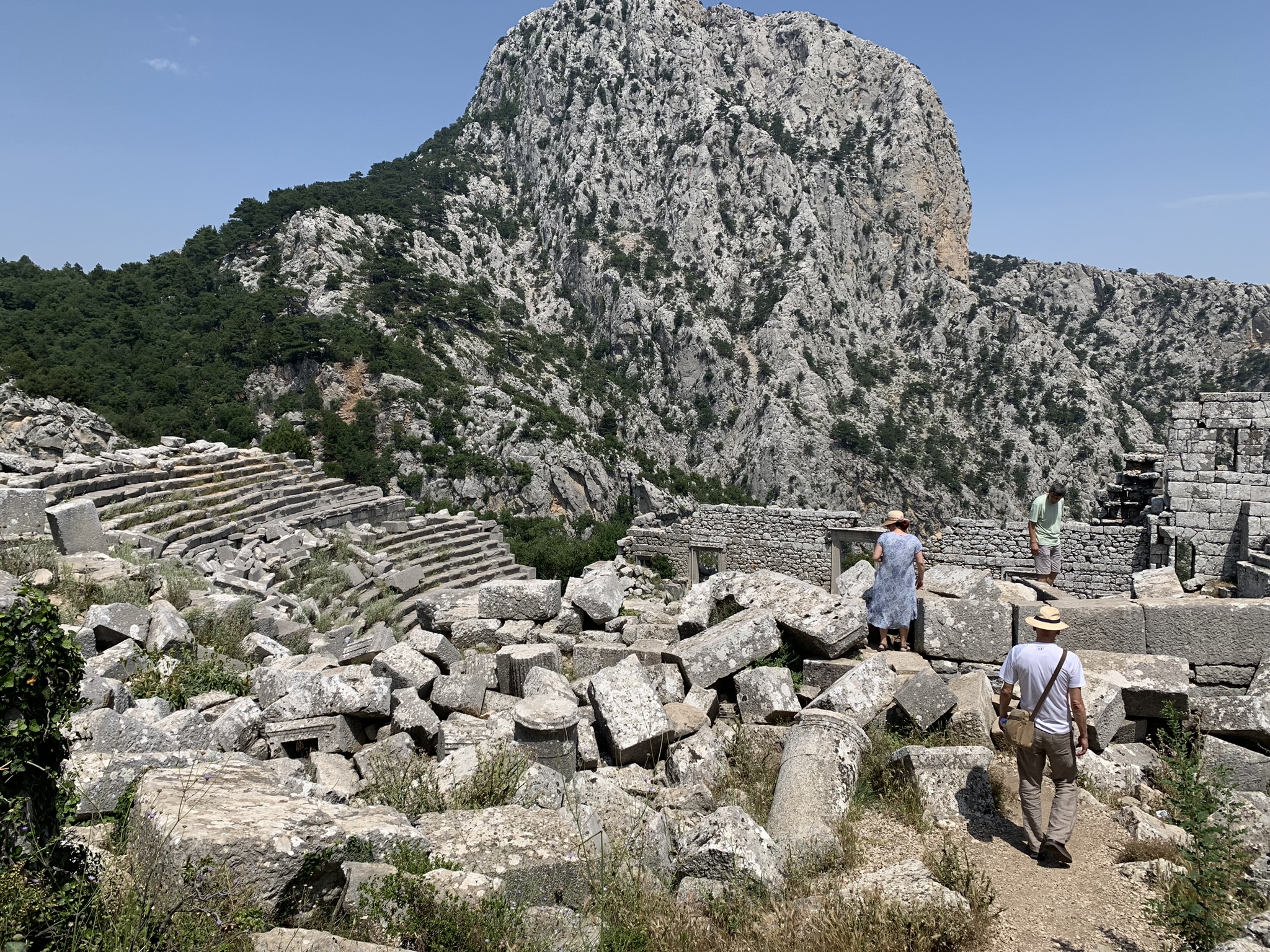
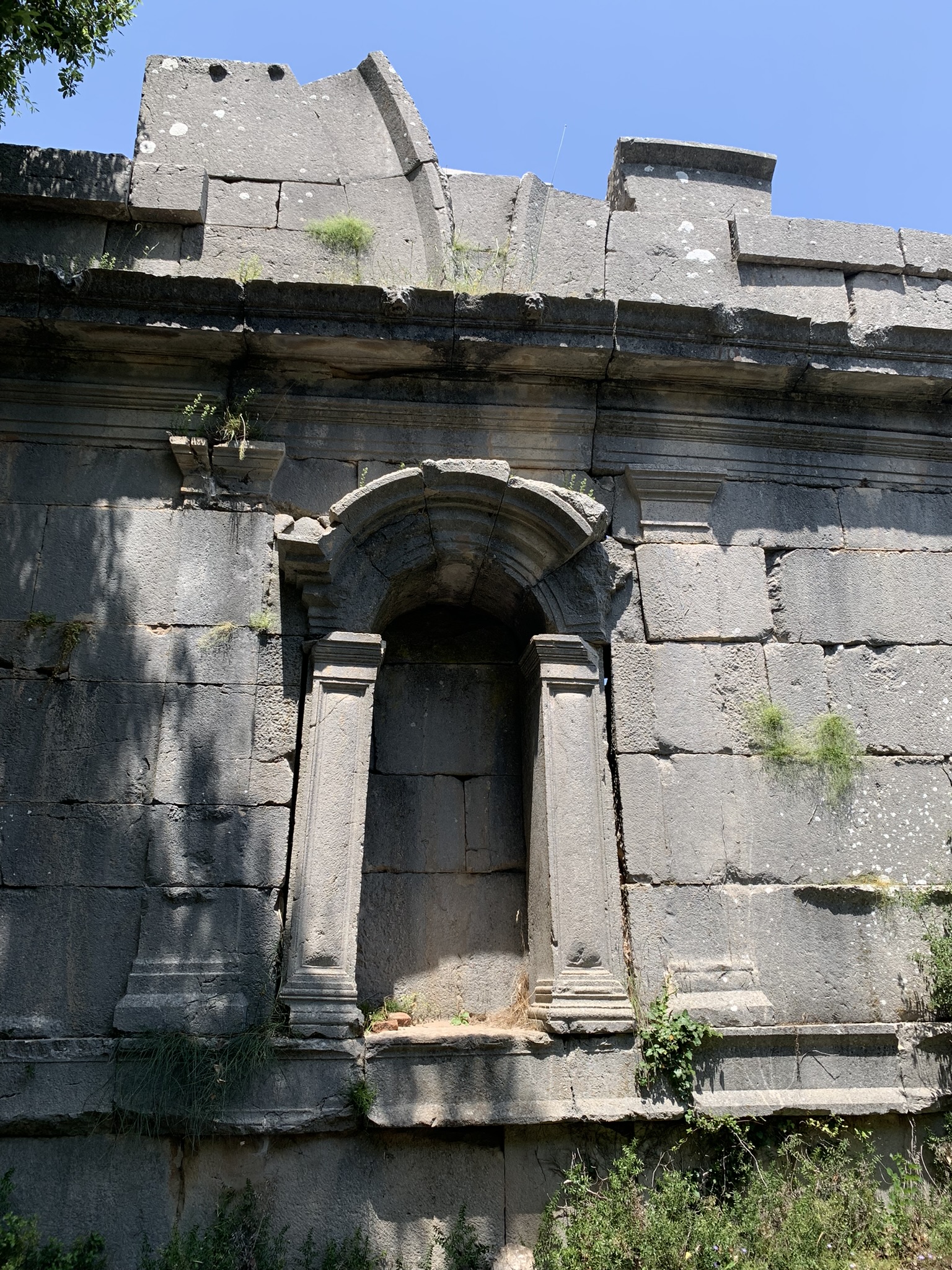
But we did luck out on the trip back to Antalya, stopping off at Termessos. Termessos was a Pisidian city state. It was obviously quite sophisticated, with temples, marketplaces, stout city walls, cisterns and even an amphitheatre. The citizens had a bit of a reputation and in 333 BC saw off Alexander the Great who failed to take the city. After this, when the Romans invaded, they were not up for the fight and did a deal with Termessos whereby they would leave it alone to get on with its mountaintop business rather than try and defeat it.
Back in Antalya, we head back into town before our flight and take a last meal. The waiter recognises the Göbekli Tepe motif on my hat and is interested as he comes from the area. Even though the restaurant didn’t serve alcohol, he offered to go and off get some beers for us, which was served in paper coffee cups. It gave a satisfying symmetry to the trip: back where it all started. And what a trip it was!
Stories of teaching and travelling. Mark Twain -Travel is fatal to prejudice, bigotry, and narrow-mindedness. Henry Miller – One's destination is never a place, but always a new way of seeing things.





































































































 WheatyPete's World