

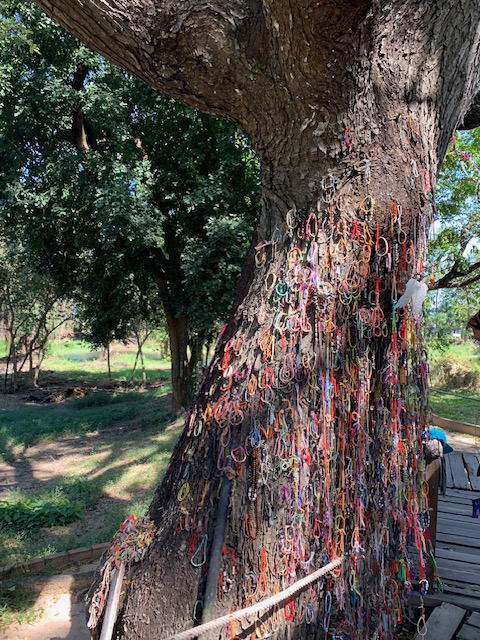
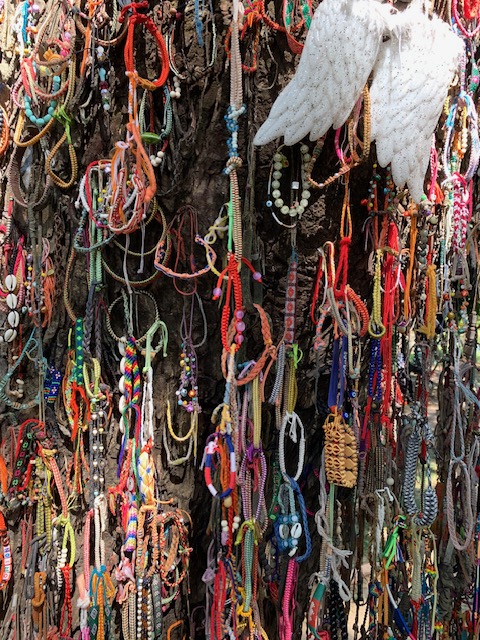
There’s one tree, of an impressive girth, that stands out from all the others at the Choeung Killing Field Memorial just outside Phnom Penh. Its trunk is festooned with brightly-coloured necklaces, angel wings, bangles, and ribbons. Although the place has the appearance of well-kept gardens, the atmosphere is sombre and you can get an audio guide that tells the story, with testimonies from some who were there. The tree is known as the Killing Tree and is a garish splash of colour in the green surroundings. It is called the Killing Tree because it was the chosen instrument of execution used in the brutal murder of young children and babies who were picked up by the feet and dashed against the trunk. They know this because of witness statements and the bits of skull and brain matter found embedded in the bark. The regime did not want to run the risk of the children of adult victims growing up with revenge issues so it decided to nip it in the bud in this indescribably cruel way. And bullets were too expensive to waste on slaughtering infants.
The Khmer Rouge under Pol Pot took power in Cambodia (which they renamed Kampuchea) in 1975 after a five-year civil war: about the time I was going through the final years of secondary school. By the time they were thrown out by the invading Vietnamese in 1979, somewhere between 1.7 and 2.5 million people had lost their lives through murder, starvation or disease directly attributable to the dictatorship. This was out of a population of about 8 million. It is the Vietnamese who were responsible for the plethora of people with missing limbs, victims of the landmines they left behind and are still a problem today. The Killing Field Memorial is just one of some 300 Killing Fields throughout Cambodia. Many of these are inaccessible nowadays due to jungle encroachment or dangers from the surrounding minefields.
So what brought about this genocide? Why would anyone do it? The truth is that you can uncover the facts, but understanding the mindset of such dictators as Pol Pot is probably beyond most of us. Pol Pot became a communist as a young man when he was living in America. He greatly admired Chairman Mao and had a vision of an agrarian socialist republic for his country. As soon as he seized power, all the schools and government offices were closed. The cities were emptied and the inhabitants marched out to labour camps in the countryside to work the land. Many died from malnutrition or disease. Many had not the faintest idea of how to work the land.
Everything from the West was banned, including medicines. Doctors were outlawed too and had been sent to the countryside along with any other intellectuals anyway. Child/teenage medics took their place and had little or no training. They performed medical experiments on enemies of the state, without anaesthetics. One horrific witness report tells of one victim who was cut open and had his intestines severed then crudely rejoined so that they could learn about the healing process.
When the Vietnamese invaded, Pol Pot fled to the jungles across the border into Thailand where he hid out and from where he still led the Khmer Rouge. The party was still recognized by the international community as the legitimate state rulers of Cambodia and conducted guerilla warfare from their base, hidden in the dense forest, right into the early 1990s. The party eventually fell into decline; Pol Pot was put under house arrest and died in 1998, almost 25 years after had begun his four-year reign of terror. Some say it was from heart failure, some say suicide. He lived to the age of 73: long enough for him to enjoy his grandchildren.
During those four terrible years, those sent to grow rice saw their crops sent away to China to earn money for bullets and arms, while they were left on the brink of starvation. And they faced the constant danger of arrest. You would be given a warning if you had transgressed. A third warning meant that you would be taken away to a ‘Re-education Camp’ (along with your family), which we today know as the Killing Fields. Any instrument of destruction was used: iron bars, hoes, machetes… The screams of the victims were drowned out by blaring communist propaganda music. Bodies were thrown into mass graves and doused with DDT to keep the smell down and finish off any who had survived the butchering.

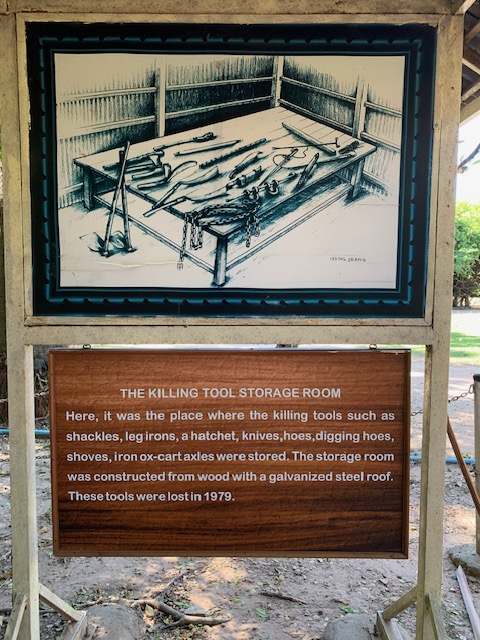
Some of the guards who committed these atrocities were also victims of the regime. Not following orders could see you decapitated. The headless bodies of soldiers found at the Killing Field tell the story. A few Australians and other foreign nationals, were amongst the dead. And it didn’t take much to get you into trouble. Crimes against the Khmer Rouge included:
- wearing glasses;
- having soft hands;
- speaking a foreign language;
- having any connection to the former regime;
- having any links with a foreign government;
- being suspected of being a professional or intellectual;
- being Vietnamese, Thai, Christian or Buddhist.
At the Killing Field, there is a mausoleum, where the skulls of 8995 victims are displayed in glass cabinets on all four sides and reaching from floor to high ceiling, arranged by age and instrument used in the execution.
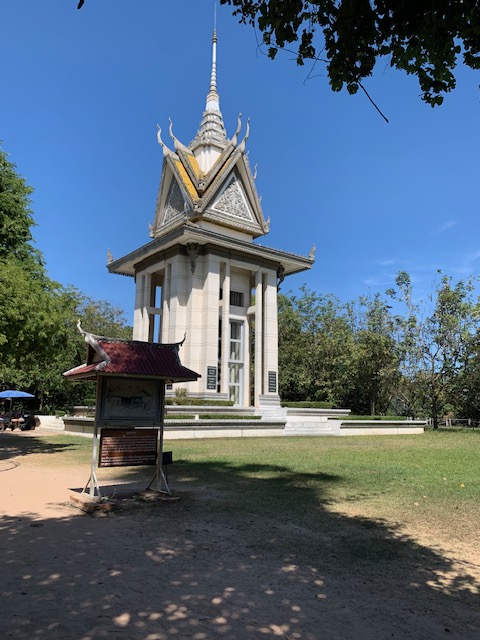
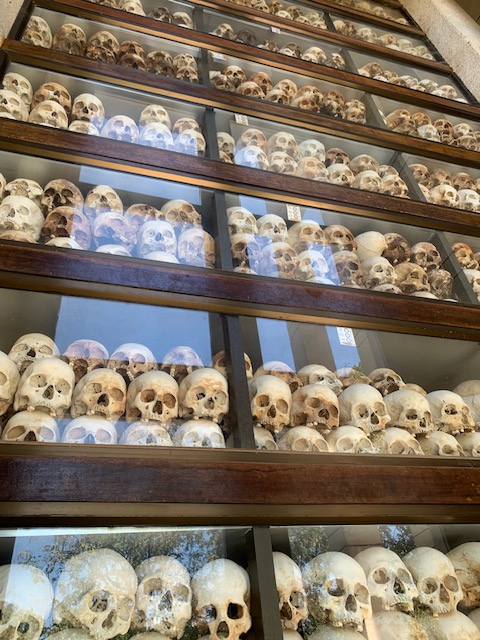
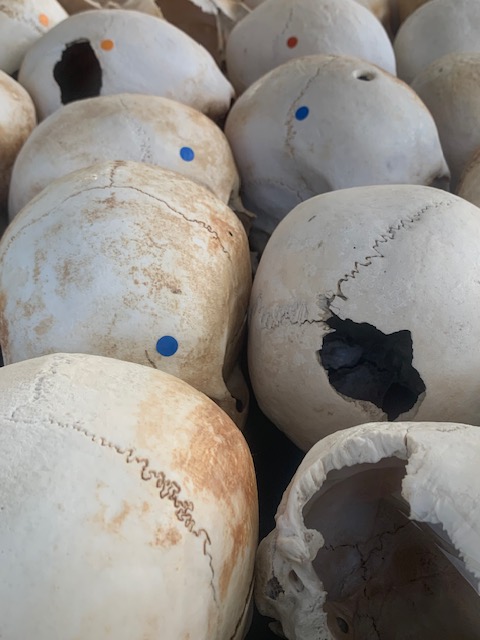
Even today, the bones of victims or pieces of their clothing are regularly coming to the surface through weathering processes or maintenance work. They are all reverently collected and are treated with great respect.

It is incomprehensible to reconcile this violent past with the beaming, gentle, polite people of Cambodia we met on our trip: the way they smile, put their hands together in a prayer position, and bow as they welcome or greet you. It is quite remarkable. But, as they themselves are all too aware, this was Cambodian people killing Cambodian people. It just doesn’t match up.
A visit to the Killing Field Memorial sends you away in a contemplative mood. You step away with an unnerving feeling of having had a snapshot glimpse into the outermost reaches of the human psyche and of finding there a dark corner of pure, unmitigated evil.
 WheatyPete's World